





















Nori Sheep Mucin 4 ELISA Kit
Price range: $508.00 through $916.00
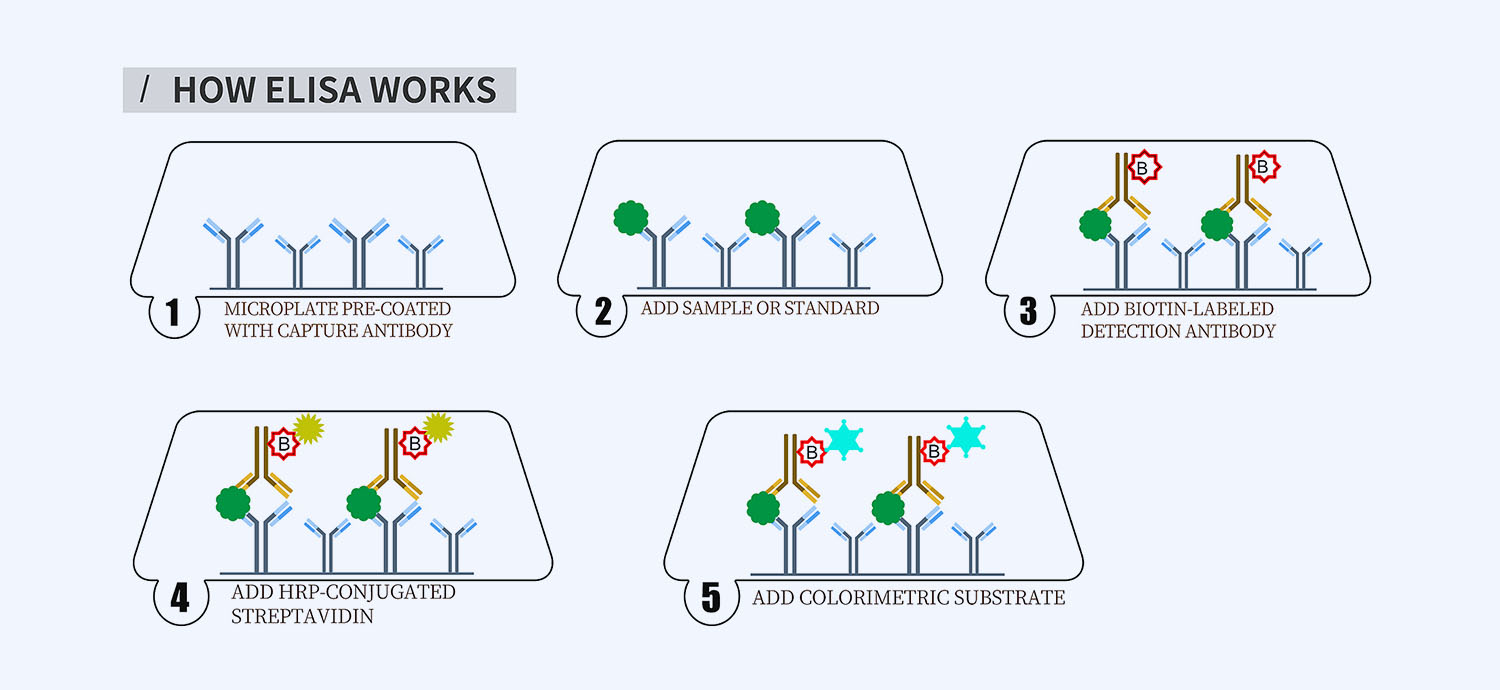
This ELISA kit is for quantification of MUC-4 in sheep. This is a quick ELISA assay that reduces time to 50% compared to the conventional method, and the entire assay only takes 3 hours. This assay employs the quantitative sandwich enzyme immunoassay technique and uses biotin-streptavidin chemistry to improve the performance of the assays. An antibody specific for MUC4 has been pre-coated onto a microplate. Standards and samples are pipetted into the wells and any MUC4 present is bound by the immobilized antibody. After washing away any unbound substances, a detection antibody specific for MUC4 is added to the wells. Following wash to remove any unbound antibody reagent, a detection reagent is added. After intensive wash a substrate solution is added to the wells and color develops in proportion to the amount of MUC4 bound in the initial step. The color development is stopped, and the intensity of the color is measured.
Alternative names for MUC4: Mucin 4, mucin-4 alpha chain, ASGP
This product is for Laboratory Research Use Only not for diagnostic and therapeutic purposes or any other purposes.
- Description
- How Elisa Works
- Documents
- Product Citation (0)
- Reviews (0)
Description
Nori Sheep Mucin 4 ELISA Kit Summary
Alternative names for MUC4: Mucin 4, mucin-4 alpha chain, ASGP
Alternative names for sheep: Ovine, lamb, goat, caprine
| Assay Type | Solid Phase Sandwich ELISA |
| Format | 96-well Microplate or 96-Well Strip Microplate |
| Method of Detection | Colorimetric |
| Number of Targets Detected | 1 |
| Target Antigen Accession Number | I7EV58 |
| Assay Length | 3 hours |
| Quantitative/Semiquantitative | Quantitative |
| Sample Type | Plasma, Serum, Cell Culture, Urine, Cell/Tissue Lysates, Synovial Fluid, BAL, |
| Recommended Sample Dilution (Plasma/Serum) | No dilution for sample <ULOQ; sufficient dilution for samples >ULOQ |
| Sensitivity | 60 pg/mL |
| Detection Range | 0.313-20 ng/mL |
| Specificity | Sheep MUC4 |
| Cross-Reactivity | < 0.5% cross-reactivity observed with available related molecules, < 50% cross-species reactivity observed with species tested. |
| Interference | No significant interference observed with available related molecules |
| Storage/Stability | 4 ºC for up to 6 months |
| Usage | For Laboratory Research Use Only. Not for diagnostic or therapeutic use. |
| Additional Notes | The kit allows for use in multiple experiments. |
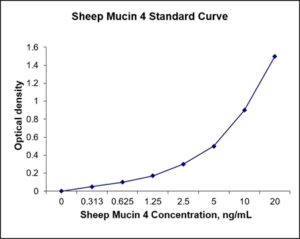
Standard Curve
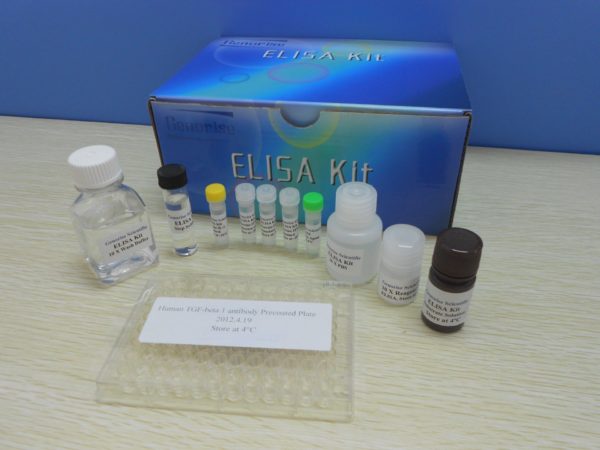
Kit Components
1. Pre-coated 96-well Microplate
2. Biotinylated Detection Antibody
3. Streptavidin-HRP Conjugate
4. Lyophilized Standards
5. TMB One-Step Substrate
6. Stop Solution
7. 20 x PBS
8. Assay Buffer
Other Materials Required but not Provided:
1. Microplate Reader capable of measuring absorption at 450 nm
2. Log-log graph paper or computer and software for ELISA data analysis
3. Precision pipettes (1-1000 µl)
4. Multi-channel pipettes (300 µl)
5. Distilled or deionized water
Protocol Outline
1. Prepare all reagents, samples and standards as instructed in the datasheet.
2. Add 100 µl of Standard or samples to each well and incubate 1 h at RT.
3. Add 100 µl of Working Detection Antibody to each well and incubate 1 h at RT.
4. Add 100 µl of Working Streptavidin-HRP to each well and incubate 20 min at RT.
5. Add 100 µl of Substrate to each well and incubate 5-30 min at RT.
6. Add 50 µl of Stop Solution to each well and read at 450 nm immediately.
Background:
Mucin 4 (MUC 4) is a mucin protein that is encoded by the MUC4 gene.[1] Like other mucins, MUC-4 is a high-molecular weight glycoprotein with a molecular weight of 550 to 930 kDa and up to 4,650 kDa with glycosylation. MUC-4 plays various roles in the progression of cancer, particularly due to its signaling and anti-adhesive properties which contribute to tumor development and metastasis. It also plays roles in other diseases such as endometriosis and inflammatory bowel disease. MUC-4 serves to protect and lubricate the epithelium, which facilitates transport and traps foreign particles. One example of its function in the reproductive lining relates to blastocyst implantation resulting from MUC4 downregulation.[2] It is overexpressed during the luteal phase of menstruation.[3] MUC-4 may also have a role in fetal morphogenic development. MUC-4 is not found in the gallbladder, pancreas, or liver except in abnormal conditions such as cancer. MUC-4, however, may normally be found in bodily fluids like saliva, tears, and milk.[3] In the soluble form, MUC-4 appears to lubricate the epithelial mucosa.[4] MUC-4 plays a role in cancer progression by repressing apoptosis and consequently increasing tumor cell proliferation. The molecular mechanism is thought to be through a MUC-4 complex with ERBB2 receptors, which alters downstream signaling and down regulates CDKN1B. The beta subunit of MUC-4 appears to serve as a ligand that causes the phosphorylation of ErbB2, but does not activate the MAPK or AKT pathways.[5] MUC-4 may also affect HER2 signaling, and result in its stabilization.[6] As a mucin, MUC-4 also alters adhesive properties of the cell. When overexpressed, the disorganization of mucins may reduce adhesion to other cells as well as the extracellular matrix, promoting cancer cell migration and metastasis. MUC4 is often overexpressed in pancreatic adenocarcinomas and has been shown to promote tumor growth and metastasis, though the mechanism by which it does so is not known.[7] MUC-4 also has important roles in inflammatory bowel disease such as Crohn’s disease and is found to be overexpressed in ulcerative colitis.[8]
References
- Porchet N, et al. (1991). Biochem Biophys Res Commun. 175 (2): 414–22.
- Audie JP, et al. (1995). Hum. Reprod. 10 (1): 98–102.
- Chaturvedi P, et al. (2008). FASEB J. 22 (4): 966–81.
- Carraway KL, et al. (2003). Prog. Nucleic Acid Res. Mol. Biol. 71: 149–85.
- Jepson S, et al. (2002). Oncogene. 21 (49): 7524–32.
- Chaturvedi P, et al. (2008). Cancer Res. 68 (7): 2065–70.
- Chaturvedi P, et al. (2008). Cancer Res. 68 (7): 2065–70.
- Srivastava SK, et al. (2011). Carcinogenesis. 32 (12): 1832–9.
- Shirazi T, et al. (2000). Postgrad Med J. 76 (898): 473–8.
Be the first to review “Nori Sheep Mucin 4 ELISA Kit”
You must be logged in to post a review.
Reviews
There are no reviews yet.