



















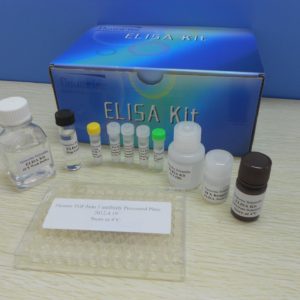
Nori Human Mucin 14 ELISA Kit
Price range: $508.00 through $916.00
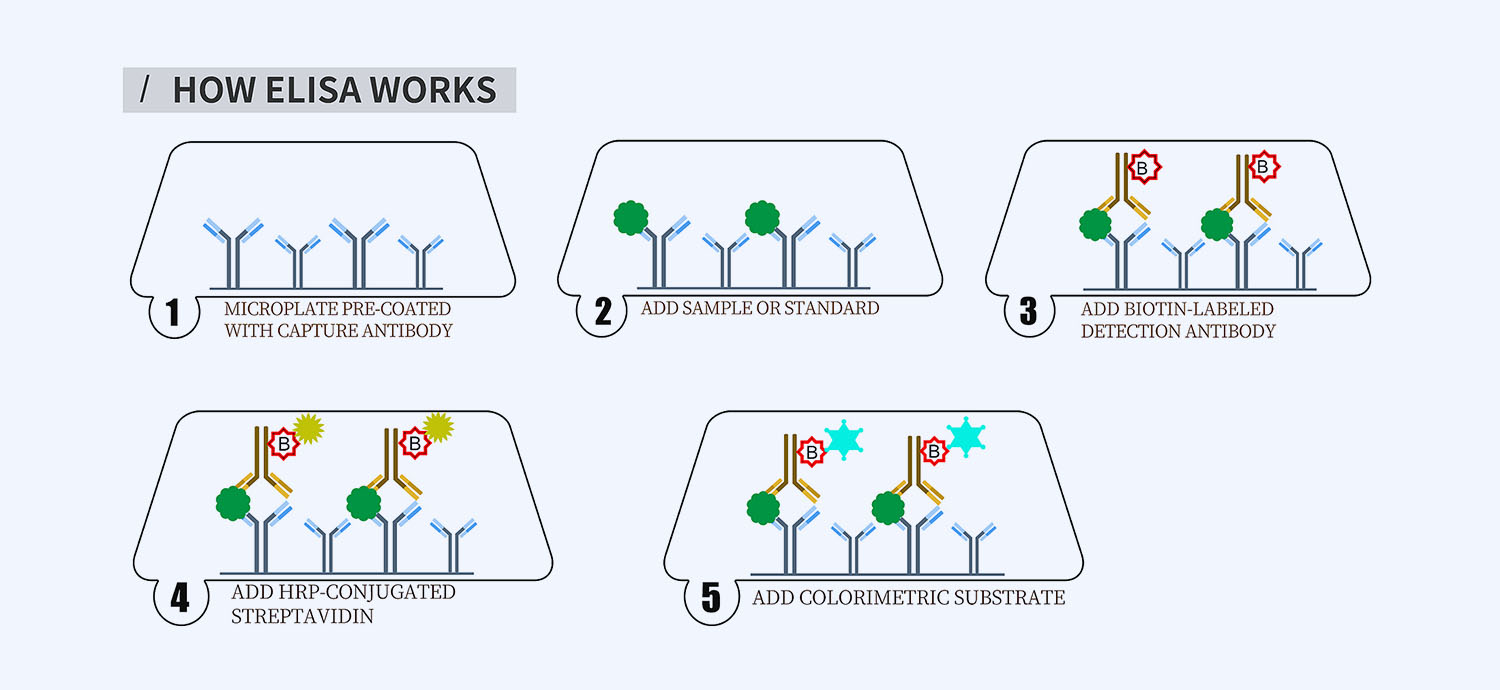
This ELISA kit is for quantification of MUC-14 in human. This is a quick ELISA assay that reduces time to 50% compared to the conventional method, and the entire assay only takes 3 hours. This assay employs the quantitative sandwich enzyme immunoassay technique and uses biotin-streptavidin chemistry to improve the performance of the assays. An antibody specific for MUC14 has been pre-coated onto a microplate. Standards and samples are pipetted into the wells and any MUC14 present is bound by the immobilized antibody. After washing away any unbound substances, a detection antibody specific for MUC14 is added to the wells. Following wash to remove any unbound antibody reagent, a detection reagent is added. After intensive wash a substrate solution is added to the wells and color develops in proportion to the amount of MUC14 bound in the initial step. The color development is stopped, and the intensity of the color is measured.
Alternative names for MUC14: Mucin 14, endomucin, endomucin-2, Ga34, EMCN, EMCN2
This product is for Laboratory Research Use Only not for diagnostic and therapeutic purposes or any other purposes.
- Description
- How Elisa Works
- Documents
- Product Citation (0)
- Reviews (0)
Description
Nori Human Mucin 14 ELISA Kit Summary
Alternative names for MUC14: Mucin 14, endomucin, endomucin-2, Ga34, EMCN, EMCN2
| Assay Type | Solid Phase Sandwich ELISA |
| Format | 96-well Microplate or 96-Well Strip Microplate |
| Method of Detection | Colorimetric |
| Number of Targets Detected | 1 |
| Target Antigen Accession Number | Q9ULC0 |
| Assay Length | 3 hours |
| Quantitative/Semiquantitative | Quantitative |
| Sample Type | Plasma, Serum, Cell Culture, Urine, Cell/Tissue Lysates, Synovial Fluid, BAL, |
| Recommended Sample Dilution (Plasma/Serum) | No dilution for sample <ULOQ; sufficient dilution for samples >ULOQ |
| Sensitivity | 50 pg/mL |
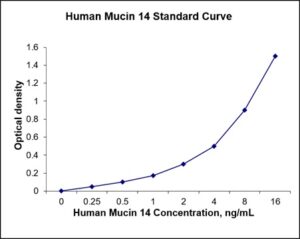
| Detection Range | 0.25-16 ng/mL |
| Specificity | Human MUC14 |
| Cross-Reactivity | < 0.5% cross-reactivity observed with available related molecules, < 50% cross-species reactivity observed with species tested. |
| Interference | No significant interference observed with available related molecules |
| Storage/Stability | 4 ºC for up to 6 months |
| Usage | For Laboratory Research Use Only. Not for diagnostic or therapeutic use. |
| Additional Notes | The kit allows for use in multiple experiments. |
Standard Curve
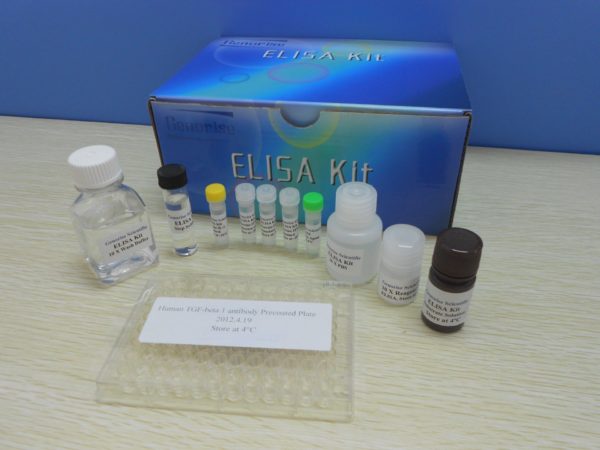
Kit Components
1. Pre-coated 96-well Microplate
2. Biotinylated Detection Antibody
3. Streptavidin-HRP Conjugate
4. Lyophilized Standards
5. TMB One-Step Substrate
6. Stop Solution
7. 20 x PBS
8. Assay Buffer
Other Materials Required but not Provided:
1. Microplate Reader capable of measuring absorption at 450 nm
2. Log-log graph paper or computer and software for ELISA data analysis
3. Precision pipettes (1-1000 µl)
4. Multi-channel pipettes (300 µl)
5. Distilled or deionized water
Protocol Outline
1. Prepare all reagents, samples and standards as instructed in the datasheet.
2. Add 100 µl of Standard or samples to each well and incubate 1 h at RT.
3. Add 100 µl of Working Detection Antibody to each well and incubate 1 h at RT.
4. Add 100 µl of Working Streptavidin-HRP to each well and incubate 20 min at RT.
5. Add 100 µl of Substrate to each well and incubate 5-30 min at RT.
6. Add 50 µl of Stop Solution to each well and read at 450 nm immediately.
Background:
Mucins are a family of high molecular weight, heavily glycosylated proteins (glycoconjugates) produced by epithelial tissues.[1] Mucins’ key characteristic is their ability to form gels; therefore they are a key component in most gel-like secretions, serving functions from lubrication to cell signaling to forming chemical barriers.[1] They often take an inhibitory role.[1] Some mucins are associated with controlling mineralization, including nacre formation in mollusks,[2] calcification in echinoderms[3] and bone formation in vertebrates.[4] They bind to pathogens as part of the immune system. Overexpression of the mucin proteins, especially MUC1, is associated with many types of cancer.[5] Although some mucins are membrane-bound due to the presence of a hydrophobic membrane-spanning domain that favors retention in the plasma membrane, most mucins are secreted as principal components of mucus by mucous membranes or are secreted to become a component of saliva. Increased mucin production occurs in many adenocarcinomas, including cancers of the pancreas, lung, breast, ovary, colon and other tissues. Mucins are also overexpressed in lung diseases such as asthma, bronchitis, chronic obstructive pulmonary disease (COPD) or cystic fibrosis. Two membrane mucins, MUC1 and MUC4 have been extensively studied in relation to their pathological implication in the disease process.[6-8] Mucins are under investigation as possible diagnostic markers for malignancies and other disease processes in which they are most commonly over- or mis-expressed. Abnormal deposits of mucin are responsible for the non-pitting facial edema seen in untreated hypothyroidism. This edema is seen in the pretibial area as well.
References
- Marin, F. D. R.; et al. (2007). Current Topics in Developmental Biology. 80: 209–76.
- Marin, F. et al. (2000). The Journal of Biological Chemistry. 275 (27): 20667–20675.
- Boskey, A. (2003). Connective Tissue Research. 44 (1): 5–9.
- RJ Midura, et al. (1996). World J. Gastroenterol. 14 (14): 2139–41.
- Niv Y (2008). World J. Gastroenterol. 14 (14): 2139–41.
- Singh AP, et al. (2004). Cancer Research. 64 (2): 622–30.
- Singh, Ajay P. et al. (2006). The Prostate. 66 (4): 421–429.
- Singh, A. P. et al. (2007). Cancer Research. 67 (2): 433–436.
Be the first to review “Nori Human Mucin 14 ELISA Kit”
You must be logged in to post a review.
Reviews
There are no reviews yet.