


















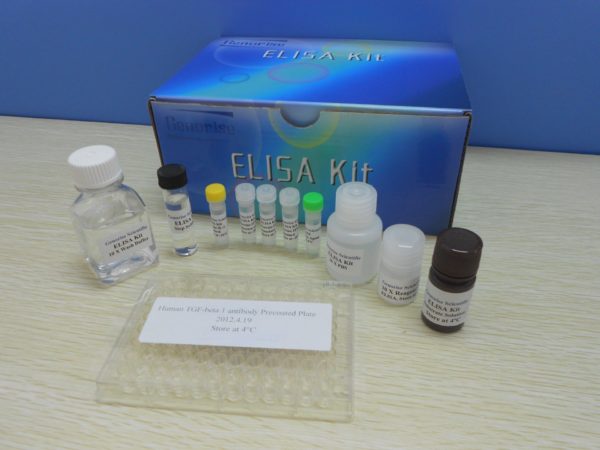
Nori Porcine VWF ELISA Kit
Price range: $508.00 through $916.00
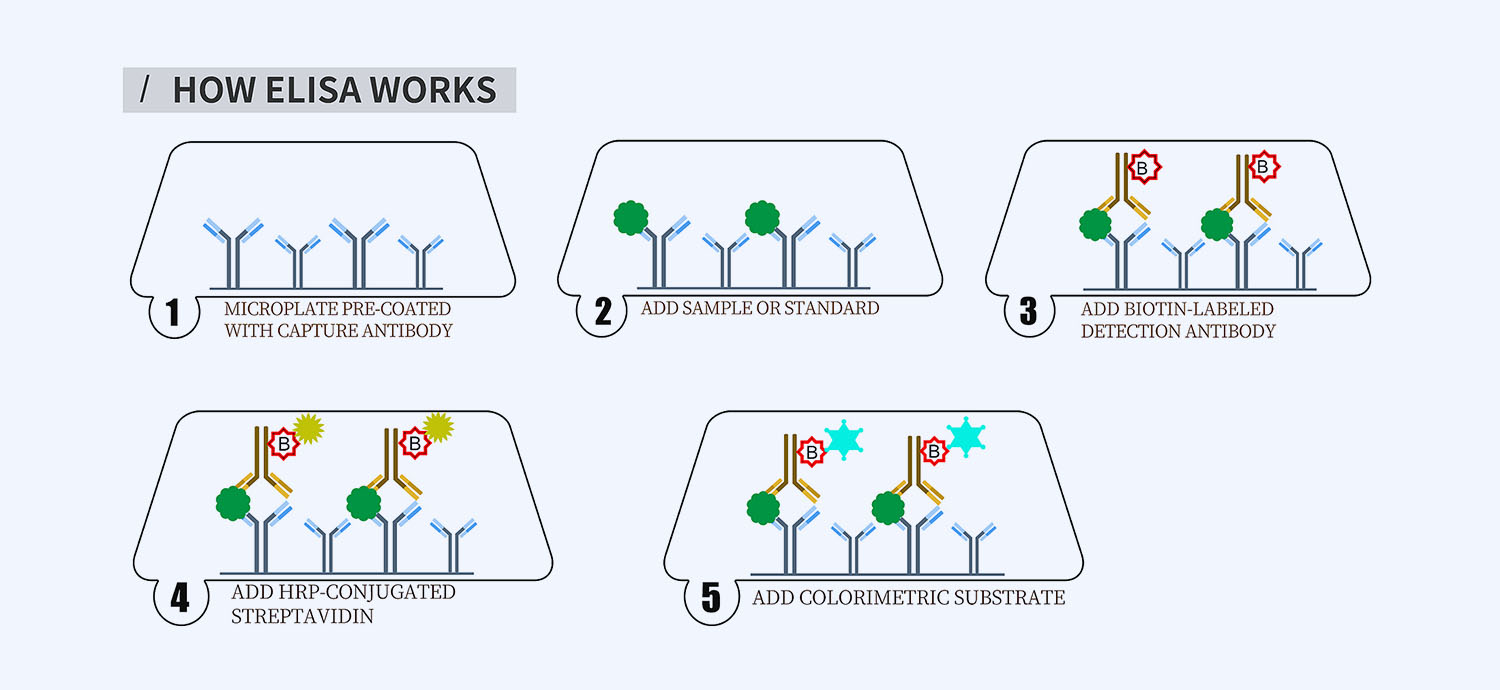
This ELISA kit is for quantification of VWF in porcine. This is a quick ELISA assay that reduces time to 50% compared to the conventional method, and the entire assay only takes 3 hours. This assay employs the quantitative sandwich enzyme immunoassay technique and uses biotin-streptavidin chemistry to improve the performance of the assays. An antibody specific for VWF has been pre-coated onto a microplate. Standards and samples are pipetted into the wells and any VWF present is bound by the immobilized antibody. After washing away any unbound substances, a detection antibody specific for VWF is added to the wells. Following wash to remove any unbound antibody reagent, a detection reagent is added. After intensive wash a substrate solution is added to the wells and color develops in proportion to the amount of VWF bound in the initial step. The color development is stopped, and the intensity of the color is measured.
Alternative names for VWF: Von Willebrand factor
This product is for laboratory research use only, not for diagnostic and therapeutic purposes or any other purposes.
- Description
- How Elisa Works
- Product Citations
- Reviews (0)
Description
Nori Porcine VWF ELISA Kit Summary
Alternative names for VWF: Von Willebrand factor
Alternative names for porcine: Pig, swine
| Assay Type | Solid Phase Sandwich ELISA |
| Format | 96-well Microplate or 96-Well Strip Microplate |
| Method of Detection | Colorimetric |
| Number of Targets Detected | 1 |
| Target Antigen Accession Number | Q28833 |
| Assay Length | 3 hours |
| Quantitative/Semiquantitative | Quantitative |
| Sample Type | Plasma, Serum, Cell Culture, Urine, Cell/Tissue Lysates, Synovial Fluid, BAL, |
| Recommended Sample Dilution (Plasma/Serum) | No dilution for sample <ULOQ; sufficient dilution for samples >ULOQ |
| Sensitivity | 150 pg/mL |
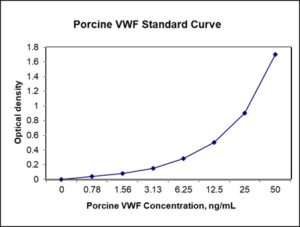
| Detection Range | 0.78-50 ng/mL |
| Specificity | Porcine VWF |
| Cross-Reactivity | < 0.5% cross-reactivity observed with available related molecules, < 50% cross-species reactivity observed with species tested. |
| Interference | No significant interference observed with available related molecules |
| Storage/Stability | 4 ºC for up to 6 months |
| Usage | For Laboratory Research Use Only. Not for diagnostic or therapeutic use. |
| Additional Notes | The kit allows for use in multiple experiments. |
Standard Curve
Kit Components
1. Pre-coated 96-well Microplate
2. Biotinylated Detection Antibody
3. Streptavidin-HRP Conjugate
4. Lyophilized Standards
5. TMB One-Step Substrate
6. Stop Solution
7. 20 x PBS
8. Assay Buffer
Other Materials Required but not Provided:
1. Microplate Reader capable of measuring absorption at 450 nm
2. Log-log graph paper or computer and software for ELISA data analysis
3. Precision pipettes (1-1000 µl)
4. Multi-channel pipettes (300 µl)
5. Distilled or deionized water
Protocol Outline
1. Prepare all reagents, samples and standards as instructed in the datasheet.
2. Add 100 µl of Standard or samples to each well and incubate 1 h at RT.
3. Add 100 µl of Working Detection Antibody to each well and incubate 1 h at RT.
4. Add 100 µl of Working Streptavidin-HRP to each well and incubate 20 min at RT.
5. Add 100 µl of Substrate to each well and incubate 5-30 min at RT.
6. Add 50 µl of Stop Solution to each well and read at 450 nm immediately.
Background:
Von Willebrand factor (VWF) is a large multimeric blood glycoprotein crucial for blood clotting that promotes primary hemostasis, specifically, platelet adhesion. It is produced by endothelial cells and megakaryocytes to help platelets adhere to injured blood vessel walls. VWF is essential for primary hemostasis. It binds to collagen at vascular injury sites, recruits platelets, and carries coagulation factor VIII (FVIII), protecting it from premature degradation. VWF plays a major role in blood coagulation and is involved in the formation of blood vessels themselves. It forms large multimers that act as shear-sensitive “force sensors” in the bloodstream. Deficiency or defects in this protein cause von Willebrand disease (VWD), a common bleeding disorder. VWF is involved in many other diseases, including thrombotic thrombocytopenic purpura, Heyde’s syndrome, and possibly hemolytic–uremic syndrome.[1] Increased plasma levels in many cardiovascular, neoplastic, metabolic (e.g. diabetes), and connective tissue diseases are presumed to arise from adverse changes to the endothelium, and may predict an increased risk of thrombosis.[2] Platelet adhesion is mainly mediated via interactions with VWF, which acts as a bridge between the platelet surface receptor glycoprotein Ib (GpIb) and the exposed collagen after vascular injury. Genetic deficiencies of VWF or GpIb (Bernard–Soulier syndrome) result in bleeding disorders. Most cases of vWD are hereditary, but abnormalities of VWF may be acquired; aortic valve stenosis, for instance, has been linked to vWD type IIA, causing gastrointestinal bleeding – an association known as Heyde’s syndrome.[3] High plasma VWF levels were found to be an independent predictor of major bleeding in anticoagulated atrial fibrillation patients.[4] VWF is a marker of endothelial dysfunction, and is consistently elevated in atrial fibrillation, associated with adverse outcomes.[5]
References
- Sadler JE(1998). Annual Review of Biochemistry. 67 (1): 395–424.
- Shahidi M (2017). Advances in Experimental Medicine and Biology. Vol. 906. pp. 285–306.
- Vincentelli A, et al. (2003). The New England Journal of Medicine. 349 (4): 343–349.
- Roldán V, et al. (2011) Journal of the American College of Cardiology. 57 (25): 2496–2504.
- Khan AA, et al. (2020). Annals of Medicine. 52 (1–2): 1–11.
Product Citations
Be the first to review “Nori Porcine VWF ELISA Kit”
You must be logged in to post a review.
Reviews
There are no reviews yet.