


















Nori Mouse Neuropeptide Y ELISA Kit
Price range: $508.00 through $916.00
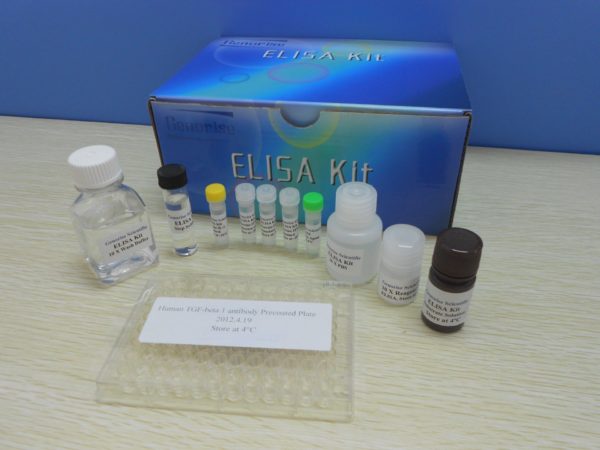
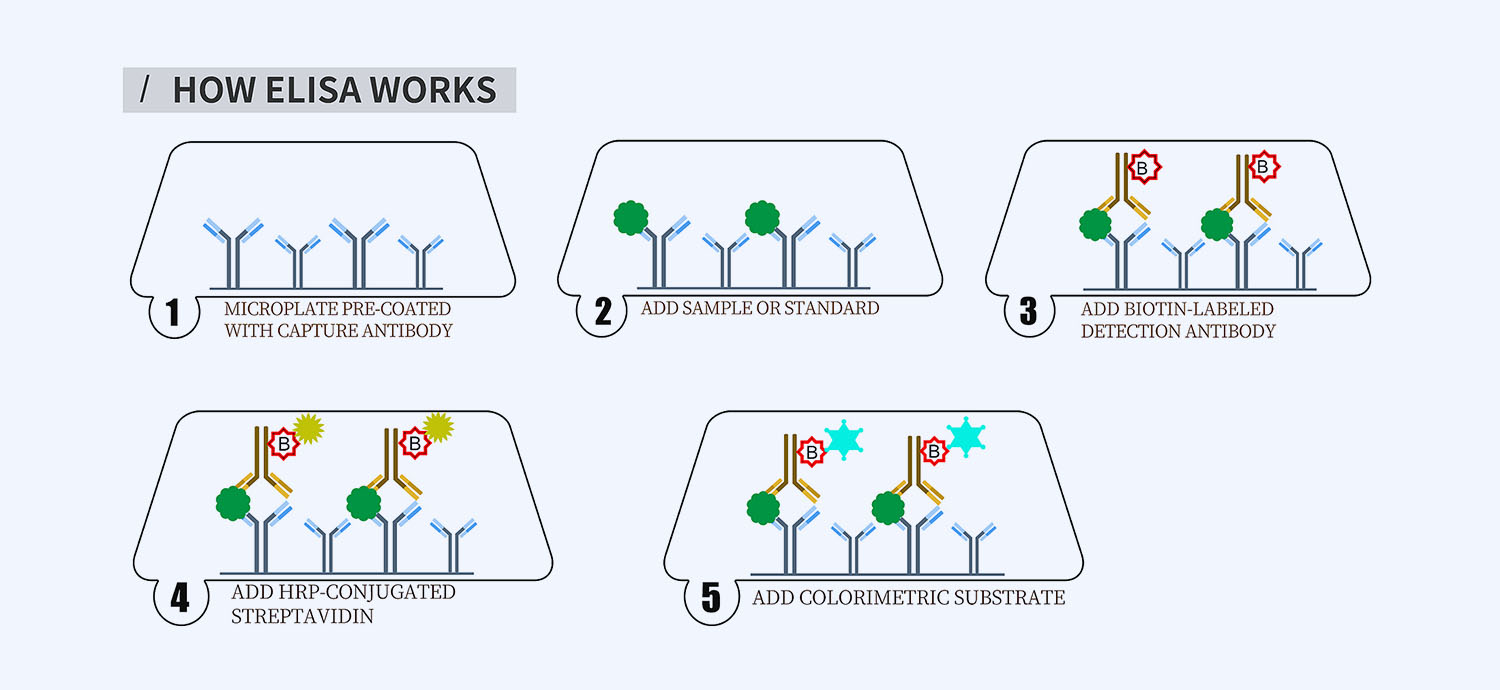
This ELISA kit is for quantification of NPY in mouse. This is a quick ELISA assay that reduces time to 50% compared to the conventional method, and the entire assay only takes 3 hours. This assay employs the quantitative sandwich enzyme immunoassay technique and uses biotin-streptavidin chemistry to improve the performance of the assays. An antibody specific for NPY has been pre-coated onto a microplate. Standards and samples are pipetted into the wells and any NPY present is bound by the immobilized antibody. After washing away any unbound substances, a detection antibody specific for NPY is added to the wells. Following wash to remove any unbound antibody reagent, a detection reagent is added. After intensive wash a substrate solution is added to the wells and color develops in proportion to the amount of NPY bound in the initial step. The color development is stopped, and the intensity of the color is measured.
Alternative names for NPY: Neuropeptide Y
This product is for Laboratory Research Use Only not for diagnostic and therapeutic purposes or any other purposes.
- Description
- How Elisa Works
- Documents
- Product Citation (0)
- Reviews (0)
Description
Nori Mouse Neuropeptide Y ELISA Kit Summary
Alternative names for neuropeptide Y: NPY,
| Assay Type | Solid Phase Sandwich ELISA |
| Format | 96-well Microplate or 96-Well Strip Microplate |
| Method of Detection | Colorimetric |
| Number of Targets Detected | 1 |
| Target Antigen Accession Number | P57774 |
| Assay Length | 3 hours |
| Quantitative/Semiquantitative | Quantitative |
| Sample Type | Plasma, Serum, Cell Culture, Urine, Cell/Tissue Lysates, Synovial Fluid, BAL, |
| Recommended Sample Dilution (Plasma/Serum) | No dilution for sample <ULOQ; sufficient dilution for samples >ULOQ |
| Sensitivity | 3 pg/mL |
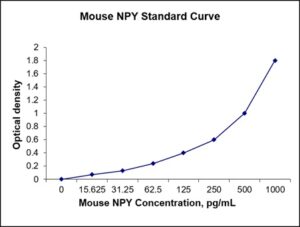
| Detection Range | 15.625-1000 pg/mL |
| Specificity | Mouse NPY |
| Cross-Reactivity | < 0.5% cross-reactivity observed with available related molecules, < 50% cross-species reactivity observed with species tested. |
| Interference | No significant interference observed with available related molecules |
| Storage/Stability | 4 ºC for up to 6 months |
| Usage | For Laboratory Research Use Only. Not for diagnostic or therapeutic use. |
| Additional Notes | The kit allows for use in multiple experiments. |
Standard Curve
Kit Components
1. Pre-coated 96-well Microplate
2. Biotinylated Detection Antibody
3. Streptavidin-HRP Conjugate
4. Lyophilized Standards
5. TMB One-Step Substrate
6. Stop Solution
7. 20 x PBS
8. Assay Buffer
Other Materials Required but not Provided:
1. Microplate Reader capable of measuring absorption at 450 nm
2. Log-log graph paper or computer and software for ELISA data analysis
3. Precision pipettes (1-1000 µl)
4. Multi-channel pipettes (300 µl)
5. Distilled or deionized water
Protocol Outline
1. Prepare all reagents, samples and standards as instructed in the datasheet.
2. Add 100 µl of Standard or samples to each well and incubate 1 h at RT.
3. Add 100 µl of Working Detection Antibody to each well and incubate 1 h at RT.
4. Add 100 µl of Working Streptavidin-HRP to each well and incubate 20 min at RT.
5. Add 100 µl of Substrate to each well and incubate 5-30 min at RT.
6. Add 50 µl of Stop Solution to each well and read at 450 nm immediately.
Background:
Neuropeptide Y (NPY) is a 36 amino-acid neuropeptide that is involved in various physiological and homeostatic processes in both the central and peripheral nervous systems. NPY has been identified as the most abundant peptide present in the mammalian central nervous system, which consists of the brain and spinal cord. It secreted alongside other neurotransmitters such as GABA and glutamate.[1] In the autonomic system it is produced mainly by neurons of the sympathetic nervous system and serves as a strong vasoconstrictor and also causes growth of fat tissue.[2] In the brain, it is produced in various locations including the hypothalamus, and is thought to have several functions, including: increasing food intake and storage of energy as fat, reducing anxiety and stress, reducing pain perception, affecting the circadian rhythm, reducing voluntary alcohol intake, lowering blood pressure, and controlling epileptic seizures.[3] Neuropeptide Y has been identified as being synthesized in GABAnergic inhibitory neurons and acts as a neurotransmitter during cellular communication. Neuropeptide Y is majorly expressed in interneurons.[4] NPY exerts most of its effects through G-protein coupled receptor proteins, Neuropeptide Y has been indicated as playing an important role in cell neurogenesis in various parts of the brain. Two particular brains areas of where NPY effect neurogenesis are the sub-ventricular zone and the dentate gyrus of the hippocampus. These areas are where cell growth and proliferation occur into adulthood.[5] Studies of mice and humans show that repeated stress—and a high-fat, high-sugar diet—stimulate the release of NPY, causing fat to build up in the abdomen. Researchers believe that by manipulating levels of NPY, they could eliminate fat from areas where it was not desired and accumulate at sites where it is needed.[2]
References
- Decressac M, Barker RA (2012). Experimental Neurology. 238 (2): 265–72.
- Kuo LE, et al. (2007). Nature Medicine. 13 (7): 803–11.
- Colmers WF, El Bahh B (2003). Epilepsy Currents. 3 (2): 53–58.
- Kask A, et al. (2002). Neuroscience and Biobehavioral Reviews. 26 (3): 259–83.
- Decressac M, et al. (2011). Hippocampus. 21 (3): 233–8.
Be the first to review “Nori Mouse Neuropeptide Y ELISA Kit”
You must be logged in to post a review.
Reviews
There are no reviews yet.