

















Nori Canine TSH ELISA Kit
Price range: $508.00 through $916.00
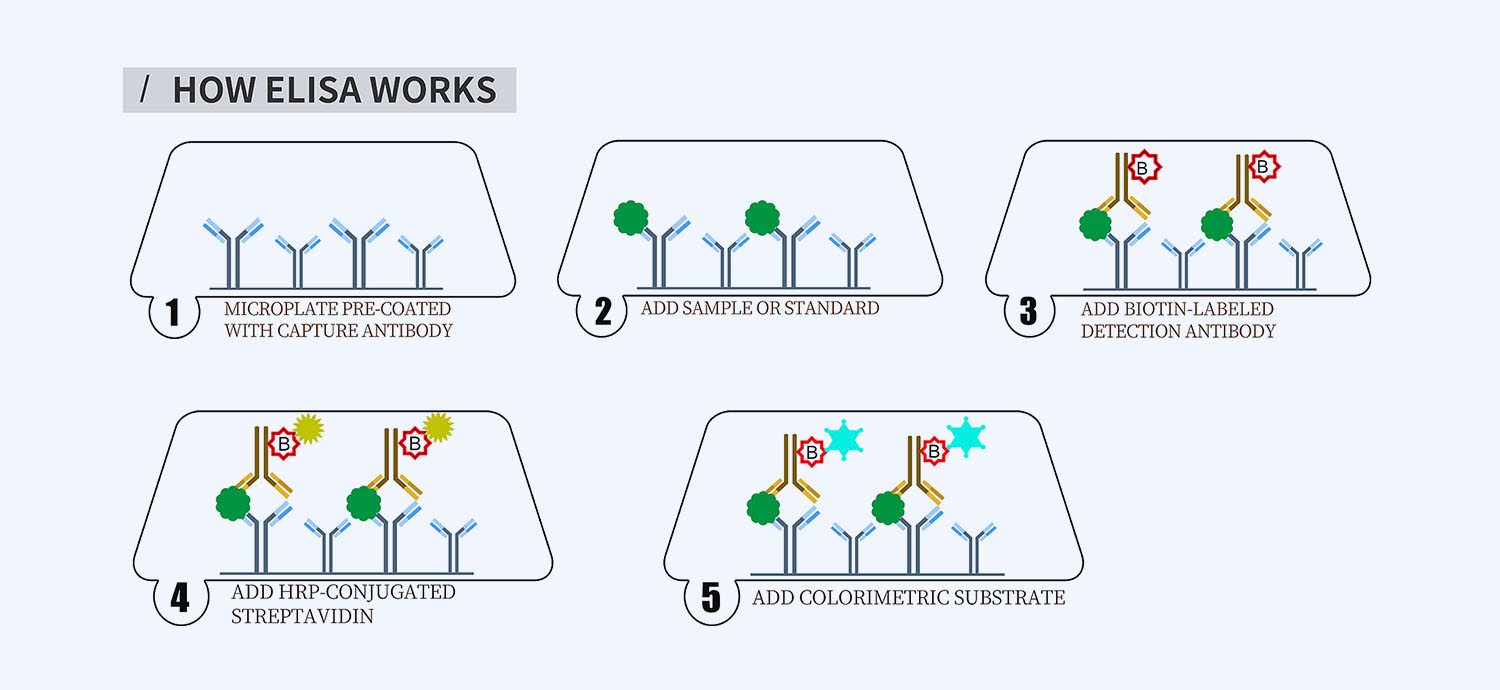
This ELISA kit is for quantification of TSH in canine. This is a quick ELISA assay that reduces time to 50% compared to the conventional method, and the entire assay only takes 3 hours. This assay employs the quantitative sandwich enzyme immunoassay technique and uses biotin-streptavidin chemistry to improve the performance of the assays. An antibody specific for TSH has been pre-coated onto a microplate. Standards and samples are pipetted into the wells and any TSH present is bound by the immobilized antibody. After washing away any unbound substances, a detection antibody specific for TSH is added to the wells. Following wash to remove any unbound antibody reagent, a detection reagent is added. After intensive wash a substrate solution is added to the wells and color develops in proportion to the amount of TSH bound in the initial step. The color development is stopped, and the intensity of the color is measured.
Alternative names for TSH: Thyroid-stimulating hormone, thyrotropin, thyrotropic hormone,
This product is for laboratory research use only not for diagnostic and therapeutic purposes or any other purposes.
- Description
- How Elisa Works
- Documents
- Product Citations (0)
- Reviews (0)
Description
Nori Canine TSH ELISA Kit Summary
Alternative names for TSH: Thyroid-stimulating hormone, thyrotropin, thyrotropic hormone,
Alternative names for canine: Dog
| Assay Type | Solid Phase Sandwich ELISA |
| Format | 96-well Microplate or 96-Well Strip Microplate |
| Method of Detection | Colorimetric |
| Number of Targets Detected | 1 |
| Target Antigen Accession Number |
CCP37964 |
| Assay Length | 3 hours |
| Quantitative/Semiquantitative | Quantitative |
| Sample Type | Plasma, Serum, Cell Culture, Urine, Cell/Tissue Lysates, Synovial Fluid, BAL, |
| Recommended Sample Dilution (Plasma/Serum) | No dilution for sample <ULOQ; sufficient dilution for samples >ULOQ |
| Sensitivity | 6 pg/mL |
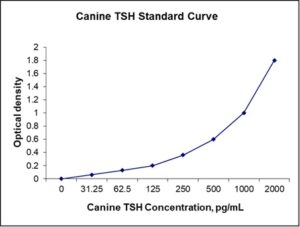
| Detection Range | 31.25-2000 pg/mL |
| Specificity | Canine TSH |
| Cross-Reactivity | < 0.5% cross-reactivity observed with available related molecules, < 50% cross-species reactivity observed with species tested. |
| Interference | No significant interference observed with available related molecules |
| Storage/Stability | 4 ºC for up to 6 months |
| Usage | For Laboratory Research Use Only. Not for diagnostic or therapeutic use. |
| Additional Notes | The kit allows for use in multiple experiments. |
Standard Curve
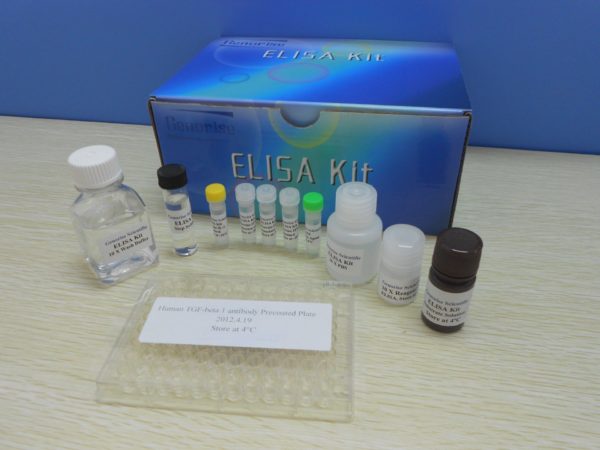
Kit Components
1. Pre-coated 96-well Microplate
2. Biotinylated Detection Antibody
3. Streptavidin-HRP Conjugate
4. Lyophilized Standards
5. TMB One-Step Substrate
6. Stop Solution
7. 20 x PBS
8. Assay Buffer
Other Materials Required but not Provided:
1. Microplate Reader capable of measuring absorption at 450 nm
2. Log-log graph paper or computer and software for ELISA data analysis
3. Precision pipettes (1-1000 µl)
4. Multi-channel pipettes (300 µl)
5. Distilled or deionized water
Protocol Outline
1. Prepare all reagents, samples and standards as instructed in the datasheet.
2. Add 100 µl of Standard or samples to each well and incubate 1 h at RT.
3. Add 100 µl of Working Detection Antibody to each well and incubate 1 h at RT.
4. Add 100 µl of Working Streptavidin-HRP to each well and incubate 20 min at RT.
5. Add 100 µl of Substrate to each well and incubate 5-30 min at RT.
6. Add 50 µl of Stop Solution to each well and read at 450 nm immediately.
Background:
Thyroid-stimulating hormone (also known as thyrotropin, thyrotropic hormone, TSH. TSH is a pituitary hormone that stimulates the thyroid gland to produce thyroxine (T4), and then triiodothyronine (T3) which stimulates the metabolism of almost every tissue in the body. TSH is a glycoprotein and consists of two subunits, the alpha and the beta subunit. It is a hormone synthesized and secreted by thyrotrope cells in the anterior pituitary gland, which regulates the endocrine function of the thyroid. TSH (with a half life of about an hour) stimulates the thyroid gland to secrete the hormone thyroxine (T4), which has only a slight effect on metabolism. T4 is converted to triiodothyronine (T3), which is the active hormone that stimulates metabolism. About 80% of this conversion is in the liver and other organs, and 20% in the thyroid itself. TSH is secreted throughout life but particularly reaches high levels during the periods of rapid growth and development. The hypothalamus, in the base of the brain, produces thyrotropin-releasing hormone (TRH). TRH stimulates the pituitary gland to produce TSH. Somatostatin is also produced by the hypothalamus, and has an opposite effect on the pituitary production of TSH, decreasing or inhibiting its release. The concentration of thyroid hormones (T3 and T4) in the blood regulates the pituitary release of TSH; when T3 and T4 concentrations are low, the production of TSH is increased, and, conversely, when T3 and T4 concentrations are high, TSH production is decreased. This is an example of a negative feedback loop.[1] Any inappropriateness of measured values, for instance a low-normal TSH together with a low-normal T4 may signal tertiary (central) disease and a TSH to TRH pathology. Elevated reverse T3 (RT3) together with low-normal TSH and low-normal T3, T4 values, which is regarded as indicative for euthyroid sick syndrome, may also have to be investigated for chronic subacute thyroiditis (SAT) with output of subpotent hormones. Absence of antibodies in patients with diagnoses of an autoimmune thyroid in their past would always be suspicious for development to SAT even in the presence of a normal TSH because there is no known recovery from autoimmunity. For clinical interpretation of laboratory results it is important to acknowledge that TSH is released in a pulsatile manner[2][3] resulting in both circadian and ultradian rhythms of its serum concentrations.
References
- Estrada JM, et al. (2014). Thyroid 24 (3): 411–23.
- Brabant G, et al. (1990). J Clinical Endocrinology and Metabolism 70 (2): 403–9.
- Samuels MH, et al. (1990). J Clinical Endocrinology and Metabolism 71 (2): 425–32.
Product Citations
Be the first to review “Nori Canine TSH ELISA Kit”
You must be logged in to post a review.
Reviews
There are no reviews yet.