



















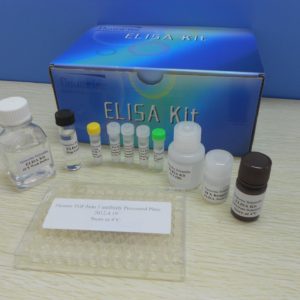
Nori Rat Serpin A4 ELISA Kit
Price range: $508.00 through $916.00
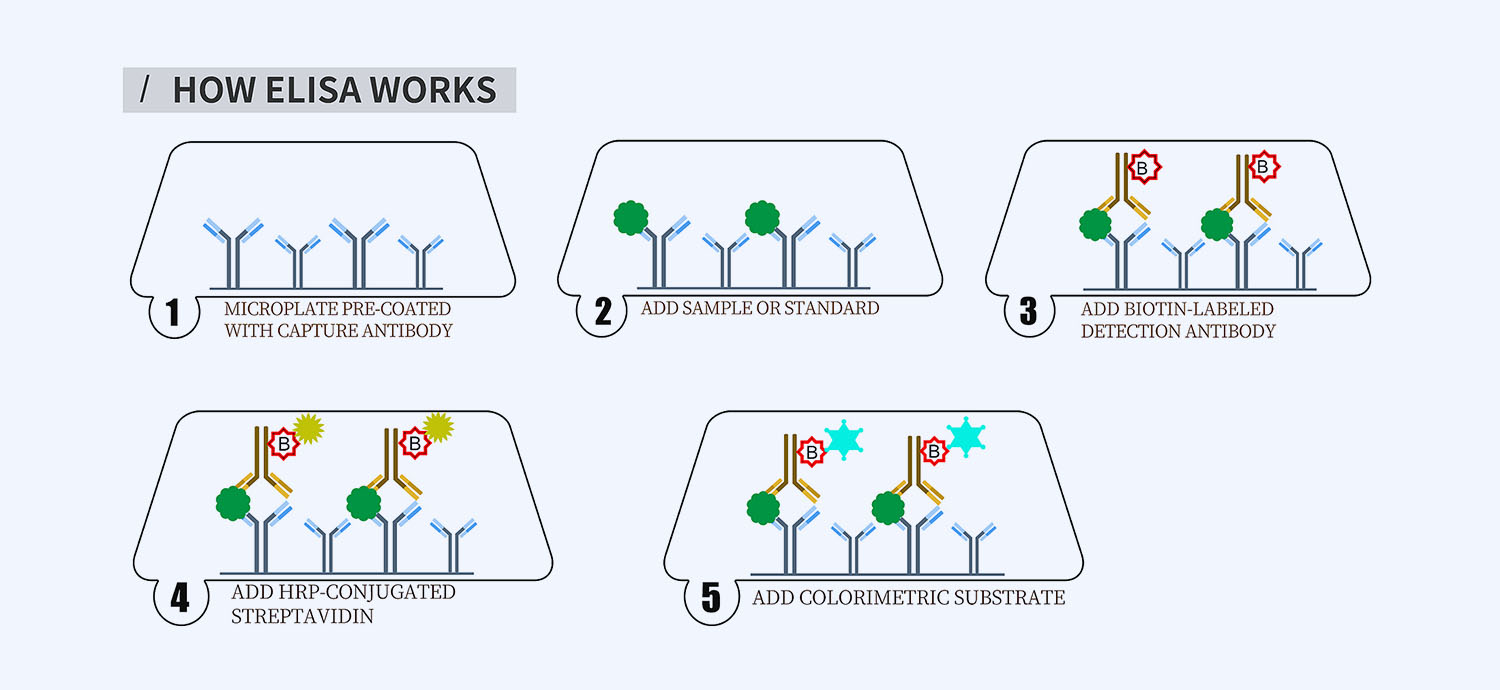
This ELISA kit is for quantification of Serpin A4 in rat. This is a quick ELISA assay that reduces time to 50% compared to the conventional method, and the entire assay only takes 3 hours. This assay employs the quantitative sandwich enzyme immunoassay technique and uses biotin-streptavidin chemistry to improve the performance of the assays. An antibody specific for SERPINA4 has been pre-coated onto a microplate. Standards and samples are pipetted into the wells and any SERPINA4 present is bound by the immobilized antibody. After washing away any unbound substances, a detection antibody specific for SERPINA4 is added to the wells. Following wash to remove any unbound antibody reagent, a detection reagent is added. After intensive wash a substrate solution is added to the wells and color develops in proportion to the amount of SERPINA4 bound in the initial step. The color development is stopped, and the intensity of the color is measured.
Alternative names for Serpin A4: SERPINA4, Serpin Family A Member 4, kallistatin, Kallikrein inhibitor, Peptidase inhibitor 4, PI-4, KST, PI4
This product is for Laboratory Research Use Only not for diagnostic and therapeutic purposes or any other purposes.
- Description
- How Elisa Works
- Documents
- Product Citation (0)
- Reviews (0)
Description
Nori Rat Serpin A4 ELISA Kit Summary
Alternative names for Serpin A4: SERPINA4, Serpin Family A Member 4, kallistatin, Kallikrein inhibitor, Peptidase inhibitor 4, PI-4, KST, PI4
| Assay Type | Solid Phase Sandwich ELISA |
| Format | 96-well Microplate or 96-Well Strip Microplate |
| Method of Detection | Colorimetric |
| Number of Targets Detected | 1 |
| Target Antigen Accession Number |
Q5M8C3 |
| Assay Length | 3 hours |
| Quantitative/Semiquantitative | Quantitative |
| Sample Type | Plasma, Serum, Cell Culture, Urine, Cell/Tissue Lysates, Synovial Fluid, BAL, |
| Recommended Sample Dilution (Plasma/Serum) | No dilution for sample <ULOQ; sufficient dilution for samples >ULOQ |
| Sensitivity | 18 pg/mL |
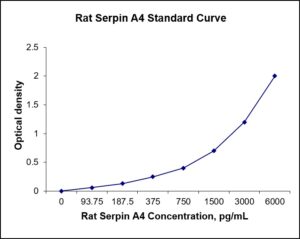
| Detection Range | 93.75-6000 pg/mL |
| Specificity | Rat Serpin A4 |
| Cross-Reactivity | < 0.5% cross-reactivity observed with available related molecules, < 50% cross-species reactivity observed with species tested. |
| Interference | No significant interference observed with available related molecules |
| Storage/Stability | 4 ºC for up to 6 months |
| Usage | For Laboratory Research Use Only. Not for diagnostic or therapeutic use. |
| Additional Notes | The kit allows for use in multiple experiments. |
Standard Curve
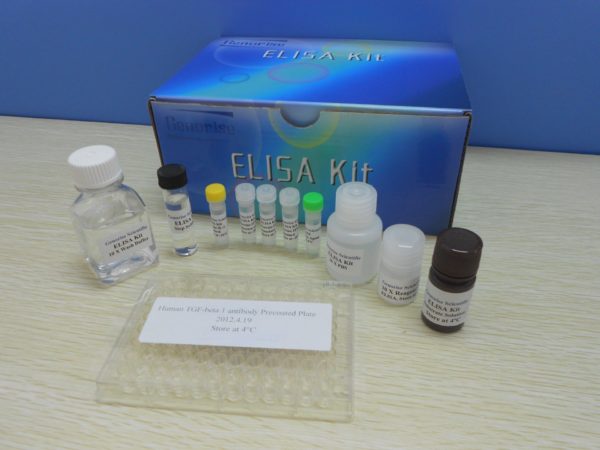
Kit Components
1. Pre-coated 96-well Microplate
2. Biotinylated Detection Antibody
3. Streptavidin-HRP Conjugate
4. Lyophilized Standards
5. TMB One-Step Substrate
6. Stop Solution
7. 20 x PBS
8. Assay Buffer
Other Materials Required but not Provided:
1. Microplate Reader capable of measuring absorption at 450 nm
2. Log-log graph paper or computer and software for ELISA data analysis
3. Precision pipettes (1-1000 µl)
4. Multi-channel pipettes (300 µl)
5. Distilled or deionized water
Protocol Outline
1. Prepare all reagents, samples and standards as instructed in the datasheet.
2. Add 100 µl of Standard or samples to each well and incubate 1 h at RT.
3. Add 100 µl of Working Detection Antibody to each well and incubate 1 h at RT.
4. Add 100 µl of Working Streptavidin-HRP to each well and incubate 20 min at RT.
5. Add 100 µl of Substrate to each well and incubate 5-30 min at RT.
6. Add 50 µl of Stop Solution to each well and read at 450 nm immediately.
Background:
Serpin A4 (Serpin Family A Member 4) is encoded by SERPINA4 gene and is a member of serpin family. An important paralog of this gene is SERPINA11. Among its related pathways are platelet activation, signaling and aggregation. It inhibits human amidolytic and kininogenase activities of tissue kallikrein. Inhibition is achieved by formation of an equimolar, heat- and SDS-stable complex between the inhibitor and the enzyme, and generation of a small C-terminal fragment of the inhibitor due to cleavage at the reactive site by tissue kallikrein. Serpins are a superfamily of proteins with similar structures that were first identified for their protease inhibition activity and are found in all kingdoms of life.[1] The acronym serpin was originally coined because the first serpins to be identified act on chymotrypsin-like serine proteases (serine protease inhibitors).[2] They are notable for their unusual mechanism of action, in which they irreversibly inhibit their target protease by undergoing a large conformational change to disrupt its active site.[3] This contrasts with the more common competitive mechanism for protease inhibitors that bind to and block access to the protease active site.[5][6] Protease inhibition by serpins controls an array of biological processes, including coagulation and inflammation, and consequently these proteins are the target of medical research.[4] Their unique conformational change also makes them of interest to the structural biology and protein folding research communities.[3] The conformational-change mechanism confers certain advantages, but it also has drawbacks: serpins are vulnerable to mutations that can result in serpinopathies such as protein misfolding and the formation of inactive long-chain polymers. [5] Serpin polymerisation not only reduces the amount of active inhibitor, but also leads to accumulation of the polymers, causing cell death and organ failure.[4] Although most serpins control proteolytic cascades, some proteins with a serpin structure are not enzyme inhibitors, but instead perform diverse functions such as storage.
References
- Silverman GA,et al. (2001) The Journal of Biological Chemistry. 276(36): 33293–6.
- Silverman GA,et al. (2010) The Journal of Biological Chemistry. 285(32): 24299–305.
- Whisstock JC, et al. (2006) Current Opinion in Structural Biology. 16(6): 761–8.
- Stein PE, Carrell RW (1995) Nature Structural Biology. 2(2): 96–113.
- Janciauskiene SM, et al. (2011). Respiratory Medicine. 105(8): 1129–39.
Be the first to review “Nori Rat Serpin A4 ELISA Kit”
You must be logged in to post a review.
Reviews
There are no reviews yet.