



















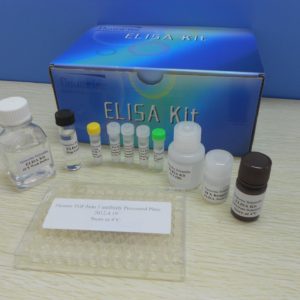
Nori Rat LDHB ELISA Kit
Price range: $508.00 through $916.00
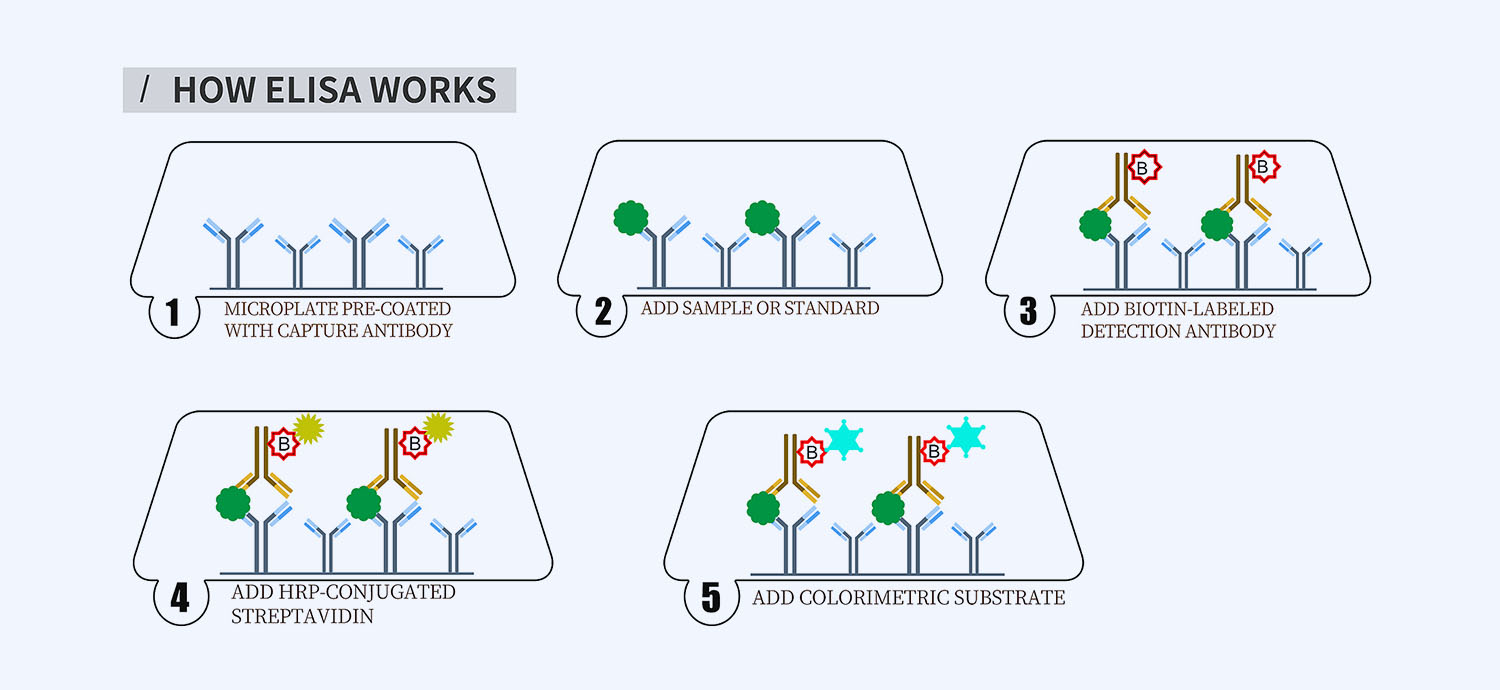
This ELISA kit is for quantification of LDHB in rat. This is a quick ELISA assay that reduces time to 50% compared to the conventional method, and the entire assay only takes 3 hours. This assay employs the quantitative sandwich enzyme immunoassay technique and uses biotin-streptavidin chemistry to improve the performance of the assays. An antibody specific for LDHB has been pre-coated onto a microplate. Standards and samples are pipetted into the wells and any LDHB present is bound by the immobilized antibody. After washing away any unbound substances, a detection antibody specific for LDHB is added to the wells. Following wash to remove any unbound antibody reagent, a detection reagent is added. After intensive wash a substrate solution is added to the wells and color develops in proportion to the amount of LDHB bound in the initial step. The color development is stopped, and the intensity of the color is measured.
Alternative names for LDHB: Lactate dehydrogenase beta chain
This product is for laboratory research use only not for diagnostic and therapeutic purposes or any other purposes.
- Description
- How Elisa Works
- Documents
- Product Citation
- Reviews (0)
Description
Nori Rat LDHB ELISA Kit Summary
Alternative names for LDHB: Lactate dehydrogenase beta chain
| Assay Type | Solid Phase Sandwich ELISA |
| Format | 96-well Microplate or 96-Well Strip Microplate |
| Method of Detection | Colorimetric |
| Number of Targets Detected | 1 |
| Target Antigen Accession Number | P42123 |
| Assay Length | 3 hours |
| Quantitative/Semiquantitative | Quantitative |
| Sample Type | Plasma, Serum, Cell Culture, Urine, Cell/Tissue Lysates, Synovial Fluid, BAL, |
| Recommended Sample Dilution (Plasma/Serum) | No dilution for sample <ULOQ; sufficient dilution for samples >ULOQ |
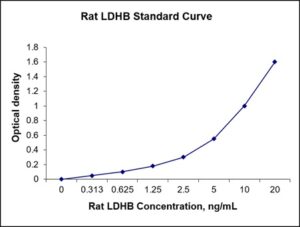
| Sensitivity | 60 pg/mL |
| Detection Range | 0.313-20 ng/mL |
| Specificity | Rat LDHB |
| Cross-Reactivity | < 0.5% cross-reactivity observed with available related molecules, < 50% cross-species reactivity observed with species tested. |
| Interference | No significant interference observed with available related molecules |
| Storage/Stability | 4 ºC for up to 6 months |
| Usage | For Laboratory Research Use Only. Not for diagnostic or therapeutic use. |
| Additional Notes | The kit allows for use in multiple experiments. |
Standard Curve
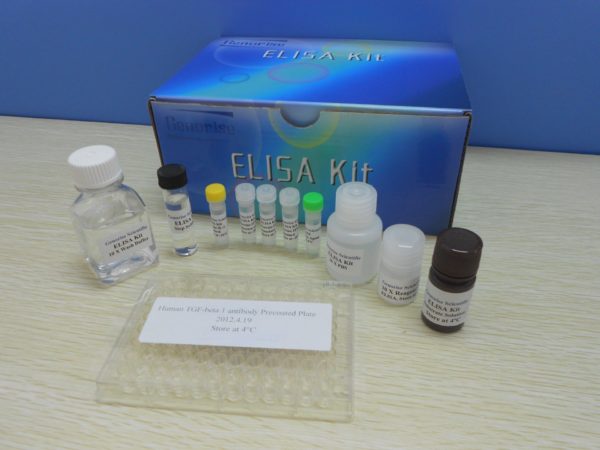
Kit Components
1. Pre-coated 96-well Microplate
2. Biotinylated Detection Antibody
3. Streptavidin-HRP Conjugate
4. Lyophilized Standards
5. TMB One-Step Substrate
6. Stop Solution
7. 20 x PBS
8. Assay Buffer
Other Materials Required but not Provided:
1. Microplate Reader capable of measuring absorption at 450 nm
2. Log-log graph paper or computer and software for ELISA data analysis
3. Precision pipettes (1-1000 µl)
4. Multi-channel pipettes (300 µl)
5. Distilled or deionized water
Protocol Outline
1. Prepare all reagents, samples and standards as instructed in the datasheet.
2. Add 100 µl of Standard or samples to each well and incubate 1 h at RT.
3. Add 100 µl of Working Detection Antibody to each well and incubate 1 h at RT.
4. Add 100 µl of Working Streptavidin-HRP to each well and incubate 20 min at RT.
5. Add 100 µl of Substrate to each well and incubate 5-30 min at RT.
6. Add 50 µl of Stop Solution to each well and read at 450 nm immediately.
Background:
Lactate dehydrogenase (LDH or LD) is an enzyme found in nearly all living cells. Lactate dehydrogenase catalyzes the interconversion of pyruvate and lactate with concomitant interconversion of NADH and NAD+. It converts pyruvate, the final product of glycolysis, to lactate when oxygen is absent or in short supply, and it performs the reverse reaction during the Cori cycle in the liver. At high concentrations of lactate, the enzyme exhibits feedback inhibition, and the rate of conversion of pyruvate to lactate is decreased. Within the heart, lactate dehydrogenase plays the role of converting lactate back into pyruvate so that the pyruvate can be used again to create more energy. Lactate dehydrogenase is composed of four subunits.[1] The two most common subunits are the LDH-M and LDH-H protein, encoded by the LDHA and LDHB genes, respectively. These two subunits can form five possible tetramers (isoenzymes): 4H, 4M, and the three mixed tetramers (3H1M, 2H2M, 1H3M). These five isoforms are enzymatically similar but show different tissue distribution: The major isoenzymes of skeletal muscle and liver, 4M, has four muscle (M) subunits, while 4H is the main isoenzymes for heart muscle in most species, containing four heart (H) subunits. LDH works to prevent muscular failure and fatigue in multiple ways.[2] The lactate-forming reaction generates cytosolic NAD+, which feeds into the glyceraldehyde 3-phosphate dehydrogenase reaction to help maintain cytosolic redox potential and promote substrate flux through the second phase of glycolysis to promote ATP generation. LDH normally appears throughout the body in small amounts and the gene expression is down-regulated by PGC-1α.[3] LDH is expressed extensively in body tissues, such as blood cells and heart muscle. High lactate dehydrogenase 5 expression correlates with high tumoral and stromal vascular endothelial growth factor expression in gastric cancer.[4] Because it is released during tissue damage, it is a marker of common injuries and disease such as heart failure. LDH is often used as a marker of tissue breakdown as LDH is abundant in red blood cells and can function as a marker for hemolysis. A blood sample that has been handled incorrectly can show false-positively high levels of LDH due to erythrocyte damage. It can also be used as a marker of myocardial infarction.
References
- Millar DB, Frattali V, Willick GE (1969) Biochemistry. 8 (6): 2416–21.
- Tesch P, et al. (1978). Acta Physiol Scand. 103 (4): 413–20.
- Summermatter S, et al. (2013). Proc Natl Acad Sci U S A. 110 (21): 8738–43.
- Kim HS, et al. (2014). Pathobiology. 81 (2): 78–85.
Be the first to review “Nori Rat LDHB ELISA Kit”
You must be logged in to post a review.
Reviews
There are no reviews yet.