




















Nori Rat HSP60 ELISA Kit
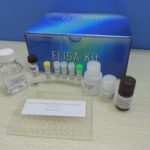
Price range: $508.00 through $916.00
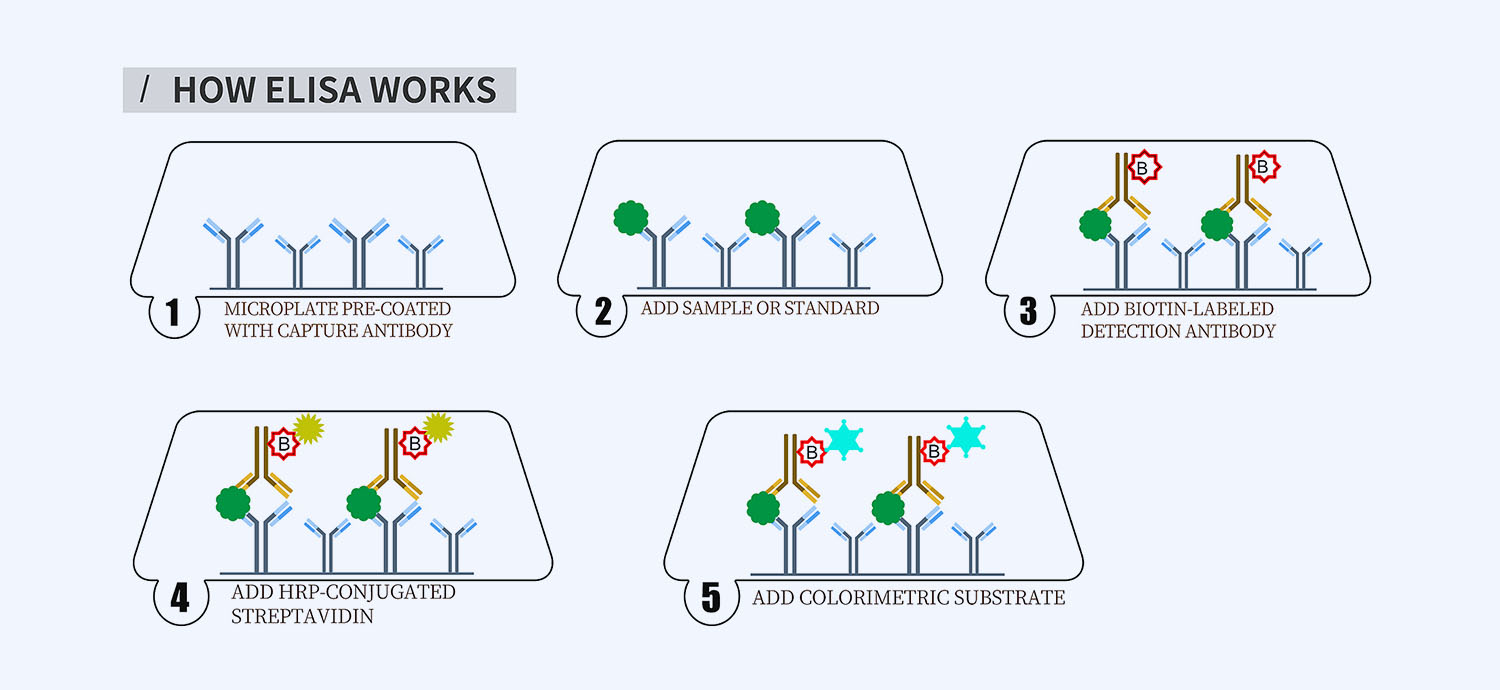
This ELISA kit is for quantification of HSP60 in rat. This is a quick ELISA assay that reduces time to 50% compared to the conventional method, and the entire assay only takes 3 hours. This assay employs the quantitative sandwich enzyme immunoassay technique and uses biotin-streptavidin chemistry to improve the performance of the assays. An antibody specific for HSP60 has been pre-coated onto a microplate. Standards and samples are pipetted into the wells and any HSP60 present is bound by the immobilized antibody. After washing away any unbound substances, a detection antibody specific for HSP60 is added to the wells. Following wash to remove any unbound antibody reagent, a detection reagent is added. After intensive wash a substrate solution is added to the wells and color develops in proportion to the amount of HSP60 bound in the initial step. The color development is stopped, and the intensity of the color is measured.
Alternative names for HSP60: Heat shock protein 60, HSPD1
This product is for laboratory research use only not for diagnostic and therapeutic purposes or any other purposes.
- Description
- How Elisa Works
- Documents
- Product Citation (0)
- Reviews (0)
Description
Nori Rat HSP60 ELISA Kit Summary
Alternative names for HSP60: Heat shock protein 60, HSPD1
| Assay Type | Solid Phase Sandwich ELISA |
| Format | 96-well Microplate or 96-Well Strip Microplate |
| Method of Detection | Colorimetric |
| Number of Targets Detected | 1 |
| Target Antigen Accession Number | P63039 |
| Assay Length | 3 hours |
| Quantitative/Semiquantitative | Quantitative |
| Sample Type | Plasma, Serum, Cell Culture, Urine, Cell/Tissue Lysates, Synovial Fluid, BAL, |
| Recommended Sample Dilution (Plasma/Serum) | No dilution for sample <ULOQ; sufficient dilution for samples >ULOQ |
| Sensitivity | 300 pg/mL |
| Detection Range | 1.56-100 ng/mL |
| Specificity | Rat HSP60 |
| Cross-Reactivity | < 0.5% cross-reactivity observed with available related molecules, < 50% cross-species reactivity observed with species tested. |
| Interference | No significant interference observed with available related molecules |
| Storage/Stability | 4 ºC for up to 6 months |
| Usage | For Laboratory Research Use Only. Not for diagnostic or therapeutic use. |
| Additional Notes | The kit allows for use in multiple experiments. |
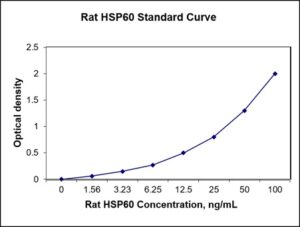
Standard Curve
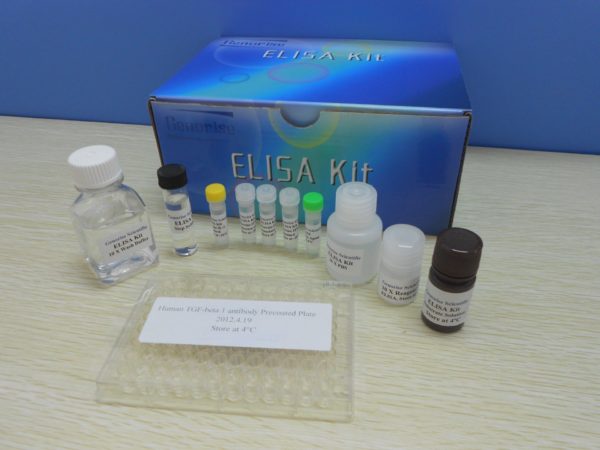
Kit Components
1. Pre-coated 96-well Microplate
2. Biotinylated Detection Antibody
3. Streptavidin-HRP Conjugate
4. Lyophilized Standards
5. TMB One-Step Substrate
6. Stop Solution
7. 20 x PBS
8. Assay Buffer
Other Materials Required but not Provided:
1. Microplate Reader capable of measuring absorption at 450 nm
2. Log-log graph paper or computer and software for ELISA data analysis
3. Precision pipettes (1-1000 µl)
4. Multi-channel pipettes (300 µl)
5. Distilled or deionized water
Protocol Outline
1. Prepare all reagents, samples and standards as instructed in the datasheet.
2. Add 100 µl of Standard or samples to each well and incubate 1 h at RT.
3. Add 100 µl of Working Detection Antibody to each well and incubate 1 h at RT.
4. Add 100 µl of Working Streptavidin-HRP to each well and incubate 20 min at RT.
5. Add 100 µl of Substrate to each well and incubate 5-30 min at RT.
6. Add 50 µl of Stop Solution to each well and read at 450 nm immediately.
Background:
Heat shock proteins (HSPs) are generally responsible for preventing damage to proteins in response to high levels of heat. Heat shock proteins are classified into six major families based on their molecular mass: small HSPs, HSP40, HSP60, HSP70, HSP90, and HSP110[1] HSP60 is a mitochondrial chaperonin that is typically responsible for the transportation and refolding of proteins from the cytoplasm into the mitochondrial matrix. HSP60 functions as a chaperonin to assist in folding linear amino acid chains into their respective three-dimensional structure. Studies have linked HSP60 to diabetes, stress response, cancer and certain types of immunological disorders. HSP60 is implicated in mitochondrial protein import and macromolecular assembly. It may facilitate the correct folding of imported proteins, and may also prevent misfolding and promote the refolding and proper assembly of unfolded polypeptides generated under stress conditions in the mitochondrial matrix. HSP60 interacts with HRAS and with HBV protein X and HTLV-1 protein p40tax. HSP60 belongs to the chaperonin (HSP60) family. The cytoplasmic HSP60 forms a complex with proteins responsible for apoptosis and regulates the activity of these proteins.[2] HSP60 is involved in the replication and transmission of mitochondrial DNA and HSP60 regulates the replication and transmission of mitochondrial DNA.[3]. HSP60 has the capability “of activating monocytes, macrophages and dendritic cells…and also of inducing secretion of a wide range of cytokines.” [4] The fact that HSP60 responds to other signal molecules like LPS or GroEL and has the ability to activate certain types of cells supports the idea that HSP60 is part of a danger signal cascade which is involved in activating an immune response. The heat shock response is a homeostatic mechanism that protects a cell from damage by upregulating the expression of HSP60.[5] The heat shock signal pathway serves as “the basic mechanism of defense against neurotoxicity elicited by free radical oxygen and nitrogen species produced in aging and neurodegenerative disorders”.[6] HSP60 and other heat shock proteins are necessary for cellular survival under toxic or stressful circumstances.[7] Overexpression of HSP60 is correlated with a better prognosis while a decreased expression is correlated with an aggressive tumor.[8]
References
- Johnson RB, et al. (2003). Genetics. 84 (2): 295–300.
- iItoh H, et al. (2002). Eur. J. Biochem. 269 (23): 5931–8.
- Kaufman, B. A. (2003). The Journal of Cell Biology. 163 (3): 457–461.
- Hansen JJ, et al. (2003). Hum. Genet. 112 (1): 71–7.
- Vargas-Parada L, Solis C (2001). Parasitology. 122 (5): 583–8.
- Calabrese V, et al. (2007). J. Neurochem. 101 (3): 709–17
- Rossi MR, et al. (2002). Environ. Health Perspect. 110 (12): 1225–32.
- Lebret T, et al. (2003). Cancer. 98 (5): 970–7.
Be the first to review “Nori Rat HSP60 ELISA Kit”
You must be logged in to post a review.
Reviews
There are no reviews yet.