





















Nori Rabbit Estrogen Receptor Alpha ELISA Kit
Price range: $508.00 through $916.00
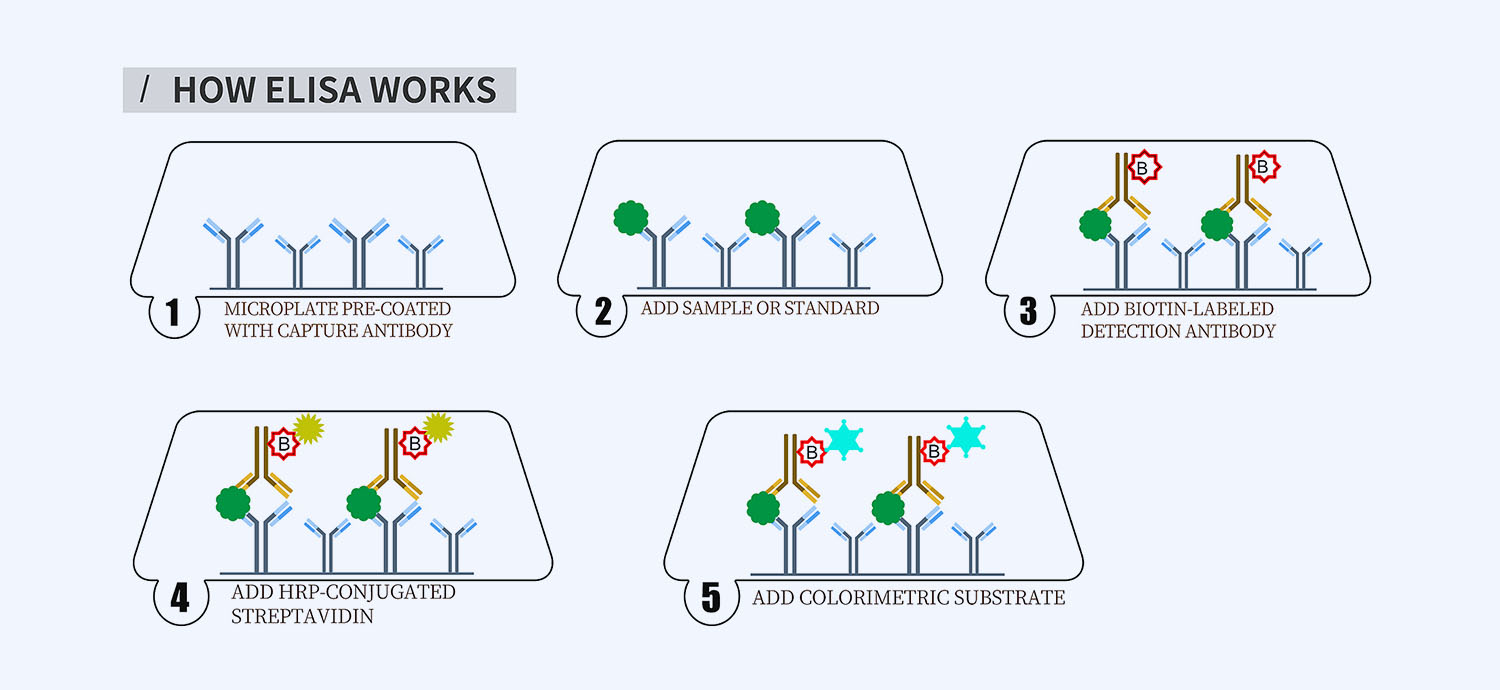
This ELISA kit is for quantification of estrogen receptor alpha in rabbit. This is a quick ELISA assay that reduces time to 50% compared to the conventional method, and the entire assay only takes 3 hours. This assay employs the quantitative sandwich enzyme immunoassay technique and uses biotin-streptavidin chemistry to improve the performance of the assays. An antibody specific for ER alpha has been pre-coated onto a microplate. Standards and samples are pipetted into the wells and any ER alpha present is bound by the immobilized antibody. After washing away any unbound substances, a detection antibody specific for ER alpha is added to the wells. Following wash to remove any unbound antibody reagent, a detection reagent is added. After intensive wash a substrate solution is added to the wells and color develops in proportion to the amount of ER alpha bound in the initial step. The color development is stopped, and the intensity of the color is measured.
Alternative names for estrogen receptor alpha: ERa, ER alpha, NR3A1, ESR1
This product is for laboratory research use only, not for diagnostic and therapeutic purposes or any other purposes.
- Description
- How Elisa Works
- Product Citations
- Reviews (0)
Description
Nori Rabbit Estrogen Receptor Alpha ELISA Kit Summary
Alternative names for estrogen receptor alpha: ERa, NR3A1, ESR1
| Assay Type | Solid Phase Sandwich ELISA |
| Format | 96-well Microplate or 96-Well Strip Microplate |
| Method of Detection | Colorimetric |
| Number of Targets Detected | 1 |
| Target Antigen Accession Number | G1SML6 |
| Assay Length | 3 hours |
| Quantitative/Semiquantitative | Quantitative |
| Sample Type | Plasma, Serum, Cell Culture, Urine, Cell/Tissue Lysates, Synovial Fluid, BAL, |
| Recommended Sample Dilution (Plasma/Serum) | No dilution for sample <ULOQ; sufficient dilution for samples >ULOQ |
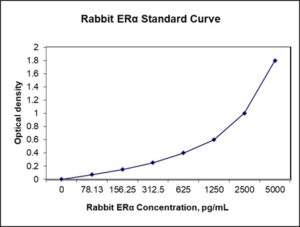
| Sensitivity | 15 pg/mL |
| Detection Range | 78.13-5000 pg/mL |
| Specificity | Rabbit ER alpha |
| Cross-Reactivity | < 0.5% cross-reactivity observed with available related molecules, < 50% cross-species reactivity observed with species tested. |
| Interference | No significant interference observed with available related molecules |
| Storage/Stability | 4 ºC for up to 6 months |
| Usage | For Laboratory Research Use Only. Not for diagnostic or therapeutic use. |
| Additional Notes | The kit allows for use in multiple experiments. |
Standard Curve
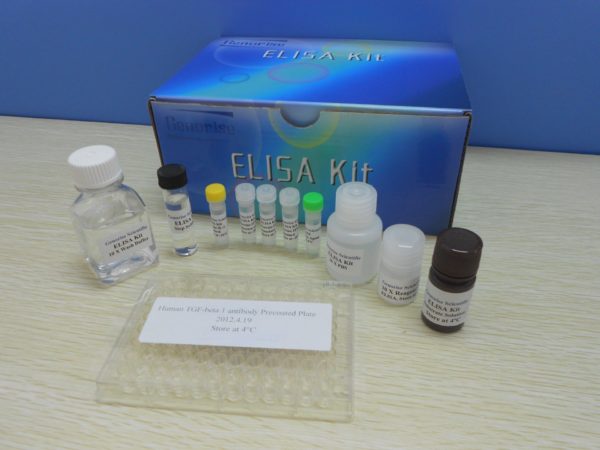
Kit Components
1. Pre-coated 96-well Microplate
2. Biotinylated Detection Antibody
3. Streptavidin-HRP Conjugate
4. Lyophilized Standards
5. TMB One-Step Substrate
6. Stop Solution
7. 20 x PBS
8. Assay Buffer
Other Materials Required but not Provided:
1. Microplate Reader capable of measuring absorption at 450 nm
2. Log-log graph paper or computer and software for ELISA data analysis
3. Precision pipettes (1-1000 µl)
4. Multi-channel pipettes (300 µl)
5. Distilled or deionized water
Protocol Outline
1. Prepare all reagents, samples and standards as instructed in the datasheet.
2. Add 100 µl of Standard or samples to each well and incubate 1 h at RT.
3. Add 100 µl of Working Detection Antibody to each well and incubate 1 h at RT.
4. Add 100 µl of Working Streptavidin-HRP to each well and incubate 20 min at RT.
5. Add 100 µl of Substrate to each well and incubate 5-30 min at RT.
6. Add 50 µl of Stop Solution to each well and read at 450 nm immediately.
Background:
Estrogen receptor alpha (ERα), also known as NR3A1 (nuclear receptor subfamily 3, group A, member 1), is one of two main types of estrogen receptor that is activated by the sex hormone estrogen. ERα is encoded by the gene ESR1.[1][2] The estrogen receptor (ER) is a ligand-activated transcription factor composed of several domains important for hormone binding, DNA binding, and activation of transcription. ERα is widely expressed throughout the body. The development and function of these tissues is disrupted in animal models lacking active ERα genes, such as the ERα knockout mouse (ERKO), providing a preliminary understanding of ERα function at specific target organs.[3] ERα is essential in the maturation of the female reproductive phenotype. Activation of ERα is known to trigger cell proliferation in the uterus.[4] The uterus of female ERKO mice is hypoplastic, suggesting that ERα mediates mitosis and differentiation in the uterus in response to estrogen stimulation.[5] Similarly, prepubertal female ERKO mice develop ovaries that are nearly indistinguishable from those of their wildtype counterparts. However, as the ERKO mice mature they progressively present an abnormal ovarian phenotype in both physiology and function.[5][3] Specifically, female ERKO mice develop enlarged ovaries containing hemorrhagic follicular cysts, which also lack the corpus luteum, and therefore do not ovulate.[5][3] This adult ovarian phenotype suggests that in the absence of ERα, estrogen is no longer able to perform negative feedback on the hypothalamus, resulting in chronically elevated LH levels and constant ovarian stimulation.[5] These results identify a pivotal role for ERα in the hypothalamus, in addition to its role in the estrogen-driven maturation through theca and interstitial cells of the ovary.[5] Estrogen signaling through ERα appears to be responsible for various aspects of central nervous development, such as synaptogenesis and synaptic remodeling.[3] Estrogen insensitivity syndrome is a very rare condition characterized by a defective ERα that is insensitive to estrogens.[6] Genetic polymorphisms in the gene encoding the ERα have been associated with breast cancer in women, gynecomastia in men and dysmenorrhea.[7]
References
- Walter P, et al. (1985). Proc Natl Acad Sci USA. 82 (23): 7889–7893.
- Greene GL, et al. (1986). Science. 231 (4742): 1150–1154.
- Lee HR, et al. (2012). Laboratory Animal Research. 28 (2): 71–76.
- Paterni I, et al. (2014). Steroids. 90: 13–29.
- Curtis Hewitt S, et al. (2000). Breast Cancer Research. 2 (5): 345–352.
- Smith EP, et al. (1994). The New England Journal of Medicine. 331 (16): 1056–1061.
- Jahandoost S, et al. (2017) Journal of the National Medical Association. 109 (2): 126–138.
Product Citations
Be the first to review “Nori Rabbit Estrogen Receptor Alpha ELISA Kit”
You must be logged in to post a review.

Reviews
There are no reviews yet.