

















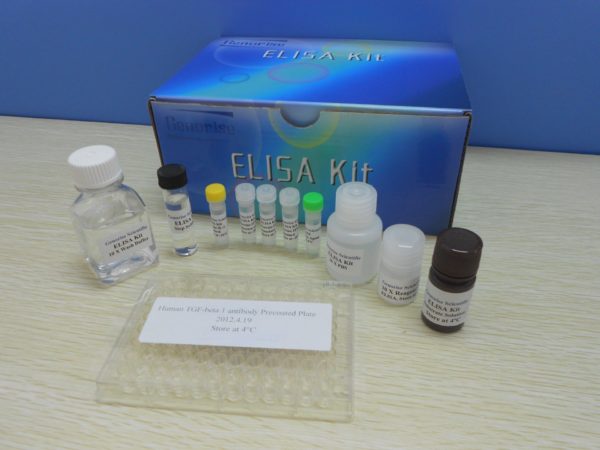
Nori Mouse RANK ELISA Kit
Price range: $508.00 through $916.00
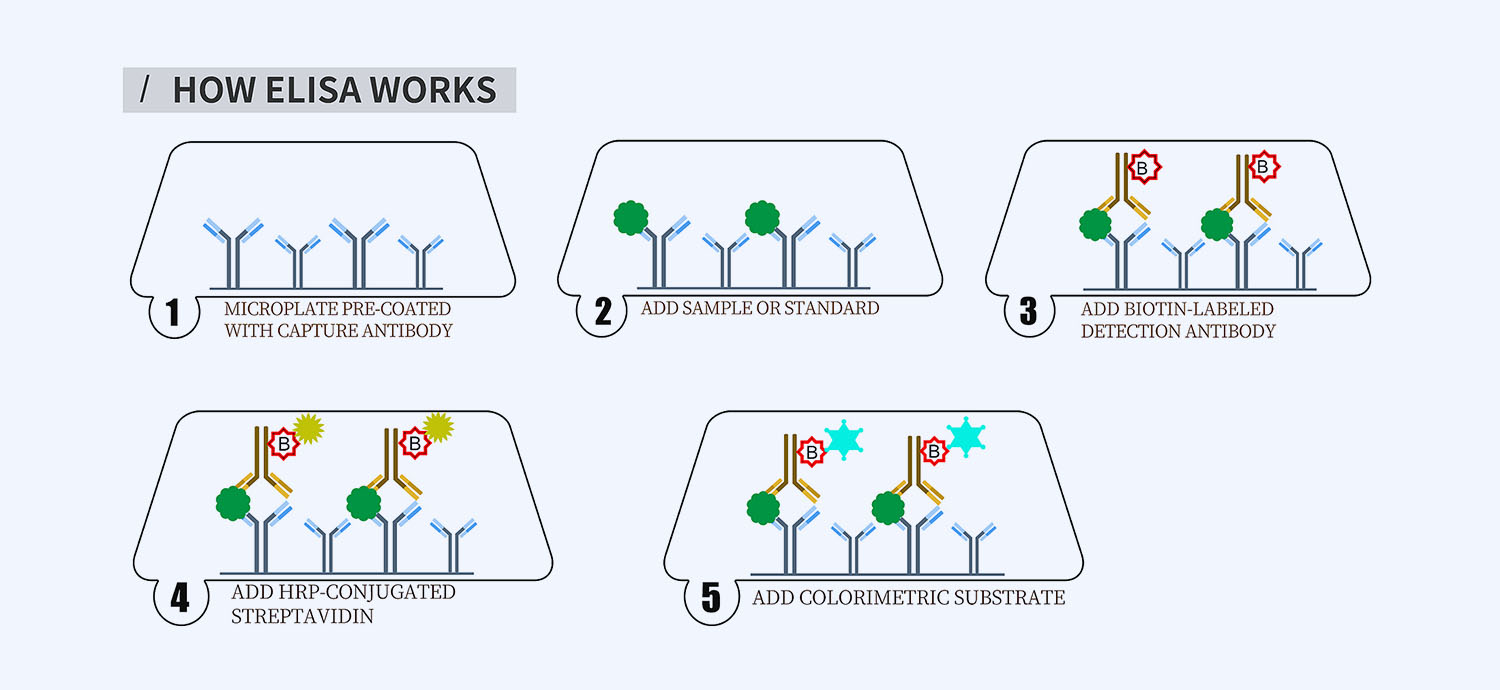
This ELISA kit is for quantification of RANK in mouse. This is a quick ELISA assay that reduces time to 50% compared to the conventional method, and the entire assay only takes 3 hours. This assay employs the quantitative sandwich enzyme immunoassay technique and uses biotin-streptavidin chemistry to improve the performance of the assays. An antibody specific for RANK has been pre-coated onto a microplate. Standards and samples are pipetted into the wells and any RANK present is bound by the immobilized antibody. After washing away any unbound substances, a detection antibody specific for RANK is added to the wells. Following wash to remove any unbound antibody reagent, a detection reagent is added. After intensive wash a substrate solution is added to the wells and color develops in proportion to the amount of RANK bound in the initial step. The color development is stopped, and the intensity of the color is measured.
Alternative names for RANK: Receptor Activator of Nuclear Factor κ B, TRANCE Receptor, TNFRSF11A, Osteoclast differentiation factor receptor, ODFR, CD265
This product is for Laboratory Research Use Only not for diagnostic and therapeutic purposes or any other purposes.
- Description
- How Elisa Works
- Documents
- Product Citation (0)
- Reviews (0)
Description
Nori Mouse RANK ELISA Kit Summary
Alternative names for RANK: Receptor Activator of Nuclear Factor κ B, TRANCE Receptor, TNFRSF11A, Osteoclast differentiation factor receptor, ODFR, CD265
| Assay Type | Solid Phase Sandwich ELISA |
| Format | 96-well Microplate or 96-Well Strip Microplate |
| Method of Detection | Colorimetric |
| Number of Targets Detected | 1 |
| Target Antigen Accession Number |
O35305 |
| Assay Length | 3 hours |
| Quantitative/Semiquantitative | Quantitative |
| Sample Type | Plasma, Serum, Cell Culture, Urine, Cell/Tissue Lysates, Synovial Fluid, BAL, |
| Recommended Sample Dilution (Plasma/Serum) | No dilution for sample <ULOQ; sufficient dilution for samples >ULOQ |
| Sensitivity | 12 pg/mL |
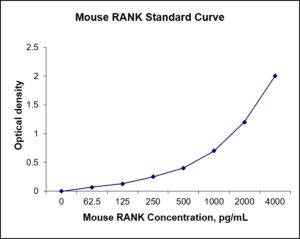
| Detection Range | 62.5-4000 pg/mL |
| Specificity | Mouse RANK |
| Cross-Reactivity | < 0.5% cross-reactivity observed with available related molecules, < 50% cross-species reactivity observed with species tested. |
| Interference | No significant interference observed with available related molecules |
| Storage/Stability | 4 ºC for up to 6 months |
| Usage | For Laboratory Research Use Only. Not for diagnostic or therapeutic use. |
| Additional Notes | The kit allows for use in multiple experiments. |
Standard Curve
Kit Components
1. Pre-coated 96-well Microplate
2. Biotinylated Detection Antibody
3. Streptavidin-HRP Conjugate
4. Lyophilized Standards
5. TMB One-Step Substrate
6. Stop Solution
7. 20 x PBS
8. Assay Buffer
Other Materials Required but not Provided:
1. Microplate Reader capable of measuring absorption at 450 nm
2. Log-log graph paper or computer and software for ELISA data analysis
3. Precision pipettes (1-1000 µl)
4. Multi-channel pipettes (300 µl)
5. Distilled or deionized water
Protocol Outline
1. Prepare all reagents, samples and standards as instructed in the datasheet.
2. Add 100 µl of Standard or samples to each well and incubate 1 h at RT.
3. Add 100 µl of Working Detection Antibody to each well and incubate 1 h at RT.
4. Add 100 µl of Working Streptavidin-HRP to each well and incubate 20 min at RT.
5. Add 100 µl of Substrate to each well and incubate 5-30 min at RT.
6. Add 50 µl of Stop Solution to each well and read at 450 nm immediately.
Background:
Receptor Activator of Nuclear Factor κ B (RANK), also known as TRANCE Receptor or TNFRSF11A, is member of the tumor necrosis factor receptor (TNFR) molecular sub-family. RANK is the receptor for RANK-Ligand (RANKL) and part of the RANK/RANKL/OPG (osteoprotegerin) signaling pathway that regulates osteoclast differentiation and activation. It is associated with bone remodeling and repair, immune cell function, lymph node development, thermal regulation, and mammary gland development. OPG is a decoy receptor for RANK, and regulates the stimulation of the RANK signaling pathway by competing for RANKL. The cytoplasmic domain of RANK binds TRAFs 1, 2, 3, 5, and 6 which transmit signals to downstream targets such as NF-κB and JNK. RANK is constitutively expressed in multiple cells and tissues.[1]. Most commonly, activation of NF-κB is mediated by RANKL, but over-expression of RANK alone is sufficient to activate the NF-κB pathway.[2] RANKL is found on the surface of stromal cells, osteoblasts, and T cells.[3] RANKL binds to RANK, which then binds to TRAF6. TRAF6 stimulates the activation of the c-jun N-terminal kinase (JNK) and nuclear factor kappa-b (NF-kB) pathways which trigger differentiation and activation of osteoclasts. This system is balanced by the relative expression of OPG to RANKL, which are highly regulated by many factors. An overexpression of RANKL can cause an overproduction and activation of osteoclasts, which break down bone. The balance between RANKL and OPG is a target for therapy in many diseases including estrogen deficiency-associated osteoporosis, rheumatoid arthritis, Paget’s disease, periodontal disease, and bone tumors and malignancies.[4] The destruction of bone releases more growth factors and RANKL which induces more osteoclastogenesis, triggering a viscous cycle of bone destruction that is seen in metastatic bone tumors.[6]
References
- Sattler AM, et al. (2004). Calcif. Tissue Int. 74 (1): 103–6.
- Anderson DM, et al. (1997). Nature 390 (6656): 175–179.
- Wong BR, et al. (1999). J. Leukoc. Biol. 65 (6): 715–24.
- Hofbauer, et al. (2001). Journal of Molecular Medicine 79 (5-6): 243–253.
- Schramek, et al. (2011). IBMS BoneKEy 8 (5): 237–256.
Be the first to review “Nori Mouse RANK ELISA Kit”
You must be logged in to post a review.
Reviews
There are no reviews yet.