


















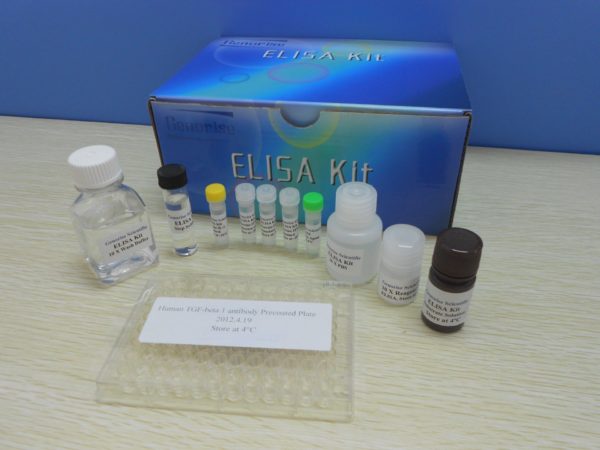
Nori Monkey Renin ELISA Kit
Price range: $508.00 through $916.00
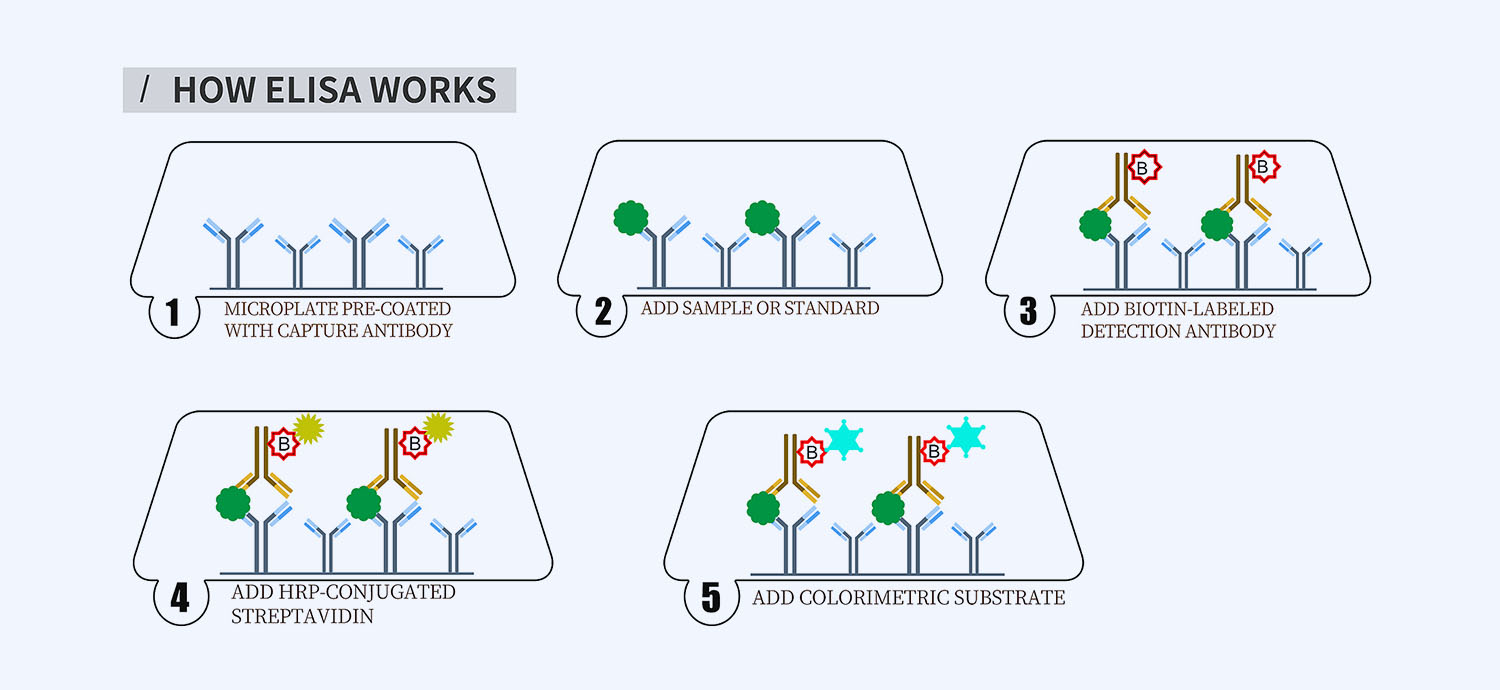
This ELISA kit is for quantification of renin in monkey. This is a quick ELISA assay that reduces time to 50% compared to the conventional method, and the entire assay only takes 3 hours. This assay employs the quantitative sandwich enzyme immunoassay technique and uses biotin-streptavidin chemistry to improve the performance of the assays. An antibody specific for REN has been pre-coated onto a microplate. Standards and samples are pipetted into the wells and any REN present is bound by the immobilized antibody. After washing away any unbound substances, a detection antibody specific for REN is added to the wells. Following wash to remove any unbound antibody reagent, a detection reagent is added. After intensive wash a substrate solution is added to the wells and color develops in proportion to the amount of REN bound in the initial step. The color development is stopped, and the intensity of the color is measured.
Alternative names for renin: Angiotensinogenase, REN
This product is for laboratory research use only not for diagnostic and therapeutic purposes or any other purposes.
- Description
- How Elisa Works
- Documents
- Product Citation (0)
- Reviews (0)
Description
Nori Monkey Renin ELISA Kit Summary
Alternative names for renin: Angiotensinogenase, REN
Alternative names for monkey: Non-human primate, Rhesus macaque, Cynomolgus macaque, Baboons, squirrel monkey, common marmoset, chimpanzee, capuchin monkey, spider monkey, howler monkey, golden snub-nosed monkey, Japanese macaque
| Assay Type | Solid Phase Sandwich ELISA |
| Format | 96-well Microplate or 96-Well Strip Microplate |
| Method of Detection | Colorimetric |
| Number of Targets Detected | 1 |
| Target Antigen Accession Number | Q6DLS0 |
| Assay Length | 3 hours |
| Quantitative/Semiquantitative | Quantitative |
| Sample Type | Plasma, Serum, Cell Culture, Urine, Cell/Tissue Lysates, Synovial Fluid, BAL, |
| Recommended Sample Dilution (Plasma/Serum) | No dilution for sample <ULOQ; sufficient dilution for samples >ULOQ |
| Sensitivity | 12 ng/mL |
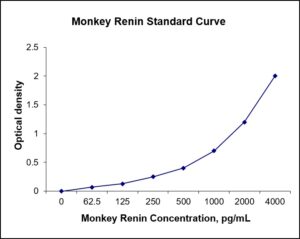
| Detection Range | 62.5-4000 ng/mL |
| Specificity | Monkey renin |
| Cross-Reactivity | < 0.5% cross-reactivity observed with available related molecules, < 50% cross-species reactivity observed with species tested. |
| Interference | No significant interference observed with available related molecules |
| Storage/Stability | 4 ºC for up to 6 months |
| Usage | For Laboratory Research Use Only. Not for diagnostic or therapeutic use. |
| Additional Notes | The kit allows for use in multiple experiments. |
Standard Curve
Kit Components
1. Pre-coated 96-well Microplate
2. Biotinylated Detection Antibody
3. Streptavidin-HRP Conjugate
4. Lyophilized Standards
5. TMB One-Step Substrate
6. Stop Solution
7. 20 x PBS
8. Assay Buffer
Other Materials Required but not Provided:
1. Microplate Reader capable of measuring absorption at 450 nm
2. Log-log graph paper or computer and software for ELISA data analysis
3. Precision pipettes (1-1000 µl)
4. Multi-channel pipettes (300 µl)
5. Distilled or deionized water
Protocol Outline
1. Prepare all reagents, samples and standards as instructed in the datasheet.
2. Add 100 µl of Standard or samples to each well and incubate 1 h at RT.
3. Add 100 µl of Working Detection Antibody to each well and incubate 1 h at RT.
4. Add 100 µl of Working Streptavidin-HRP to each well and incubate 20 min at RT.
5. Add 100 µl of Substrate to each well and incubate 5-30 min at RT.
6. Add 50 µl of Stop Solution to each well and read at 450 nm immediately.
Background:
Renin is an angiotensinogenase, an enzyme that participates in the body’s renin-angiotensin aldosterone system (RAAS)—also known as the renin-angiotensin-aldosterone axis—that mediates extracellular volume (i.e., that of the blood plasma, lymph and interstitial fluid), and arterial vasoconstriction. Thus, it regulates the body’s mean arterial blood pressure. Renin has an enzymatic activity with which it hydrolyses angiotensinogen to angiotensin I. Mature renin contains 340 amino acids and has a mass of 37 kDa.[1] Renin is secreted by the afferent arterioles of the kidney from specialized cells called granular cells of the juxtaglomerular apparatus in response to three stimuli including a decrease in arterial blood pressure, a decrease in sodium levels in the ultrafiltrate of the nephron and sympathetic nervous system activity, which also controls blood pressure, acting through the beta1 adrenergic receptors. Human renin is secreted by at least 2 cellular pathways: a constitutive pathway for the secretion of prorenin and a regulated pathway for the secretion of mature renin.[2] Renin can bind to ATP6AP2, which results in a fourfold increase in the conversion of angiotensinogen to angiotensin I over that shown by soluble renin. In addition, renin binding results in phosphorylation of serine and tyrosine residues of ATP6AP2.[3] An over-active renin-angiotension system leads to vasoconstriction and retention of sodium and water. These effects lead to hypertension. Therefore, renin inhibitors can be used for the treatment of hypertension. [4] The plasma renin activity (PRA) is measured specially in case of certain diseases that present with hypertension or hypotension. PRA is also raised in certain tumors. A PRA measurement may be compared to a plasma aldosterone concentration (PAC) as a PAC/PRA ratio. The normal concentration of renin in adult human plasma is 1.98-24.6 ng/L in the upright position. The differential diagnosis of kidney cancer in a young patient with hypertension includes juxtaglomerular cell tumor (reninoma), Wilms’ tumor, and renal cell carcinoma, all of which may produce renin.[5]
References
- Imai T, et al. (1983). Proceedings National Academy of Sci USA 80 (24): 7405–9.
- Pratt RE, et al. (1988) The Journal of Biological Chemistry 263 (7): 3137–41.
- Nguyen G, et al. (2002) The Journal of Clinical Investigation 109 (11): 1417–27.
- Ram CV (2009) Future Cardiology 5 (5): 453–65.
- Méndez GP, et al. (2011) International Journal of Surgical Pathology 19 (1): 93–8.
Be the first to review “Nori Monkey Renin ELISA Kit”
You must be logged in to post a review.
Reviews
There are no reviews yet.