



















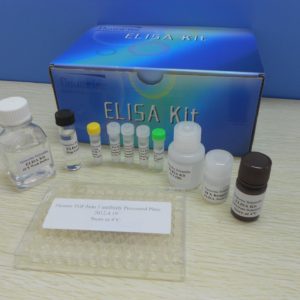
Nori Human TGF alpha ELISA Kit
Price range: $508.00 through $916.00
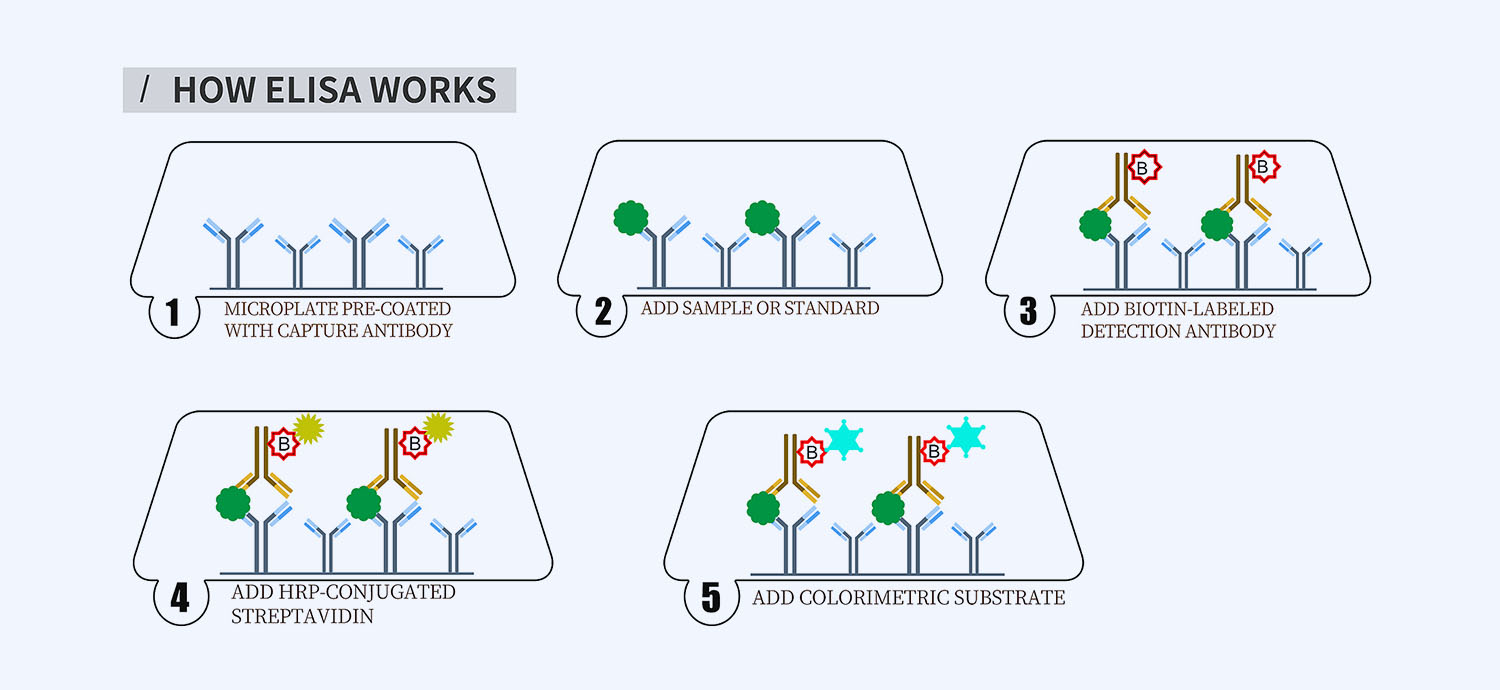
This ELISA kit is for quantification of TGF alpha in human. This is a quick ELISA assay that reduces time to 50% compared to the conventional method, and the entire assay only takes 3 hours. This assay employs the quantitative sandwich enzyme immunoassay technique and uses biotin-streptavidin chemistry to improve the performance of the assays. An antibody specific for TGFA has been pre-coated onto a microplate. Standards and samples are pipetted into the wells and any TGFA present is bound by the immobilized antibody. After washing away any unbound substances, a detection antibody specific for TGFA is added to the wells. Following wash to remove any unbound antibody reagent, a detection reagent is added. After intensive wash a substrate solution is added to the wells and color develops in proportion to the amount of TGFA bound in the initial step. The color development is stopped, and the intensity of the color is measured.
Alternative names for TGF alpha: Transforming growth factor alpha, TGFa, TGFA
This product is for Laboratory Research Use Only not for diagnostic and therapeutic purposes or any other purposes.
- Description
- How Elisa Works
- Documents
- Product Citation (0)
- Reviews (0)
Description
Nori Human TGF alpha ELISA Kit Summary
Alternative names for TGF alpha: Transforming growth factor alpha, TGFa, TGFA
| Assay Type | Solid Phase Sandwich ELISA |
| Format | 96-well Microplate or 96-Well Strip Microplate |
| Method of Detection | Colorimetric |
| Number of Targets Detected | 1 |
| Target Antigen Accession Number |
P01135 |
| Assay Length | 3 hours |
| Quantitative/Semiquantitative | Quantitative |
| Sample Type | Plasma, Serum, Cell Culture, Urine, Cell/Tissue Lysates, Synovial Fluid, BAL, |
| Recommended Sample Dilution (Plasma/Serum) | No dilution for sample <ULOQ; sufficient dilution for samples >ULOQ |
| Sensitivity | 6 pg/mL |
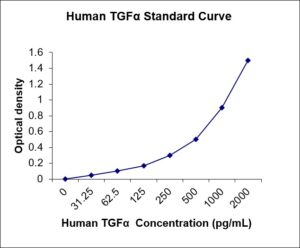
| Detection Range | 31.25-2000 pg/mL |
| Specificity | Human TGFa |
| Cross-Reactivity | < 0.5% cross-reactivity observed with available related molecules, < 50% cross-species reactivity observed with species tested. |
| Interference | No significant interference observed with available related molecules |
| Storage/Stability | 4 ºC for up to 6 months |
| Usage | For Laboratory Research Use Only. Not for diagnostic or therapeutic use. |
| Additional Notes | The kit allows for use in multiple experiments. |
Standard Curve
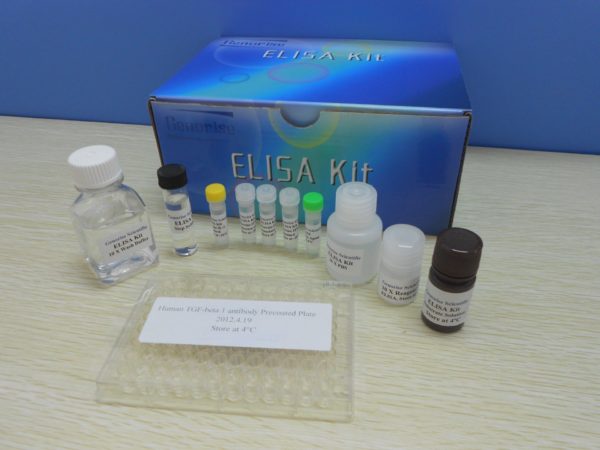
Kit Components
1. Pre-coated 96-well Microplate
2. Biotinylated Detection Antibody
3. Streptavidin-HRP Conjugate
4. Lyophilized Standards
5. TMB One-Step Substrate
6. Stop Solution
7. 20 x PBS
8. Assay Buffer
Other Materials Required but not Provided:
1. Microplate Reader capable of measuring absorption at 450 nm
2. Log-log graph paper or computer and software for ELISA data analysis
3. Precision pipettes (1-1000 µl)
4. Multi-channel pipettes (300 µl)
5. Distilled or deionized water
Protocol Outline
1. Prepare all reagents, samples and standards as instructed in the datasheet.
2. Add 100 µl of Standard or samples to each well and incubate 1 h at RT.
3. Add 100 µl of Working Detection Antibody to each well and incubate 1 h at RT.
4. Add 100 µl of Working Streptavidin-HRP to each well and incubate 20 min at RT.
5. Add 100 µl of Substrate to each well and incubate 5-30 min at RT.
6. Add 50 µl of Stop Solution to each well and read at 450 nm immediately.
Background:
Transforming growth factor alpha (TGF-α) is a protein that is encoded by the TGFA gene.[1] As a member of the epidermal growth factor (EGF) family, TGF-α is a mitogenic polypeptide.[2] The protein becomes activated when binding to receptors capable of protein kinase activity for cellular signaling. The protein, however, is not directly related to TGF-β. TGF-α is a ligand for the epidermal growth factor receptor, which activates a signaling pathway for cell proliferation, differentiation and development. This protein may act as either a transmembrane-bound ligand or a soluble ligand. This gene has been associated with many types of cancers, and it may also be involved in some cases of cleft lip/palate. TGF-α can be produced in macrophages, brain cells, and keratinocytes. TGF-α induces epithelial development. In the stomach, TGF-α is produced within the normal gastric mucosa.[3] TGF-α has been shown to inhibit gastric acid secretion. The biological actions of TGF-α and EGF are similar. When TGF-α binds to EGFR it can initiate multiple cell proliferation events.[4] Cell proliferation events that involve TGF-α bound to EGFR include wound healing and embryogenesis. TGF-α is also involved in tumerogenesis and believed to promote angiogenesis.[5] TGF-α has also been shown to stimulate neural cell proliferation in the adult injured brain.[6] TGF-α is heavily involved in cancer progression (e.g., lung, breast, pancreatic), acts as a biomarker for various tumors, and is associated with Menetrier’s disease, a rare stomach condition. It acts synergistically with TGF-beta to encourage anchorage-independent cell proliferation. Overexpression is associated with gastric cancer, pancreatic cancer, and melanoma. It is also implicated in fibroproliferative diseases and cartilage degradation.
References
- Lee DC, et al. (1985). Nature. 313 (6002): 489–491.
- Ojeda SR, et al. (1997). Molecular Psychiatry. 2 (5): 355–358.
- Coffey RJ, et al. (1995). European Journal of Gastroenterology & Hepatology. 7 (10): 923–7.
- McInnes C, et al. (1998). The Journal of Biological Chemistry. 273 (42): 27357–27363.
- Ferrer I, et al. (1996). Progress in Neurobiology. 49 (2): 99–123.
- Fallon J, et al. (2000). Proc Acad Sci USA. 97 (26): 14686–14691.
Be the first to review “Nori Human TGF alpha ELISA Kit”
You must be logged in to post a review.
Reviews
There are no reviews yet.