



















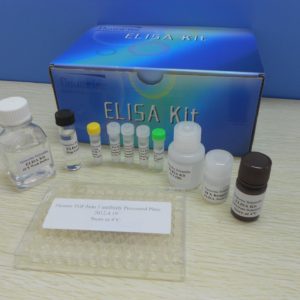
Nori Human Myonectin ELISA Kit
Price range: $508.00 through $916.00
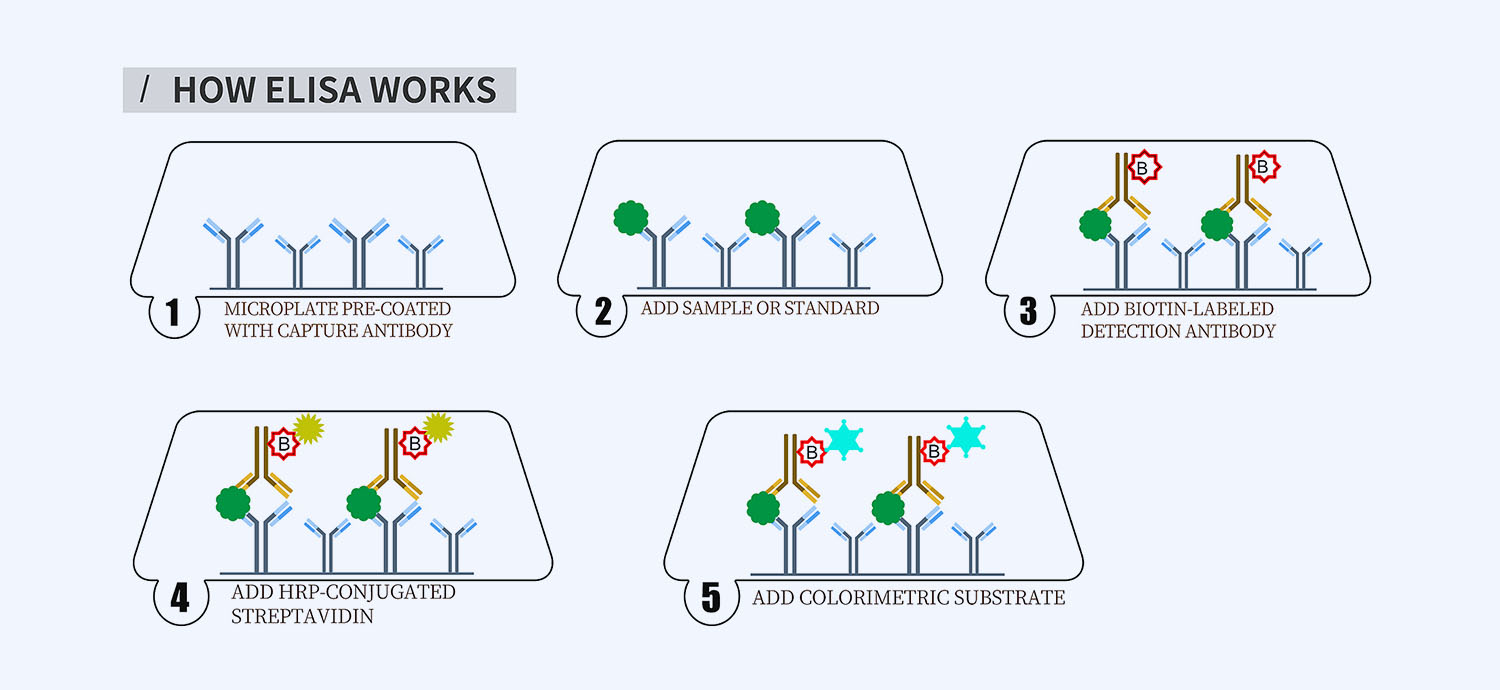
This ELISA kit is for quantification of Myonectin in human. This is a quick ELISA assay that reduces time to 50% compared to the conventional method, and the entire assay only takes 3 hours. This assay employs the quantitative sandwich enzyme immunoassay technique and uses biotin-streptavidin chemistry to improve the performance of the assays. An antibody specific for ERFE has been pre-coated onto a microplate. Standards and samples are pipetted into the wells and any ERFE present is bound by the immobilized antibody. After washing away any unbound substances, a detection antibody specific for ERFE is added to the wells. Following wash to remove any unbound antibody reagent, a detection reagent is added. After intensive wash a substrate solution is added to the wells and color develops in proportion to the amount of ERFE bound in the initial step. The color development is stopped, and the intensity of the color is measured.
Alternative names for Myonectin: CTRP15, erythroferrone, ERFE
This product is for Laboratory Research Use Only not for diagnostic and therapeutic purposes or any other purposes.
- Description
- How Elisa Works
- Documents
- Product Citation (0)
- Reviews (0)
Description
Nori Human Myonectin ELISA Kit Summary
Alternative names for myonectin: CTRP15, erythroferrone, ERFE
| Assay Type | Solid Phase Sandwich ELISA |
| Format | 96-well Microplate or 96-Well Strip Microplate |
| Method of Detection | Colorimetric |
| Number of Targets Detected | 1 |
| Target Antigen Accession Number | Q4G0M1 |
| Assay Length | 3 hours |
| Quantitative/Semiquantitative | Quantitative |
| Sample Type | Plasma, Serum, Cell Culture, Urine, Cell/Tissue Lysates, Synovial Fluid, BAL, |
| Recommended Sample Dilution (Plasma/Serum) | No dilution for sample <ULOQ; sufficient dilution for samples >ULOQ |
| Sensitivity | 60 pg/mL |
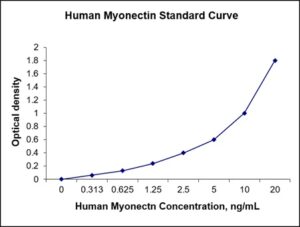
| Detection Range | 0.313-20 ng/mL |
| Specificity | Human Myonectin |
| Cross-Reactivity | < 0.5% cross-reactivity observed with available related molecules, < 50% cross-species reactivity observed with species tested. |
| Interference | No significant interference observed with available related molecules |
| Storage/Stability | 4 ºC for up to 6 months |
| Usage | For Laboratory Research Use Only. Not for diagnostic or therapeutic use. |
| Additional Notes | The kit allows for use in multiple experiments. |
Standard Curve
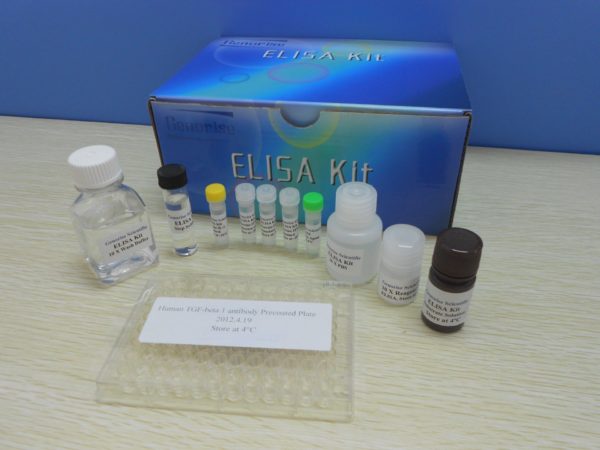
Kit Components
1. Pre-coated 96-well Microplate
2. Biotinylated Detection Antibody
3. Streptavidin-HRP Conjugate
4. Lyophilized Standards
5. TMB One-Step Substrate
6. Stop Solution
7. 20 x PBS
8. Assay Buffer
Other Materials Required but not Provided:
1. Microplate Reader capable of measuring absorption at 450 nm
2. Log-log graph paper or computer and software for ELISA data analysis
3. Precision pipettes (1-1000 µl)
4. Multi-channel pipettes (300 µl)
5. Distilled or deionized water
Protocol Outline
1. Prepare all reagents, samples and standards as instructed in the datasheet.
2. Add 100 µl of Standard or samples to each well and incubate 1 h at RT.
3. Add 100 µl of Working Detection Antibody to each well and incubate 1 h at RT.
4. Add 100 µl of Working Streptavidin-HRP to each well and incubate 20 min at RT.
5. Add 100 µl of Substrate to each well and incubate 5-30 min at RT.
6. Add 50 µl of Stop Solution to each well and read at 450 nm immediately.
Background:
Myonectin (CTRP15) is a novel nutrient-responsive myokine secreted by skeletal muscle to regulate whole-body fatty acid metabolism.[1] Myonectin is a member of the C1q/TNF-related protein (CTRP) family and was shown to be identical to erythroferrone, a hormone produced in erythroblasts that is involved in iron metabolism.[2] This important, biologically active molecule is released into circulation by muscular contraction, and is roughly equivalent to insulin in its potency. Myonectin responds to changes in cellular energy state resulting from glucose or fatty acid fluxes. Many metabolically relevant secreted proteins (e.g. adiponectin, leptin, resistin, and RBP) and the signaling pathways they regulate in tissues are known to be dysregulated in the condition of obesity. The reduction in expression and circulating levels of myonectin in the obese state may represent yet another component of the complex metabolic circuitry dysregulated by excess caloric intake. Although exercise has long been known to have profound positive impacts on systemic insulin sensitivity and energy balance, the underlying mechanisms remain incompletely understood. That voluntary exercise dramatically increases the expression and circulating levels of myonectin to promote fatty acid uptake into cells may underlie one of the beneficial effects of physical exercise.”[1] Serum CTRP15 concentrations were associated with the key components of MetS and insulin resistance and acutely increase in response to EPO in the setting of normal or impaired kidney function.[3][4] Myonectin links skeletal muscle to lipid homeostasis in liver and adipose tissue in response to alterations in energy state, revealing a novel myonectin-mediated metabolic circuit.[5] CTRP5 is a novel pro-atherogenic cytokine and promotes transcytosis and oxidation of LDL in endothelial cells via up-regulation of 12/15-LOX.[6] CTRP5 has a role in extracellular deposit formation in late-onset retinal degeneration.[7]
References
- Marcus M. S, et al. Biol. Chem. 287, NO. 15, pp. 11968–11980.
- Kautz L, et al. (2014). Nat Genet. 46 (7): 678–84.
- Mi, Q. et al. (2019) Diabetes Metab. Res. Rev. 35 (1), e3085.
4. Hanudel MR, et al. (2018) Haematologica 103 (4), e141-e142.
- Seldin MM, et al. (2012) J. Biol. Chem. 287 (15), 11968-11980.
- Li C et al. (2018) Atherosclerosis 278, 197-209.
7. Hayward C, et al. (2003) Hum. Mol. Genet. 12 (20), 2657-2667.
Be the first to review “Nori Human Myonectin ELISA Kit”
You must be logged in to post a review.
Reviews
There are no reviews yet.