



















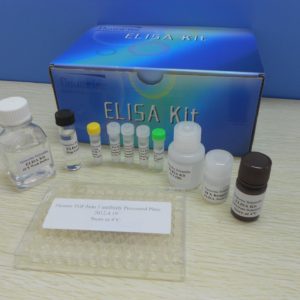
Nori Human Ferritin ELISA Kit
Price range: $508.00 through $916.00
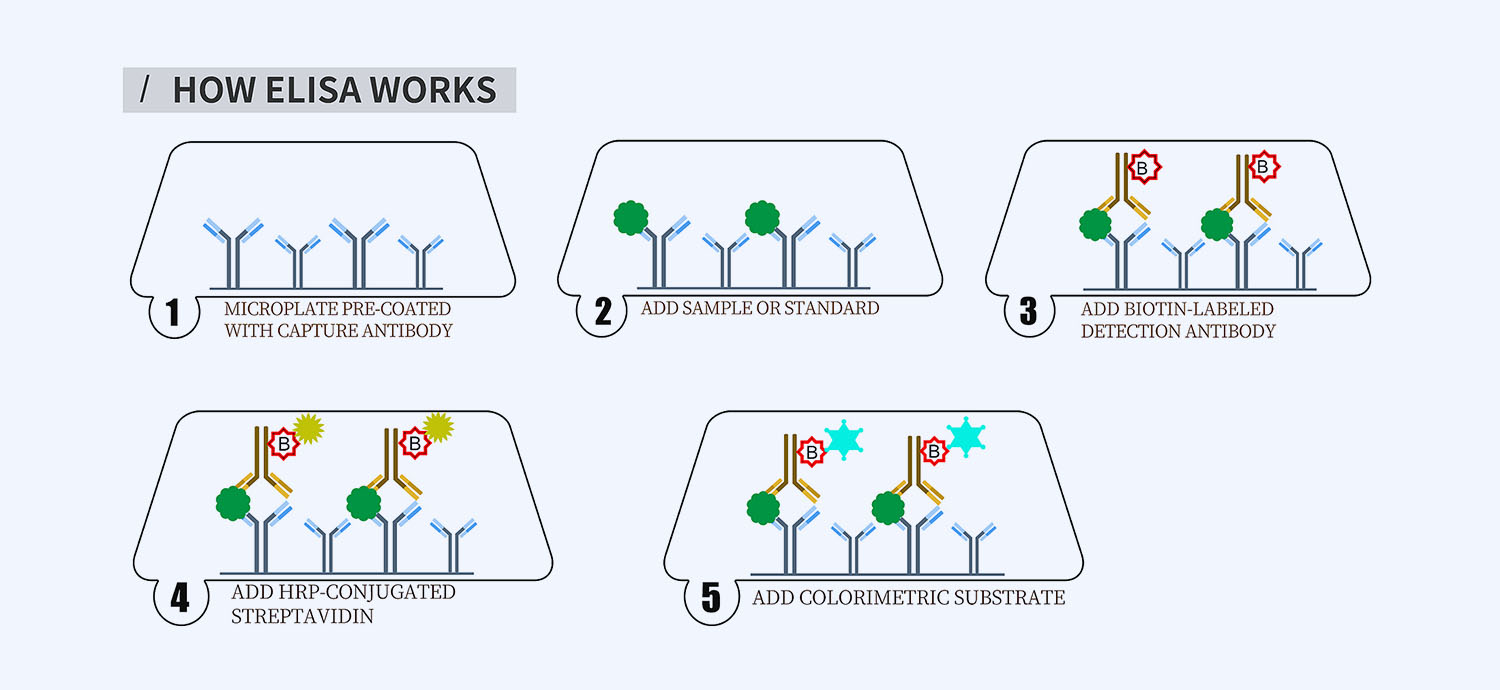
This ELISA kit is for quantification of ferritin in humnan. This is a quick ELISA assay that reduces time to 50% compared to the conventional method, and the entire assay only takes 3 hours. This assay employs the quantitative sandwich enzyme immunoassay technique and uses biotin-streptavidin chemistry to improve the performance of the assays. An antibody specific for FTL has been pre-coated onto a microplate. Standards and samples are pipetted into the wells and any FTL present is bound by the immobilized antibody. After washing away any unbound substances, a detection antibody specific for FTL is added to the wells. Following wash to remove any unbound antibody reagent, a detection reagent is added. After intensive wash a substrate solution is added to the wells and color develops in proportion to the amount of FTL bound in the initial step. The color development is stopped, and the intensity of the color is measured.
Alternative names for Ferritin: Ferritin light chain, FTL
This product is for laboratory research use only not for diagnostic and therapeutic purposes or any other purposes.
- Description
- How Elisa Works
- Documents
- Product Citation (0)
- Reviews (0)
Description
Nori Human Ferritin ELISA Kit Summary
Alternative names for ferritin: Ferritin light chain, FTL
| Assay Type | Solid Phase Sandwich ELISA |
| Format | 96-well Microplate or 96-Well Strip Microplate |
| Method of Detection | Colorimetric |
| Number of Targets Detected | 1 |
| Target Antigen Accession Number | P02792 |
| Assay Length | 3 hours |
| Quantitative/Semiquantitative | Quantitative |
| Sample Type | Plasma, Serum, Cell Culture, Urine, Cell/Tissue Lysates, Synovial Fluid, BAL, |
| Recommended Sample Dilution (Plasma/Serum) | No dilution for sample <ULOQ; sufficient dilution for samples >ULOQ |
| Sensitivity | 300 pg/mL |
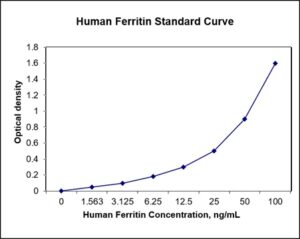
| Detection Range | 1.563-100 ng/mL |
| Specificity | Human FTL |
| Cross-Reactivity | < 0.5% cross-reactivity observed with available related molecules, < 50% cross-species reactivity observed with species tested. |
| Interference | No significant interference observed with available related molecules |
| Storage/Stability | 4 ºC for up to 6 months |
| Usage | For Laboratory Research Use Only. Not for diagnostic or therapeutic use. |
| Additional Notes | The kit allows for use in multiple experiments. |
Standard Curve
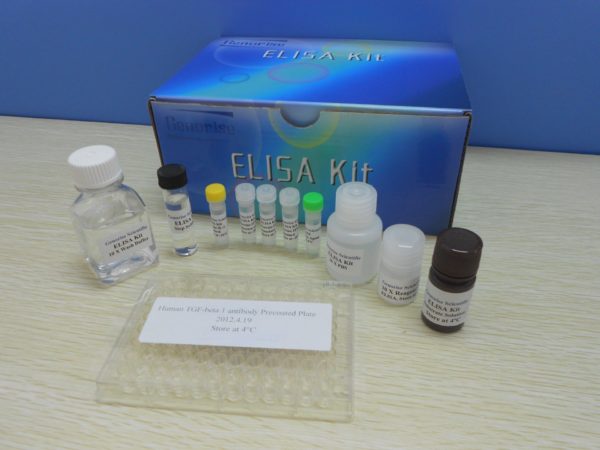
Kit Components
1. Pre-coated 96-well Microplate
2. Biotinylated Detection Antibody
3. Streptavidin-HRP Conjugate
4. Lyophilized Standards
5. TMB One-Step Substrate
6. Stop Solution
7. 20 x PBS
8. Assay Buffer
Other Materials Required but not Provided:
1. Microplate Reader capable of measuring absorption at 450 nm
2. Log-log graph paper or computer and software for ELISA data analysis
3. Precision pipettes (1-1000 µl)
4. Multi-channel pipettes (300 µl)
5. Distilled or deionized water
Protocol Outline
1. Prepare all reagents, samples and standards as instructed in the datasheet.
2. Add 100 µl of Standard or samples to each well and incubate 1 h at RT.
3. Add 100 µl of Working Detection Antibody to each well and incubate 1 h at RT.
4. Add 100 µl of Working Streptavidin-HRP to each well and incubate 20 min at RT.
5. Add 100 µl of Substrate to each well and incubate 5-30 min at RT.
6. Add 50 µl of Stop Solution to each well and read at 450 nm immediately.
Background:
Ferritin is a universal intracellular protein that stores iron and releases it in a controlled fashion. It is a globular protein complex consisting of 24 protein subunits forming a nanocage with multiple metal–protein interactions. It is the primary intracellular iron-storage protein, keeping iron in a soluble and non-toxic form. Ferritin that is not combined with iron is called apoferritin. The protein is produced by almost all living organisms and is found in most tissues as a cytosolic protein, but small amounts are secreted into the serum where it functions as an iron carrier. In humans, it acts as a buffer against iron deficiency and iron overload. Plasma ferritin is also an indirect marker of the total amount of iron stored in the body, hence serum ferritin is used as a diagnostic test for iron-deficiency anemia.[1] Ferritin serves to store iron in a non-toxic form, to deposit it in a safe form, and to transport it to areas where it is required.[2] The function and structure of the expressed ferritin protein varies in different cell types.[3] The presence of iron itself is a major trigger for the production of ferritin,[3] with some exceptions.[4] Ferritin concentrations increase drastically in the presence of an infection or cancer. The concentration of ferritin has been shown to increase in response to stresses such as anoxia;[5] this implies that it is an acute phase protein.[6] Ferritin levels may be artificially high in cases of anemia of chronic disease where ferritin is elevated in its capacity as an inflammatory acute phase protein and not as a marker for iron overload.
References
- Wang W, et al. (2010). Biochimica et Biophysica Acta. 1800 (8): 760–9.
- Seckback J (1982). Journal of Plant Nutrition. 5 (4–7): 369–394.
- Theil EC (1987). Annual Review of Biochemistry. 56 (1): 289–315.
- Andrews SC, et al. (1992). Journal of Inorganic Biochemistry. 47 (3–4): 161–74.
- Larade K, Storey KB (2004). The Journal of Experimental Biology. 207 (Pt 8): 1353–60.
- Beck G, et al. (2002). Developmental and Comparative Immunology. 26 (1): 11–26.
Be the first to review “Nori Human Ferritin ELISA Kit”
You must be logged in to post a review.
Reviews
There are no reviews yet.