


















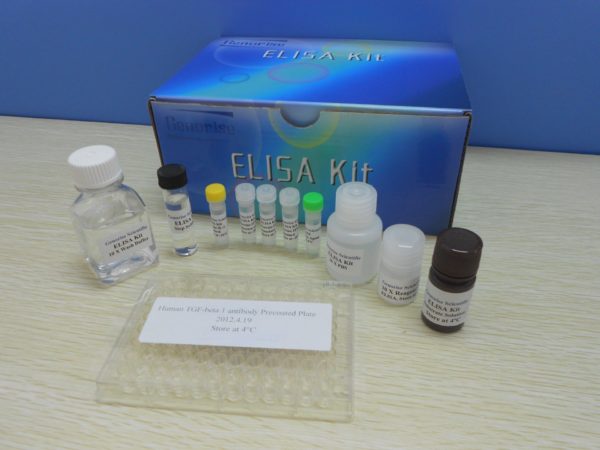
Nori Human Collagen XVII ELISA Kit
Price range: $508.00 through $916.00
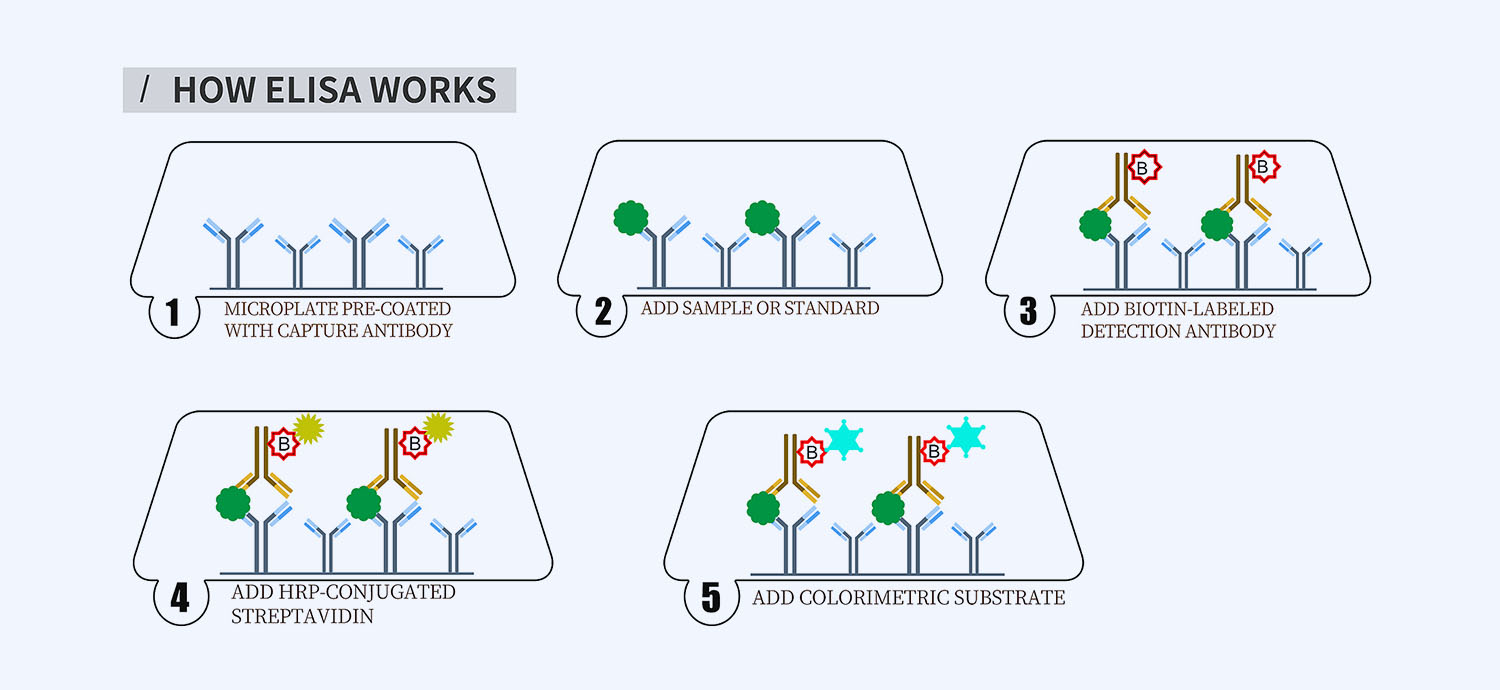
This ELISA kit is for quantification of COL17A1 in human. This is a quick ELISA assay that reduces time to 50% compared to the conventional method, and the entire assay only takes 3 hours. This assay employs the quantitative sandwich enzyme immunoassay technique and uses biotin-streptavidin chemistry to improve the performance of the assays. An antibody specific for COL17A1 has been pre-coated onto a microplate. Standards and samples are pipetted into the wells and any COL17A1 present is bound by the immobilized antibody. After washing away any unbound substances, a detection antibody specific for COL17A1 is added to the wells. Following wash to remove any unbound antibody reagent, a detection reagent is added. After intensive wash a substrate solution is added to the wells and color develops in proportion to the amount of COL17A1 bound in the initial step. The color development is stopped, and the intensity of the color is measured.
Alternative names for collagen XVII: Collagen alpha 1 chain, COL1A1, BP180, BPAG2
This product is for laboratory research use only not for diagnostic and therapeutic purposes or any other purposes.
- Description
- How Elisa Works
- Documents
- Product Citations
- Reviews (0)
Description
Nori Human Collagen XVII ELISA Kit Summary
Alternative names for collagen XVII: Collagen alpha 1 chain, COL17A1, BP180, BPAG2,
| Assay Type | Solid Phase Sandwich ELISA |
| Format | 96-well Microplate or 96-Well Strip Microplate |
| Method of Detection | Colorimetric |
| Number of Targets Detected | 1 |
| Target Antigen Accession Number | Q9UMD9 |
| Assay Length | 3 hours |
| Quantitative/Semiquantitative | Quantitative |
| Sample Type | Plasma, Serum, Cell Culture, Urine, Cell/Tissue Lysates, Synovial Fluid, BAL, |
| Recommended Sample Dilution (Plasma/Serum) | No dilution for sample <ULOQ; sufficient dilution for samples >ULOQ |
| Sensitivity | 30 pg/mL |
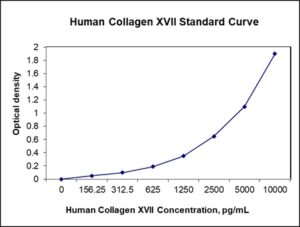
| Detection Range | 156-10000 pg/mL |
| Specificity | Human COL17A1 |
| Cross-Reactivity | < 0.5% cross-reactivity observed with available related molecules, < 50% cross-species reactivity observed with species tested. |
| Interference | No significant interference observed with available related molecules |
| Storage/Stability | 4 ºC for up to 6 months |
| Usage | For Laboratory Research Use Only. Not for diagnostic or therapeutic use. |
| Additional Notes | The kit allows for use in multiple experiments. |
Standard Curve
Kit Components
1. Pre-coated 96-well Microplate
2. Biotinylated Detection Antibody
3. Streptavidin-HRP Conjugate
4. Lyophilized Standards
5. TMB One-Step Substrate
6. Stop Solution
7. 20 x PBS
8. Assay Buffer
Other Materials Required but not Provided:
1. Microplate Reader capable of measuring absorption at 450 nm
2. Log-log graph paper or computer and software for ELISA data analysis
3. Precision pipettes (1-1000 µl)
4. Multi-channel pipettes (300 µl)
5. Distilled or deionized water
Protocol Outline
1. Prepare all reagents, samples and standards as instructed in the datasheet.
2. Add 100 µl of Standard or samples to each well and incubate 1 h at RT.
3. Add 100 µl of Working Detection Antibody to each well and incubate 1 h at RT.
4. Add 100 µl of Working Streptavidin-HRP to each well and incubate 20 min at RT.
5. Add 100 µl of Substrate to each well and incubate 5-30 min at RT.
6. Add 50 µl of Stop Solution to each well and read at 450 nm immediately.
Background:
Collagen XVII, previously called BP180, is a transmembrane protein which plays a critical role in maintaining the linkage between the intracellular and the extracellular structural elements involved in epidermal adhesion, identified by Diaz and colleagues in 1990.[1] Collagen XVII is encoded by
COL17A1 gene. Like collagen XIII, XXIII and XXV. Collagen XVII is a structural component of hemidesmosomes, multiprotein complexes at the dermal-epidermal basement membrane zone that mediate adhesion of keratinocytes to the underlying membrane. It also appears to be a key protein in maintaining the integrity of the corneal epithelium.[2] Mutations in this gene are associated with both generalized atrophic benign and junctional epidermolysis bullosa, as well as recurrent corneal erosions, and expression of this gene is abnormal in various cancers.[3] Two homotrimeric forms of type XVII collagen exist. A soluble form, referred to as either ectodomain or LAD-1, is generated by proteolytic processing of the full length COL17A1. Collagen XVII is a homotrimer of three alpha1chains.[4] Each 180 kD a-chain contains a large C-terminal ectodomain and a globular intracellular domain of approximately 70 kDa, which interacts with beta4-integrin, plectin, and BP230 [5] and is necessary for the stable attachment of hemidesmosomes to keratin intermediate filaments.[6] The largest collagenous domain, Col15, which contains 232 amino acids (amino acids 567-808), contributes significantly to stability of collagen XVII homotrimer. The C-terminus of collagen XVII binds to laminin 5, and correct integration of laminin 5 into the matrix requires collagen XVII. Collagen XVII plays a role as an autoantigen in Bullous pemphigoid and herpes gestationis, both acquired subepithelial blistering disorders.[7] Most immunodominant epitopes lie within the NC16A domain and the binding of the autoantibodies leads to epidermal-dermal separation and skin blistering.[8] Collagen XVII is constitutively shed from the keratinocyte surface within NC16A domain by ADAM17.[10] The shedding is lipid raft dependent. Collagen XVII is extracellularly phosphorylated by ecto-casein kinase 2 within the NC16A domain, phosphorylation negatively regulates ectodomain shedding.[11]
References
- Diaz LA, et al. (199). The Journal of Clinical Investigation. 86 (4): 1088–1094.
- Oliver VF, et al. (2016). Ophthalmology. 123 (4): 709–722.
- Thangavelu PU, et al. (2016). Clinical Epigenetics. 8 120: 120.
- Hirako Y, et al. (1996). The Journal of Biological Chemistry. 271 (23): 13739–13745.
- Hopkinson SB, et al. (1998). The Journal of Investigative Dermatology. 111 (6): 1015–1022.
- Hopkinson SB, Jones JC (2000). Molecular Biology of the Cell. 11 (1): 277–286.
- Diaz LA, et al. (1990). The Journal of Clinical Investigation. 86 (4): 1088–1094.
- Liu Z, et al. (1993). The Journal of Clinical Investigation. 92 (5): 2480–2488.
- Thangavelu PU, et al. (2016). Clinical Epigenetics. 8 120: 120.
- Franzke CW, et al. (2004). The Journal of Biological Chemistry. 279 (23): 24521–24529.
- Zimina EP, et al. (2007). The Journal of Biological Chemistry. 282 (31): 22737–22746.
Product Citations
Be the first to review “Nori Human Collagen XVII ELISA Kit”
You must be logged in to post a review.
Reviews
There are no reviews yet.