


















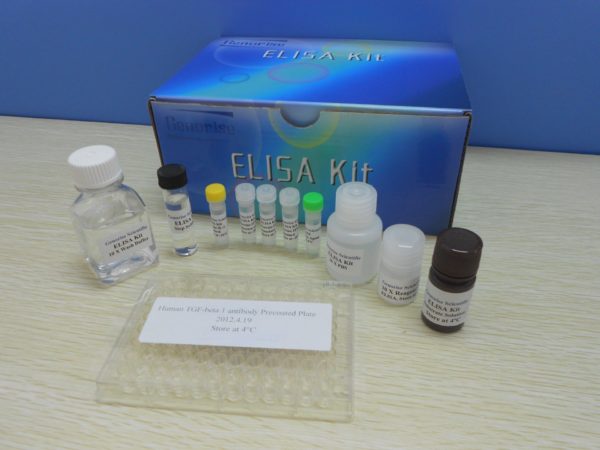
Nori Human CCL1 ELISA Kit
Price range: $508.00 through $916.00
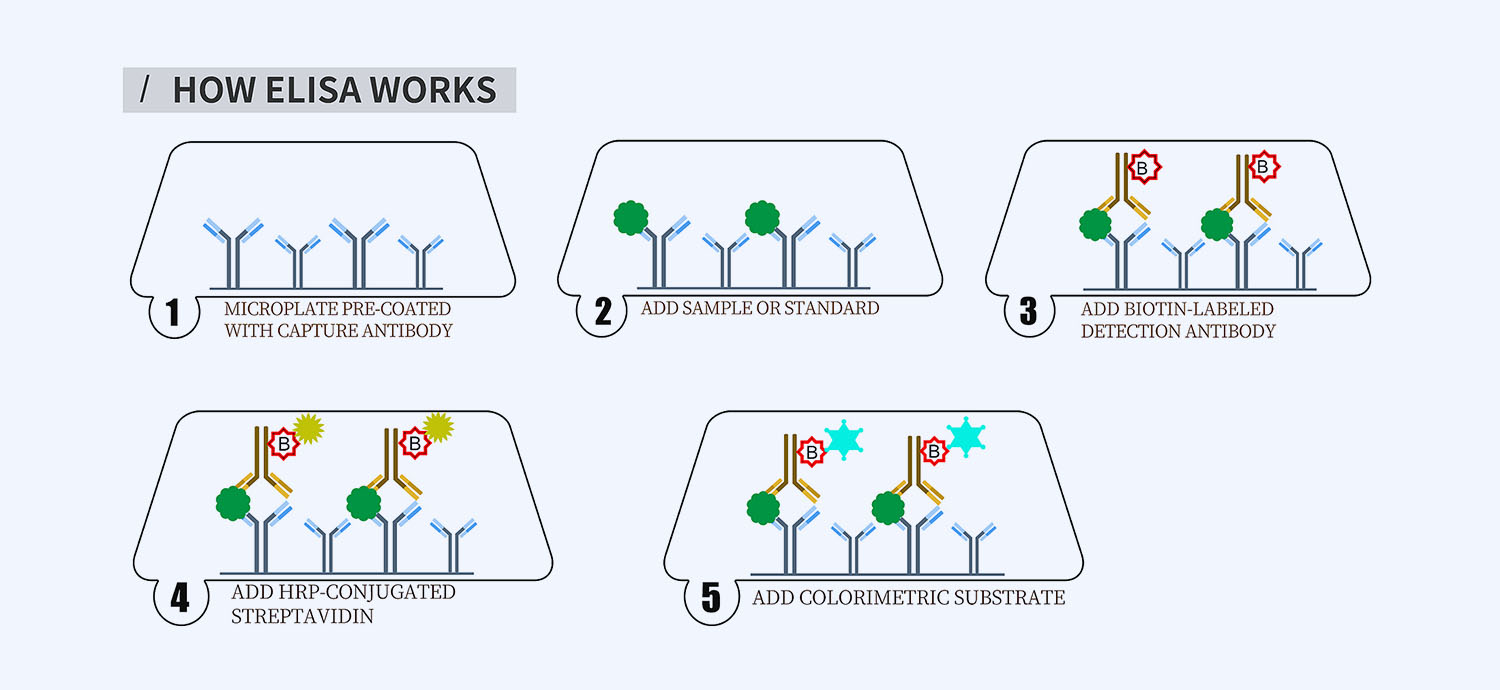
This ELISA kit is for quantification of CCL1 in human. This is a quick ELISA assay that reduces time to 50% compared to the conventional method, and the entire assay only takes 3 hours. This assay employs the quantitative sandwich enzyme immunoassay technique and uses biotin-streptavidin chemistry to improve the performance of the assays. An antibody specific for CCL1 has been pre-coated onto a microplate. Standards and samples are pipetted into the wells and any CCL1 present is bound by the immobilized antibody. After washing away any unbound substances, a detection antibody specific for CCL1 is added to the wells. Following wash to remove any unbound antibody reagent, a detection reagent is added. After intensive wash a substrate solution is added to the wells and color develops in proportion to the amount of CCL1 bound in the initial step. The color development is stopped, and the intensity of the color is measured.
Alternative names for CCL1: Chemokine (C-C motif) ligand 1, small inducible cytokine A1 and I-309, SCYA1
This product is for Laboratory Research Use Only not for diagnostic and therapeutic purposes or any other purposes.
- Description
- How Elisa Works
- Documents
- Product Citation (0)
- Reviews (0)
Description
Nori Human CCL1 ELISA Kit Summary
Alternative names for CCL1: Chemokine (C-C motif) ligand 1, small inducible cytokine A1 and I-309, SCYA1
| Assay Type | Solid Phase Sandwich ELISA |
| Format | 96-well Microplate or 96-Well Strip Microplate |
| Method of Detection | Colorimetric |
| Number of Targets Detected | 1 |
| Target Antigen Accession Number | P22362 |
| Assay Length | 3 hours |
| Quantitative/Semiquantitative | Quantitative |
| Sample Type | Plasma, Serum, Cell Culture, Urine, Cell/Tissue Lysates, Synovial Fluid, BAL, |
| Recommended Sample Dilution (Plasma/Serum) | No dilution for sample <ULOQ; sufficient dilution for samples >ULOQ |
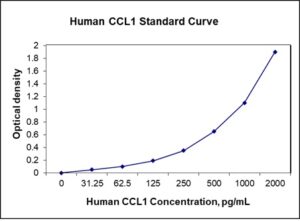
| Sensitivity | 6 pg/mL |
| Detection Range | 31.25-2000 pg/mL |
| Specificity | Human CCL1 |
| Cross-Reactivity | < 0.5% cross-reactivity observed with available related molecules, < 50% cross-species reactivity observed with species tested. |
| Interference | No significant interference observed with available related molecules |
| Storage/Stability | 4 ºC for up to 6 months |
| Usage | For Laboratory Research Use Only. Not for diagnostic or therapeutic use. |
| Additional Notes | The kit allows for use in multiple experiments. |
Standard Curve
Kit Components
1. Pre-coated 96-well Microplate
2. Biotinylated Detection Antibody
3. Streptavidin-HRP Conjugate
4. Lyophilized Standards
5. TMB One-Step Substrate
6. Stop Solution
7. 20 x PBS
8. Assay Buffer
Other Materials Required but not Provided:
1. Microplate Reader capable of measuring absorption at 450 nm
2. Log-log graph paper or computer and software for ELISA data analysis
3. Precision pipettes (1-1000 µl)
4. Multi-channel pipettes (300 µl)
5. Distilled or deionized water
Protocol Outline
1. Prepare all reagents, samples and standards as instructed in the datasheet.
2. Add 100 µl of Standard or samples to each well and incubate 1 h at RT.
3. Add 100 µl of Working Detection Antibody to each well and incubate 1 h at RT.
4. Add 100 µl of Working Streptavidin-HRP to each well and incubate 20 min at RT.
5. Add 100 µl of Substrate to each well and incubate 5-30 min at RT.
6. Add 50 µl of Stop Solution to each well and read at 450 nm immediately.
Background:
Chemokine (C-C motif) ligand 1 (CCL1) is also known as small inducible cytokine A1 and I-309 and is encoded by CCL1 gene.[1] CCL1 is a small glycoprotein that belongs to the CC chemokine family and is expressed by specifically activated T cells upon secondary stimulation.[2] CCL1 is secreted by activated monocytes/macrophages, T lymphocytes and endothelial cells.[2][3] CCL1 mainly acts as a chemoattractant for monocytes/macrophages, T lymphocytes, specially Th2-differentiated T cells and a subset of T regulatory cells in vitro into inflammatory siter. It can also attract NK cells, immature B cells but do not attracts neutrophils.[2] CCL1 binds to the chemokine receptor CCR8 and induces Ca2+ influx, chemotaxis and regulate apoptosis.[4] CCL1 stimulates a transient increase in the concentration of cytoplasmic free calcium in monocytes but not in other type of cells.[2] Furthermore, CCL1 inhibits apoptosis in thymic cell lines by the RAS/MAPK pathway but can prevent dexamethasone-induced apoptosis in cultured murine thymic lymphoma cells.[5][4] CCL1 is involved in inflammatory processes through leukocyte recruitment and could play a crucial role in angiogenesis and other viral and tumoral processes.[6] CCL1 is also overexpressed in ATL cells and mediates an autocrine antiapoptotic loop along CCR8 for in vivo growth and survival of leukemic cells.[6] Due to these facts, the dysregulation of CCL1 can leads in pathogenesis of several diseases. CCL1 plays a role in various CNS functions and could be associated with some neuroinflammatory disorders. In addition to other chemokines, the presence of CCL1 has been reported in the development of brain abscesses, most likely leading to an influx of lymphocytes and monocytes and thus to an adaptive immune response.[7]
References
- Miller MD, et al. (1990) J Immunol 145 (8), 2737-2744.
- Miller MD, Krangel MS (1992). Proc Natl Acad Sci USA. 89(7): 2950–4.
- Wilson SD, et al. (1988). Journal of Immunology. 141 (5): 1563–70.
- Tiffany HL, et al. (1997) The Journal of Experimental Medicine. 186 (1): 165–70.
- Louahed J, et al. (2003). European Journal of Immunology. 33 (2): 494–501.
- Ruckes T, et al. (2001). Blood. 98 (4): 1150–9.
- Kielian T, et al. (2001). Journal of Immunology. 166 (7): 4634–43.
Be the first to review “Nori Human CCL1 ELISA Kit”
You must be logged in to post a review.
Reviews
There are no reviews yet.