


















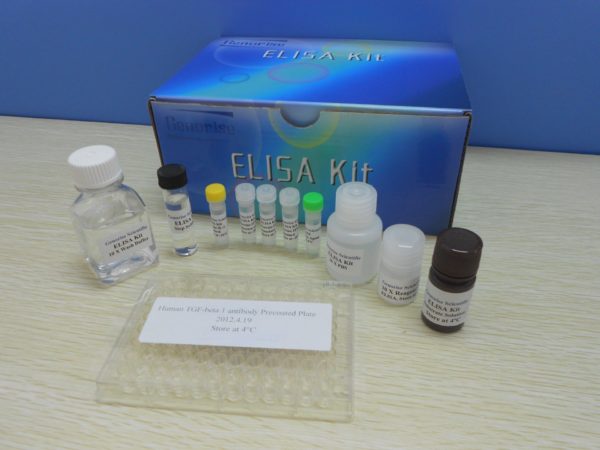
Nori Chicken RANKL ELISA Kit
Price range: $508.00 through $916.00
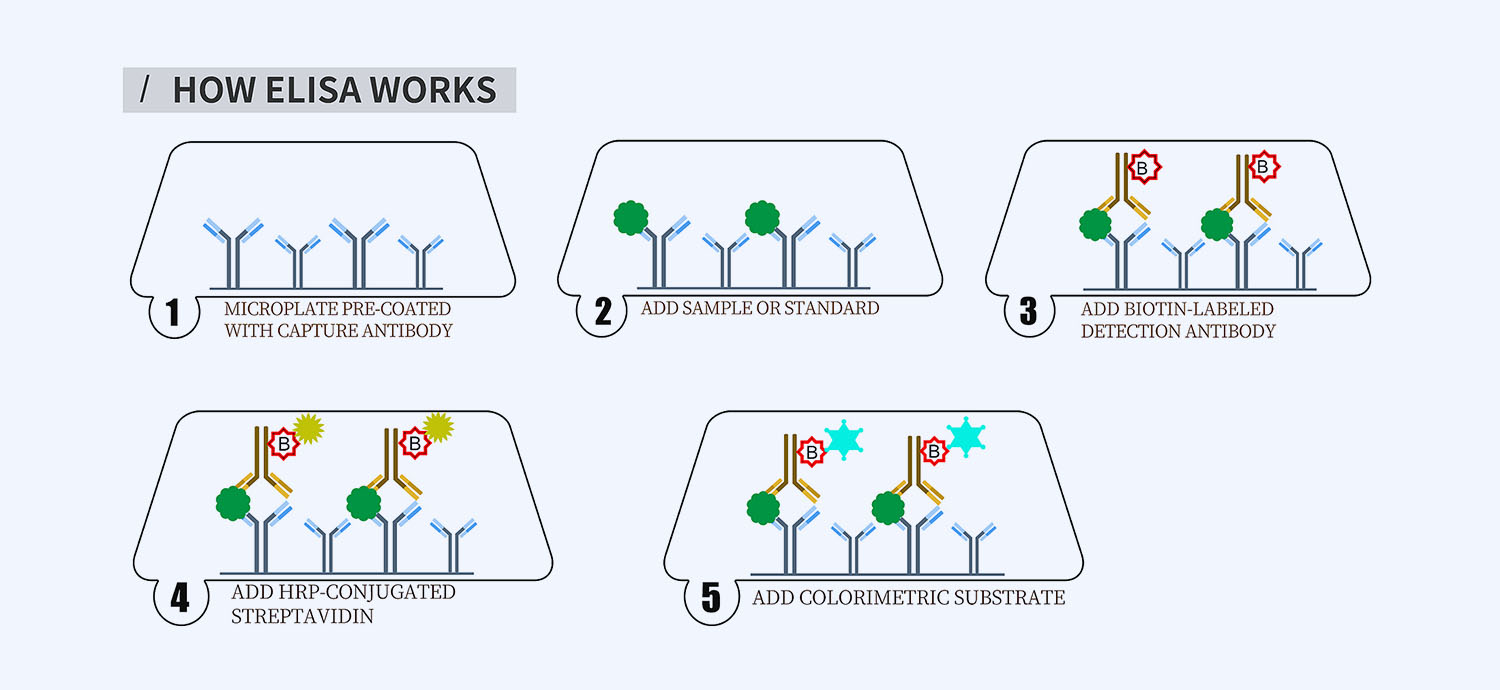
This ELISA kit is for quantification of RANKL in chicken. This is a quick ELISA assay that reduces time to 50% compared to the conventional method, and the entire assay only takes 3 hours. This assay employs the quantitative sandwich enzyme immunoassay technique and uses biotin-streptavidin chemistry to improve the performance of the assays. An antibody specific for RANKL has been pre-coated onto a microplate. Standards and samples are pipetted into the wells and any RANKL present is bound by the immobilized antibody. After washing away any unbound substances, a detection antibody specific for RANKL is added to the wells. Following wash to remove any unbound antibody reagent, a detection reagent is added. After intensive wash a substrate solution is added to the wells and color develops in proportion to the amount of RANKL bound in the initial step. The color development is stopped, and the intensity of the color is measured.
Alternative names for RANKL: Receptor activator of nuclear factor kappa-B ligand (RANKL), TNFSF11
This product is for laboratory research use only not for diagnostic and therapeutic purposes or any other purposes.
- Description
- How Elisa Works
- Product Citations (3)
- Reviews (0)
Description
Nori Chicken RANKL ELISA Kit Summary
Alternative names for RANKL: Receptor activator of nuclear factor kappa-B ligand (RANKL), TNFSF11
| Assay Type | Solid Phase Sandwich ELISA |
| Format | 96-well Microplate or 96-Well Strip Microplate |
| Method of Detection | Colorimetric |
| Number of Targets Detected | 1 |
| Target Antigen Accession Number |
A0A8V0XG17 |
| Assay Length | 3 hours |
| Quantitative/Semiquantitative | Quantitative |
| Sample Type | Plasma, Serum, Cell Culture, Urine, Cell/Tissue Lysates, Synovial Fluid, BAL, |
| Recommended Sample Dilution (Plasma/Serum) | No dilution for sample <ULOQ; sufficient dilution for samples >ULOQ |
| Sensitivity | 12 pg/mL |
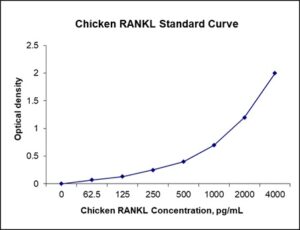
| Detection Range | 62.5-4000 pg/mL |
| Specificity | Chicken RANKL |
| Cross-Reactivity | < 0.5% cross-reactivity observed with available related molecules, < 50% cross-species reactivity observed with species tested. |
| Interference | No significant interference observed with available related molecules |
| Storage/Stability | 4 ºC for up to 6 months |
| Usage | For Laboratory Research Use Only. Not for diagnostic or therapeutic use. |
| Additional Notes | The kit allows for use in multiple experiments. |
Standard Curve
Kit Components
1. Pre-coated 96-well Microplate
2. Biotinylated Detection Antibody
3. Streptavidin-HRP Conjugate
4. Lyophilized Standards
5. TMB One-Step Substrate
6. Stop Solution
7. 20 x PBS
8. Assay Buffer
Other Materials Required but not Provided:
1. Microplate Reader capable of measuring absorption at 450 nm
2. Log-log graph paper or computer and software for ELISA data analysis
3. Precision pipettes (1-1000 µl)
4. Multi-channel pipettes (300 µl)
5. Distilled or deionized water
Protocol Outline
1. Prepare all reagents, samples and standards as instructed in the datasheet.
2. Add 100 µl of Standard or samples to each well and incubate 1 h at RT.
3. Add 100 µl of Working Detection Antibody to each well and incubate 1 h at RT.
4. Add 100 µl of Working Streptavidin-HRP to each well and incubate 20 min at RT.
5. Add 100 µl of Substrate to each well and incubate 5-30 min at RT.
6. Add 50 µl of Stop Solution to each well and read at 450 nm immediately.
Background:
Receptor activator of nuclear factor kappa-B ligand (RANKL) is a protein that is encoded by the TNFSF11 gene.[1] RANKL is known as a type II membrane protein and is a member of the tumor necrosis factor (TNF) superfamily.[2] RANKL has been identified to affect the immune system and control bone regeneration and remodeling. RANKL may be used as an apoptosis regulator gene, a binding partner of OPG, a ligand for the receptor RANK and control proliferation by modifying protein levels of Id4, Id2 and cyclin D1.[3] RANKL is expressed in several tissues and organs and high protein expression of RANKL are commonly detected in the lung, thymus and lymph nodes.[3] The level of RANKL expression does not linearly correlate to the effect of this ligand., While bone marrow expresses low levels of RANKL, it plays a critical role for adequate bone metabolism, this surface-bound molecule (also known as CD254) found on osteoblasts serves to activate osteoclasts, which are critically involved in bone resorption. Osteoclastic activity is triggered via the osteoblasts’ surface-bound RANKL activating the osteoclasts’ surface-bound receptor activator of nuclear factor kappa-B (RANK). RANKL also has a function in the immune system, where it is expressed by T helper cells and is thought to be involved in dendritic cell maturation. This protein was shown to be a dendritic cell survival factor and is involved in the regulation of T cell-dependent immune response. T cell activation was reported to induce expression of this gene and lead to an increase of osteoclastogenesis and bone loss. This protein was shown to activate antiapoptotic kinase AKT/PKB through a signaling complex involving SRC kinase and tumor necrosis factor receptor-associated factor 6 (TRAF6), which indicated this protein may have a role in the regulation of cell apoptosis.
References
- Anderson DM, et al. (1997). Nature 390 (6656): 175–9.
- Hanada R, et al. (2011). J. Mol. Med. 89 (7): 647–56.
- Wada T, et al. (2006). Trends Mol Med 12 (1): 17–25.
Product Citations
- Joung JY et al (2025) Preventive effects of fermented soy protein isolate with Limosilactobacillus fermentumon D-galactose-induced senile osteoporosis in rats via gut microbiome modulation. Food Biosci 72:107422. Impact factor: 5.9. Products used and cited: Nori Rat TNFa, RANKL ELISA Kit.
- Czerwinska K et al. (2022) Association Between Serum Selenium Concentration and OPG/RANKL/RANK Axis in Patients with Arterial Hypertension. Springer Nature Link 22:620-630. Products used and cited: Nori Human OPG, RANKL ELISA Kit.
- Abdulrahman A Almehizia et al. (2023) Anti‑inflammatory activity of novel derivatives of pyrazolo [3,4d] pyridazine against digestive system inflammation. Nauryn-Schmiedberg’s Archives of Pharmacology https://doi.org/10.1007/s00210.023-02493-7. Impact factor: 3.1. Products used and cited: Nori Mouse IL-22, TNFa, RANKL, IgM, IgG ELISA Kit.
Be the first to review “Nori Chicken RANKL ELISA Kit”
You must be logged in to post a review.
Reviews
There are no reviews yet.