





















Nori Canine Hepcidin ELISA Kit
Price range: $508.00 through $916.00
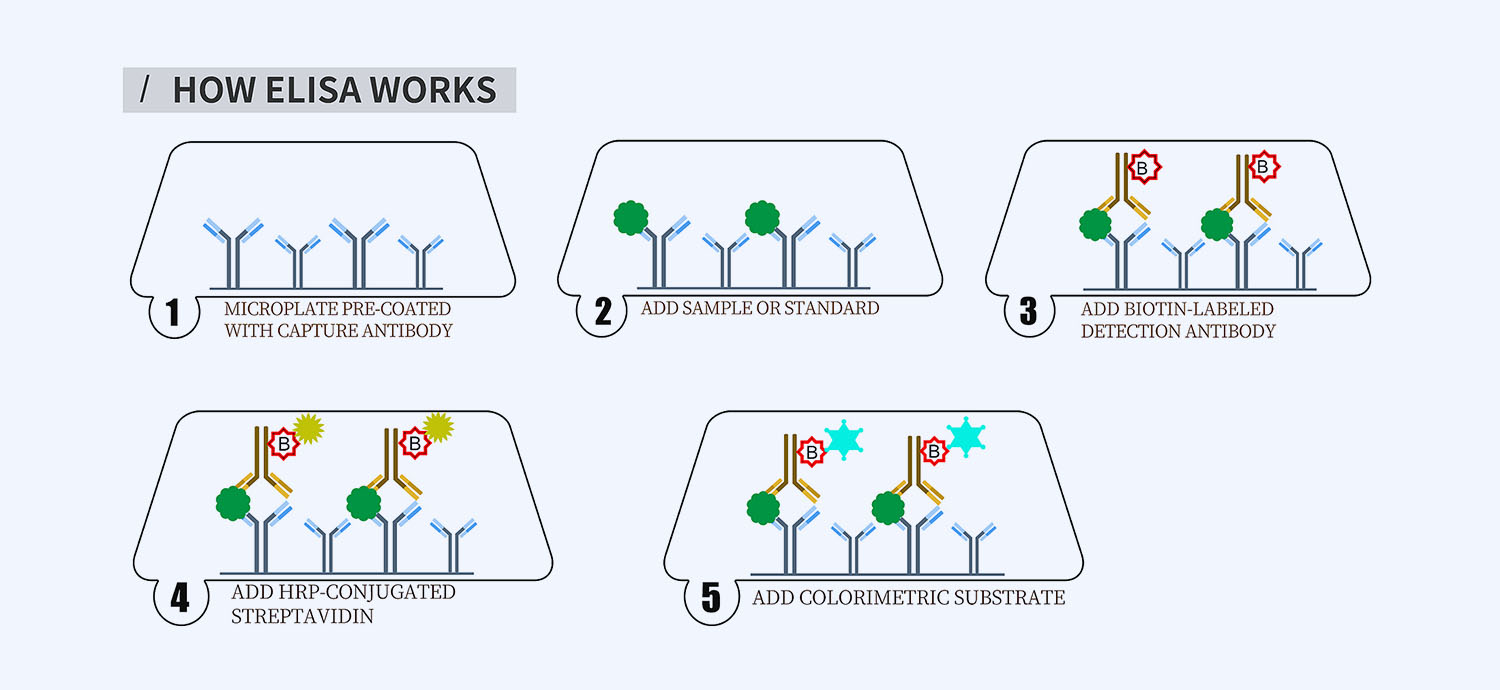
This ELISA kit is for quantification of Hepcidin in canine. This is a quick ELISA assay that reduces time to 50% compared to the conventional method, and the entire assay only takes 3 hours. This assay employs the quantitative sandwich enzyme immunoassay technique and uses biotin-streptavidin chemistry to improve the performance of the assays. An antibody specific for HAMP has been pre-coated onto a microplate. Standards and samples are pipetted into the wells and any HAMP present is bound by the immobilized antibody. After washing away any unbound substances, a detection antibody specific for HAMP is added to the wells. Following wash to remove any unbound antibody reagent, a detection reagent is added. After intensive wash a substrate solution is added to the wells and color develops in proportion to the amount of HAMP bound in the initial step. The color development is stopped, and the intensity of the color is measured.
Alternative names for Hepcidin: HAMP, HEPC
This product is for laboratory research use only not for diagnostic and therapeutic purposes or any other purposes.
- Description
- How Elisa Works
- Documents
- Product Citation (0)
- Reviews (0)
Description
Nori Canine Hepcidin ELISA Kit Summary
Alternative names for Hepcidin: HAMP, HEPC
Alternative names for canine: Dog
| Assay Type | Solid Phase Sandwich ELISA |
| Format | 96-well Microplate or 96-Well Strip Microplate |
| Method of Detection | Colorimetric |
| Number of Targets Detected | 1 |
| Target Antigen Accession Number | Q5U9D2 |
| Assay Length | 3 hours |
| Quantitative/Semiquantitative | Quantitative |
| Sample Type | Plasma, Serum, Cell Culture, Urine, Cell/Tissue Lysates, Synovial Fluid, BAL, |
| Recommended Sample Dilution (Plasma/Serum) | No dilution for sample <ULOQ; sufficient dilution for samples >ULOQ |
| Sensitivity | 3 pg/mL |
| Detection Range | 15.63-1000 pg/mL |
| Specificity | Canine Hepcidin |
| Cross-Reactivity | < 0.5% cross-reactivity observed with available related molecules, < 50% cross-species reactivity observed with species tested. |
| Interference | No significant interference observed with available related molecules |
| Storage/Stability | 4 ºC for up to 6 months |
| Usage | For Laboratory Research Use Only. Not for diagnostic or therapeutic use. |
| Additional Notes | The kit allows for use in multiple experiments. |
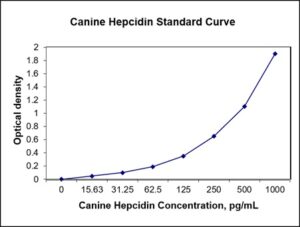
Standard Curve
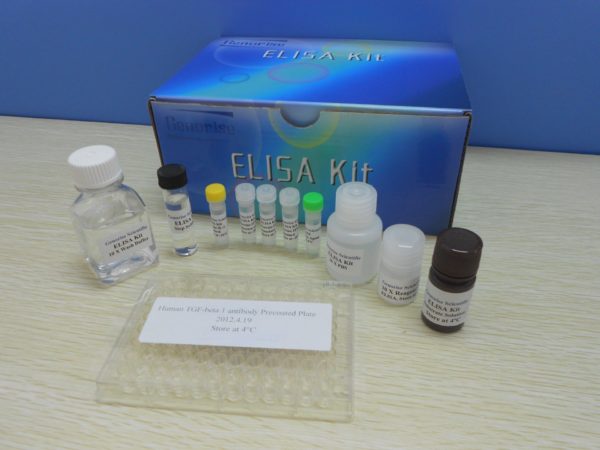
Kit Components
1. Pre-coated 96-well Microplate
2. Biotinylated Detection Antibody
3. Streptavidin-HRP Conjugate
4. Lyophilized Standards
5. TMB One-Step Substrate
6. Stop Solution
7. 20 x PBS
8. Assay Buffer
Other Materials Required but not Provided:
1. Microplate Reader capable of measuring absorption at 450 nm
2. Log-log graph paper or computer and software for ELISA data analysis
3. Precision pipettes (1-1000 µl)
4. Multi-channel pipettes (300 µl)
5. Distilled or deionized water
Protocol Outline
1. Prepare all reagents, samples and standards as instructed in the datasheet.
2. Add 100 µl of Standard or samples to each well and incubate 1 h at RT.
3. Add 100 µl of Working Detection Antibody to each well and incubate 1 h at RT.
4. Add 100 µl of Working Streptavidin-HRP to each well and incubate 20 min at RT.
5. Add 100 µl of Substrate to each well and incubate 5-30 min at RT.
6. Add 50 µl of Stop Solution to each well and read at 450 nm immediately.
Background:
Hepcidin is a protein that is encoded by the HAMP gene. Hepcidin is a key regulator of the entry of iron into the circulation in mammals.[1] Hepcidin synthesis and secretion by the liver is controlled by iron stores within macrophages, inflammation (hepcidin is an acute phase reactant), hypoxia, and erythropoiesis. Macrophages communicate with the hepatocyte to regulate hepcidin release into the circulation via hemojuvelin, hereditary hemochromatosis protein, transferrin receptor 2, bone morphogenic protein 6 (BMP6), matriptase-2, neogenin, BMP receptors, and transferrin.[2] Hepcidin is a regulator of iron metabolism. It inhibits iron transport by binding to the iron export channel ferroportin which is located in the basolateral plasma membrane of gut enterocytes and the plasma membrane of reticuloendothelial cells (macrophages), ultimately resulting in ferroportin breakdown in lysosomes. Inhibiting ferroportin prevents iron from being exported from the cell.[3][4] In enterocytes, this prevents iron transmission into the hepatic portal system, thereby reducing dietary iron absorption. In macrophages, ferroportin inhibition causes iron sequestration within the cell. Increased hepcidin activity is partially responsible for reduced iron availability seen in anemia of chronic inflammation, such as kidney failure.[5] Hepcidin has strong antimicrobial activity and is also active against the fungus Candida albicans, but has no activity against Pseudomonas aeruginosa. Erythroferrone may inhibit hepcidin and so providing more iron for hemoglobin synthesis in situations such as stress erythropoiesis.[6] and vitamin D may decrease hepcidin. During conditions in which the hepcidin level is abnormally high, such as inflammation, serum iron falls due to iron trapping within macrophages and liver cells and decreased gut iron absorption. This typically leads to anemia due to an inadequate amount of serum iron being available for developing red blood cells. When the hepcidin level is abnormally low such as in hemochromatosis, iron overload occurs due to increased ferroportin mediated iron efflux from storage and increased gut iron absorption.
References
- Ganz T (2003). Blood. 102(3): 783–8.
- Zhao N, et al. (2013). “Iron regulation by hepcidin”. J Clin Invest. 123(6): 2337–43.
- Rossi E (2005). Clin Biochem Rev. 26(3): 47–9.
- Gulec S, et al. (2014). Am J Physiol. GI Liver Physiol. 307(4): G397–409.
- Ashby DR, et al. (2009). Kidney Int. 75(9): 976–81.
- Kautz L, et al. (2014). Nature Genetics. 46(7): 678–84.
Be the first to review “Nori Canine Hepcidin ELISA Kit”
You must be logged in to post a review.
Reviews
There are no reviews yet.