



















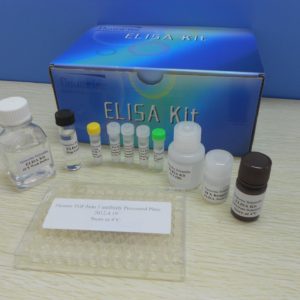
Nori Canine E-Selectin ELISA Kit
Price range: $508.00 through $916.00
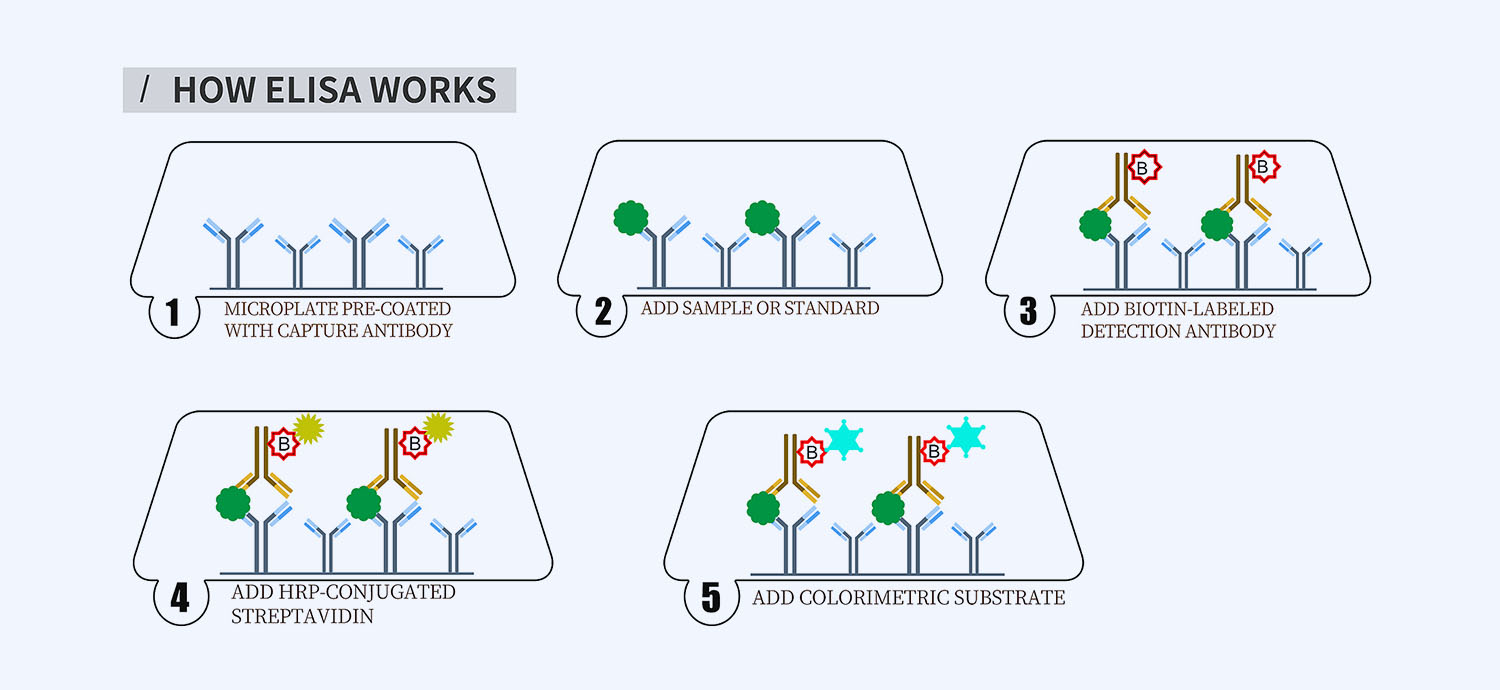
This ELISA kit is for quantification of E-Selectin in canine. This is a quick ELISA assay that reduces time to 50% compared to the conventional method, and the entire assay only takes 3 hours. This assay employs the quantitative sandwich enzyme immunoassay technique and uses biotin-streptavidin chemistry to improve the performance of the assays. An antibody specific for SELE has been pre-coated onto a microplate. Standards and samples are pipetted into the wells and any SELE present is bound by the immobilized antibody. After washing away any unbound substances, a detection antibody specific for SELE is added to the wells. Following wash to remove any unbound antibody reagent, a detection reagent is added. After intensive wash a substrate solution is added to the wells and color develops in proportion to the amount of SELE bound in the initial step. The color development is stopped, and the intensity of the color is measured.
Alternative names for E-Selectin: SELE, ELAM1, LECAM2, CD62E
This product is for Laboratory Research Use Only not for diagnostic and therapeutic purposes or any other purposes.
- Description
- How Elisa Works
- Documents
- Product Citation (0)
- Reviews (0)
Description
Nori Canine E-Selectin ELISA Kit Summary
Alternative names for E-Selectin: SELE, ELAM1, LECAM2, CD62E
Alternative name for canine: Dog
| Assay Type | Solid Phase Sandwich ELISA |
| Format | 96-well Microplate or 96-Well Strip Microplate |
| Method of Detection | Colorimetric |
| Number of Targets Detected | 1 |
| Target Antigen Accession Number |
P33730 |
| Assay Length | 3 hours |
| Quantitative/Semiquantitative | Quantitative |
| Sample Type | Plasma, Serum, Cell Culture, Urine, Cell/Tissue Lysates, Synovial Fluid, BAL, |
| Recommended Sample Dilution (Plasma/Serum) | No dilution for sample <ULOQ; sufficient dilution for samples >ULOQ |
| Sensitivity | 50 pg/mL |
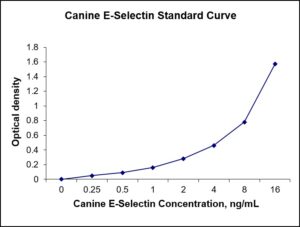
| Detection Range | 0.25-16 ng/mL |
| Specificity | Canine E-Selectin |
| Cross-Reactivity | < 0.5% cross-reactivity observed with available related molecules, < 50% cross-species reactivity observed with species tested. |
| Interference | No significant interference observed with available related molecules |
| Storage/Stability | 4 ºC for up to 6 months |
| Usage | For Laboratory Research Use Only. Not for diagnostic or therapeutic use. |
| Additional Notes | The kit allows for use in multiple experiments. |
Standard Curve
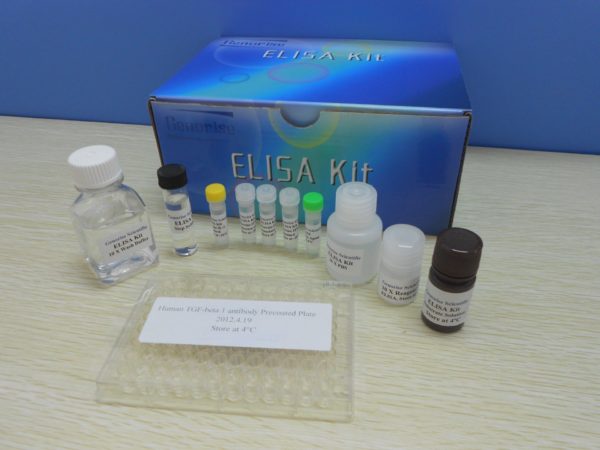
Kit Components
1. Pre-coated 96-well Microplate
2. Biotinylated Detection Antibody
3. Streptavidin-HRP Conjugate
4. Lyophilized Standards
5. TMB One-Step Substrate
6. Stop Solution
7. 20 x PBS
8. Assay Buffer
Other Materials Required but not Provided:
1. Microplate Reader capable of measuring absorption at 450 nm
2. Log-log graph paper or computer and software for ELISA data analysis
3. Precision pipettes (1-1000 µl)
4. Multi-channel pipettes (300 µl)
5. Distilled or deionized water
Protocol Outline
1. Prepare all reagents, samples and standards as instructed in the datasheet.
2. Add 100 µl of Standard or samples to each well and incubate 1 h at RT.
3. Add 100 µl of Working Detection Antibody to each well and incubate 1 h at RT.
4. Add 100 µl of Working Streptavidin-HRP to each well and incubate 20 min at RT.
5. Add 100 µl of Substrate to each well and incubate 5-30 min at RT.
6. Add 50 µl of Stop Solution to each well and read at 450 nm immediately.
Background:
E-selectin is encoded by the SELE gene. Different from P-selectin, which is stored in vesicles called Weibel-Palade bodies, E-selectin is not stored in the cell and has to be transcribed, translated, and transported to the cell surface. The production of E-selectin is stimulated by the expression of P-selectin which in turn, is stimulated by tumor necrosis factor α (TNFα), interleukin-1 (IL-1) and lipopolysaccharide (LPS).[1] It takes about two hours, after cytokine recognition, for E-selectin to be expressed on the endothelial cell’s surface. Maximal expression of E-selectin occurs around 6–12 hours after cytokine stimulation, and levels returns to baseline within 24 hours.[1] Shear forces are also found to affect E-selectin expression. A high laminar shear enhances acute endothelial cell response to interleukin-1β in naïve or shear-conditioned endothelial cells as may be found in the pathological setting of ischemia/reperfusion injury while conferring rapid E-selectin down regulation to protect against chronic inflammation.[2] E-selectin recognizes and binds to sialylated carbohydrates present on the surface proteins of certain leukocytes. E-selectin ligands are expressed by neutrophils, monocytes, eosinophils, memory-effector T-like lymphocytes, and natural killer cells. Each of these cell types is found in acute and chronic inflammatory sites in association with expression of E-selectin, thus implicating E-selectin in the recruitment of these cells to such inflammatory sites. During inflammation, E-selectin plays an important part in recruiting leukocytes to the site of injury. Cancer cells are able to infiltrate the inflammatory system by interacting with selectins. E-selectin mediates the adhesion of tumor cells to endothelial cells, by binding to E-selectin ligands. The immunohistochemical expressions of E-selectin and PECAM-1 were significantly increased at intima in vulnerable plaques of acute coronary syndrome (ACS) group, especially in neovascular endothelial cells, and positively correlated with inflammatory cell density, suggesting that PECAM-1 and E-selectin might play an important role in inflammatory reaction and development of vulnerable plaque. E-selectin Ser128Arg polymorphism is associated with ACS, and it might be a risk factor for ACS.[24]
References
- Leeuwenberg JF, et al. (1992) Immunology 77 (4): 543–9.
- Huang RB, et al. (2012) PLoS ONE 7 (2): e31874.
- Fang F, et al. (2011) Zhonghua Xin Xue Guan Bing Za Zhi (in Chinese) 39 (12): 1110–6.
Be the first to review “Nori Canine E-Selectin ELISA Kit”
You must be logged in to post a review.
Reviews
There are no reviews yet.