



















Recombinant Feline IL-13 Protein
Price range: $99.00 through $456.00
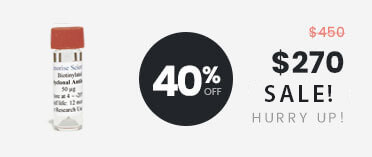
The recombinant feline IL-13 protein is derived from in vivo expression of feline IL13 gene in E. coli and purified using his-tag affinity column and can be used in multiple applications such as cell culture.
Alternative names for IL-13: Interleukin 13
This product is for Laboratory Research Use Only, not for diagnostic and therapeutic purposes or any other purposes.
- Description
- Product Citations
- Reviews (0)
Description
Genorise Recombinant Feline IL-13 Protein Summary
Alternative names for IL-13: Interleukin 13
Alternative name for feline: cat
Product Specifications
| Purity | > 97%, by SDSPAGE under reducing conditions and visualized by silver stain. |
| Endotoxin Level | < 1.0 EU per 1 μg of the protein by the LAL method. |
| Activity | Measured in a cell proliferation assay using TF1 human erythroleukemic cells.
Kitamura, T. et al. (1989) J. Cell Physiol. 140:323. The ED50 for this effect is typically 1.6- 7.5 ng/mL. |
| Source | E. coli derived feline IL-13. |
| Accession # | A0ABI7ZMI3 |
| N-Terminal Sequence Analysis | Arg |
| Amino Acid Sequence | Arg21-Lys141 |
| Predicted Molecular Mass | 13 kDa |
| SDS-PAGE | 28 kDa, reducing conditions |
Background:
Interleukin 13 (IL-13) is a protein that is encoded by the IL13 gene.[1][2][3] IL-13 is cytokine secreted by many cell types, but especially T helper type 2 (Th2) cells,[4] that is a mediator of allergic inflammation and disease. In addition to effects on immune cells that are similar to those of the closely related cytokine IL-4, IL-13 is more importantly implicated as a central mediator of the physiologic changes induced by allergic inflammation in many tissues. IL-13 induces its effects through a multi-subunit receptor that includes the alpha chain of the IL-4 receptor (IL-4Rα) and at least one of two known IL-13-specific binding chains.[4] The functions of IL-13 overlap considerably with those of IL-4, especially with regard to changes induced on hematopoietic cells, but these effects are probably less important given the more potent role of IL-4. Thus, although IL-13 can induce immunoglobulin E (IgE) secretion from activated human B cells. Rather than a lymphoid cytokine, IL-13 acts more prominently as a molecular bridge linking allergic inflammatory cells to the non-immune cells in contact with them, thereby altering physiological function. Although IL-13 is associated primarily with the induction of airway disease, it also has anti-inflammatory properties. Airway matrix metalloproteinases (MMPs), which are protein-degrading enzymes, are required to induce egression of effete parenchymal inflammatory cells into the airway lumen where they are then cleared. Among other factors, IL-13 induces these MMPs as part of a mechanism that protects against excessive allergic inflammation that predisposes to asphyxiation.
Reference
- Minty A, et al. (1993). Nature 362 (6417): 248–50.
- McKenzie AN, et al. (1993) Natl. Acad. Sci. U.S.A. 90 (8): 3735–9.
- Morgan JG, et al.. Nucleic Acids Res. 20 (19): 5173–9.
- Wynn TA (2003). “IL-13 effector functions”. Rev. Immunol. 21: 425–56.
- Smith PC, et al (2001). Cytokine Growth Factor Rev. 12 (1): 33–40.
- Hong, D.S. et al. (2007) Cancer 110, 1911-28.
- Nishimoto N (2006). Curr Opin Rheumatol 18 (3): 277–81
Product Citations
Be the first to review “Recombinant Feline IL-13 Protein”
You must be logged in to post a review.
Reviews
There are no reviews yet.