


















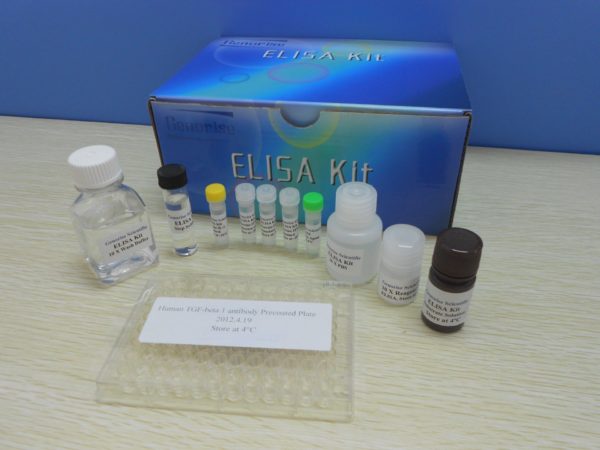
Nori Human Pro-C6 ELISA Kit
Price range: $508.00 through $916.00
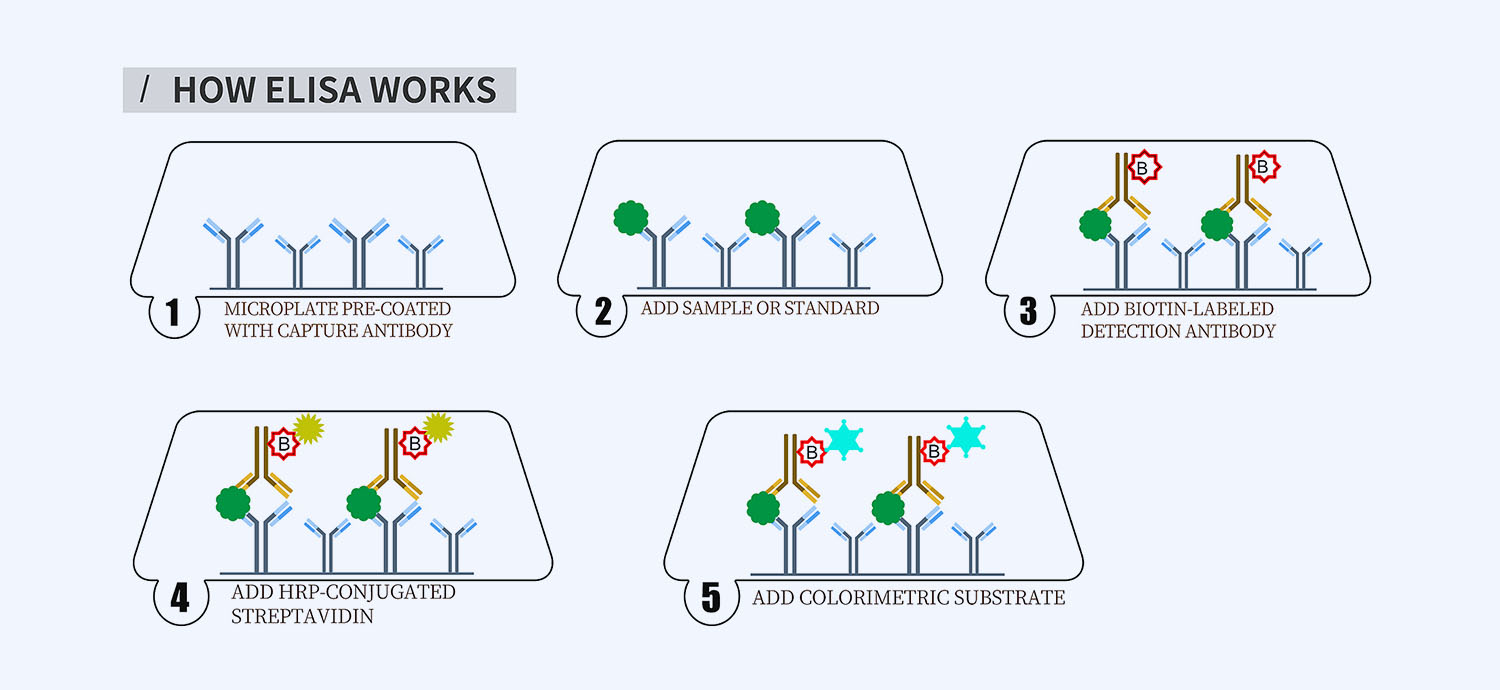
This ELISA kit is for quantification of Pro-C6 in human. This is a quick ELISA assay that reduces time to 50% compared to the conventional method, and the entire assay only takes 3 hours. This assay employs the quantitative sandwich enzyme immunoassay technique and uses biotin-streptavidin chemistry to improve the performance of the assays. An antibody specific for Pro-C6 has been pre-coated onto a microplate. Standards and samples are pipetted into the wells and any Pro-C6 present is bound by the immobilized antibody. After washing away any unbound substances, a detection antibody specific for Pro-C6 is added to the wells. Following wash to remove any unbound antibody reagent, a detection reagent is added. After intensive wash a substrate solution is added to the wells and color develops in proportion to the amount of Pro-C6 bound in the initial step. The color development is stopped, and the intensity of the color is measured.
Alternative names for Pro-C6: pro-collagen VI peptide
This product is for Laboratory Research Use Only not for diagnostic and therapeutic purposes or any other purposes.
- Description
- How Elisa Works
- Product Citation (0)
- Reviews (0)
Description
Nori Human Pro-C6 ELISA Kit Summary
Alternative names for Pro-C6: pro-collagen VI peptide
| Assay Type | Solid Phase Sandwich ELISA |
| Format | 96-well Microplate or 96-Well Strip Microplate |
| Method of Detection | Colorimetric |
| Number of Targets Detected | 1 |
| Target Antigen Accession Number | na |
| Assay Length | 3 hours |
| Quantitative/Semiquantitative | Quantitative |
| Sample Type | Plasma, Serum, Cell Culture, Urine, Cell/Tissue Lysates, Synovial Fluid, BAL, |
| Recommended Sample Dilution (Plasma/Serum) | No dilution for sample <ULOQ; sufficient dilution for samples >ULOQ |
| Sensitivity | 150 pg/mL |
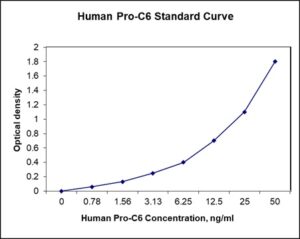
| Detection Range | 0.78-50 ng/mL |
| Specificity | Human Pro-C6 |
| Cross-Reactivity | < 0.5% cross-reactivity observed with available related molecules, < 50% cross-species reactivity observed with species tested. |
| Interference | No significant interference observed with available related molecules |
| Storage/Stability | 4 ºC for up to 6 months |
| Usage | For Laboratory Research Use Only. Not for diagnostic or therapeutic use. |
| Additional Notes | The kit allows for use in multiple experiments. |
Standard Curve
Kit Components
1. Pre-coated 96-well Microplate
2. Biotinylated Detection Antibody
3. Streptavidin-HRP Conjugate
4. Lyophilized Standards
5. TMB One-Step Substrate
6. Stop Solution
7. 20 x PBS
8. Assay Buffer
Other Materials Required but not Provided:
1. Microplate Reader capable of measuring absorption at 450 nm
2. Log-log graph paper or computer and software for ELISA data analysis
3. Precision pipettes (1-1000 µl)
4. Multi-channel pipettes (300 µl)
5. Distilled or deionized water
Protocol Outline
1. Prepare all reagents, samples and standards as instructed in the datasheet.
2. Add 100 µl of Standard or samples to each well and incubate 1 h at RT.
3. Add 100 µl of Working Detection Antibody to each well and incubate 1 h at RT.
4. Add 100 µl of Working Streptavidin-HRP to each well and incubate 20 min at RT.
5. Add 100 µl of Substrate to each well and incubate 5-30 min at RT.
6. Add 50 µl of Stop Solution to each well and read at 450 nm immediately.
Background:
PRO-C6 is the propeptide of type VI collagen. Preliminary studies have shown that PRO-C6 may be a useful biomarker for the formation of fibrotic tissue and predictive of negative outcomes in patients with HFpEF.5. A fragment of C-terminal type VIa3 collagen (Endotrophin). Measures highly activated fibroblasts, linking ECM and wound healing.[1] It shows that the pro-fibrotic and pro-inflammatory molecule endotrophin is markedly increased in plasma of patients known to have increased risk of outcome, and that endotrophin is an independent predictor of clinically relevant outcomes, likely related to kidney fibrosis and inflammation.[2] Pro-C6 is a marker of type VI collagen formation that is associated with higher arterial stiffness in type I diabetes.[3] Collagen VI (ColVI) is a type of collagen primarily associated with the extracellular matrix of skeletal muscle.[4] ColVI maintains regularity in muscle function and stabilizes the cell membrane.[5] It is synthesized by a complex, multistep pathway that leads to the formation of a unique network of linked microfilaments located in the extracellular matrix (ECM). ColVI plays a vital role in numerous cell types, including chondrocytes, neurons, myocytes, fibroblasts, and cardiomyocytes.[6] ColVI molecules are made up of three alpha chains: α1(VI), α2(VI), and α3(VI).[7] It is encoded by 6 genes: COL6A1, COL6A2, COL6A3, COL6A4, COL6A5, and COL6A6.[6] The chain lengths of α1(VI) and α2(VI) are about 1,000 amino acids. The chain length of α3(VI) is roughly a third larger than those of α1(VI) and α2(VI), and it consists of several spliced variants within the range of 2,500 to 3,100 amino acids.[8]
References
- Naugle SE et al 2006 Am J Physiol-Heart Circulatory Physiol 290(1):H323 30
- Genovese F et al. 2022 J Am Society Nephrology 33 (11S):534
- Frimodt-Moller M et al. (2019) Acta Diabetologica 56:711-712.
- Merlini L, et al. (2008). Proc Natl Acad Sci USA. 105 (13): 5225–9.
- Bernardi P, Bonaldo P (2008). Annals of the New York Academy of Sciences. 1147: 303–11.
- Matilde C et al. (2015) J Cell Sci 2015 128: 3525-3531.
- Pan TC, et al. (2014). The Journal of Biological Chemistry. 289 (15): 10293–307.
- Chen P, et al. (2013). Trends in Molecular Medicine. 19 (7): 410–7.
Be the first to review “Nori Human Pro-C6 ELISA Kit”
You must be logged in to post a review.

Reviews
There are no reviews yet.