


















Nori Chicken Transferrin ELISA Kit
Price range: $508.00 through $916.00
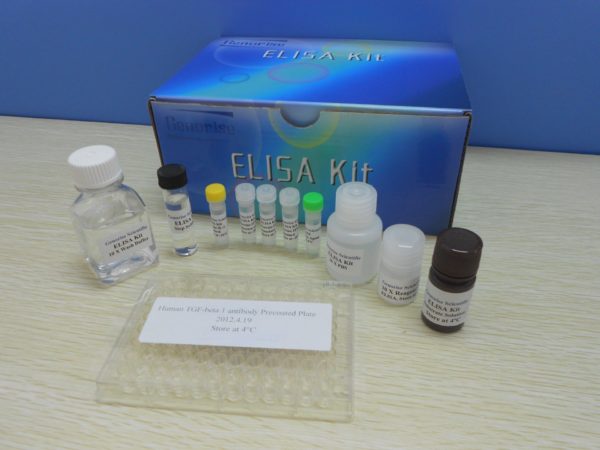
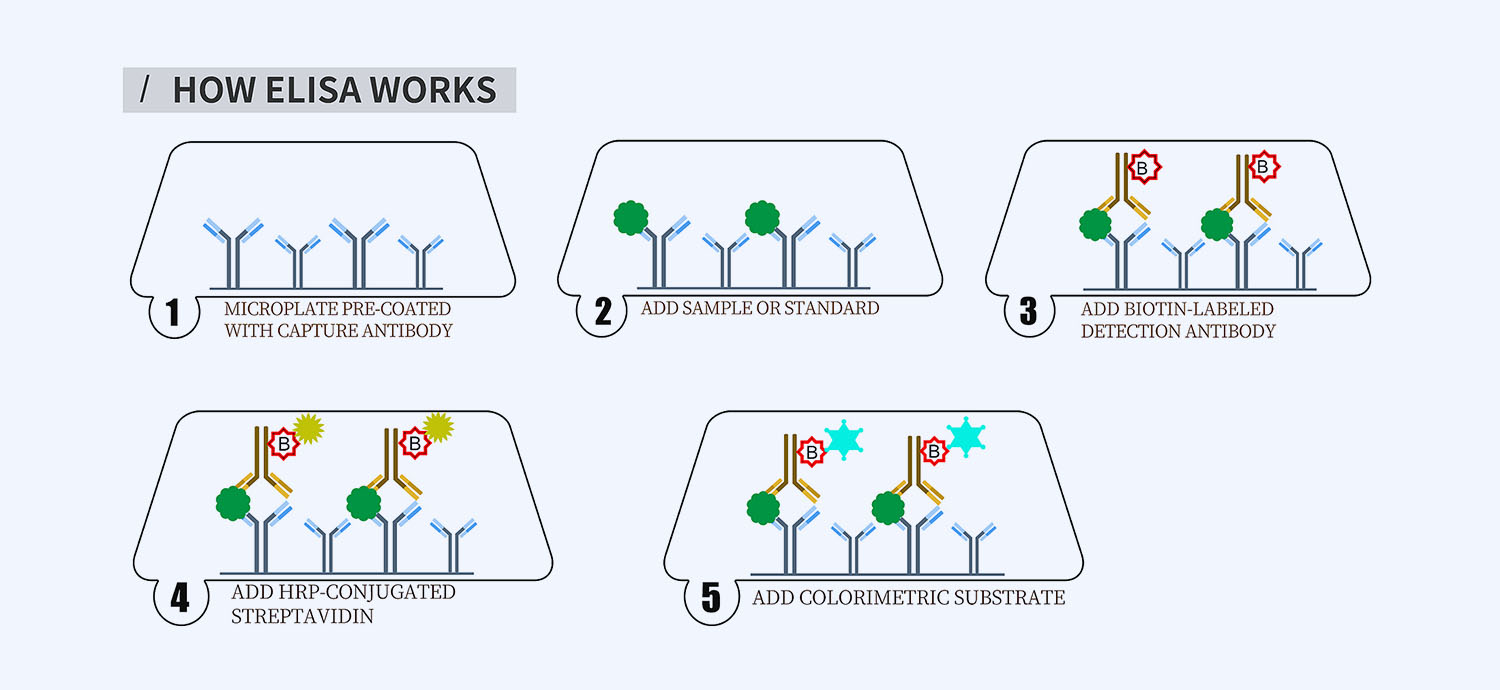
This ELISA kit is for quantification of Transferrin in chicken. This is a quick ELISA assay that reduces time to 50% compared to the conventional method, and the entire assay only takes 3 hours. This assay employs the quantitative sandwich enzyme immunoassay technique and uses biotin-streptavidin chemistry to improve the performance of the assays. An antibody specific for TF has been pre-coated onto a microplate. Standards and samples are pipetted into the wells and any TF present is bound by the immobilized antibody. After washing away any unbound substances, a detection antibody specific for TF is added to the wells. Following wash to remove any unbound antibody reagent, a detection reagent is added. After intensive wash a substrate solution is added to the wells and color develops in proportion to the amount of TF bound in the initial step. The color development is stopped, and the intensity of the color is measured.
Alternative names for Transferrin: TF, serotransferrin
This product is for laboratory research use only not for diagnostic and therapeutic purposes or any other purposes.
- Description
- How Elisa Works
- Documents
- Product Citations (0)
- Reviews (0)
Description
Nori Chicken Transferrin ELISA Kit Summary
Alternative names for transferrin: TF, serotransferrin
| Assay Type | Solid Phase Sandwich ELISA |
| Format | 96-well Microplate or 96-Well Strip Microplate |
| Method of Detection | Colorimetric |
| Number of Targets Detected | 1 |
| Target Antigen Accession Number | P02787 |
| Assay Length | 3 hours |
| Quantitative/Semiquantitative | Quantitative |
| Sample Type | Plasma, Serum, Cell Culture, Urine, Cell/Tissue Lysates, Synovial Fluid, BAL, |
| Recommended Sample Dilution (Plasma/Serum) | No dilution for sample <ULOQ; sufficient dilution for samples >ULOQ |
| Sensitivity | 1.8 ng/mL |
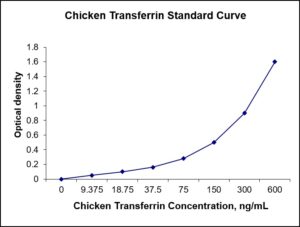
| Detection Range | 9.375-600 ng/mL |
| Specificity | Chicken Transferrin |
| Cross-Reactivity | < 0.5% cross-reactivity observed with available related molecules, < 50% cross-species reactivity observed with species tested. |
| Interference | No significant interference observed with available related molecules |
| Storage/Stability | 4 ºC for up to 6 months |
| Usage | For Laboratory Research Use Only. Not for diagnostic or therapeutic use. |
| Additional Notes | The kit allows for use in multiple experiments. |
Standard Curve
Kit Components
1. Pre-coated 96-well Microplate
2. Biotinylated Detection Antibody
3. Streptavidin-HRP Conjugate
4. Lyophilized Standards
5. TMB One-Step Substrate
6. Stop Solution
7. 20 x PBS
8. Assay Buffer
Other Materials Required but not Provided:
1. Microplate Reader capable of measuring absorption at 450 nm
2. Log-log graph paper or computer and software for ELISA data analysis
3. Precision pipettes (1-1000 µl)
4. Multi-channel pipettes (300 µl)
5. Distilled or deionized water
Protocol Outline
1. Prepare all reagents, samples and standards as instructed in the datasheet.
2. Add 100 µl of Standard or samples to each well and incubate 1 h at RT.
3. Add 100 µl of Working Detection Antibody to each well and incubate 1 h at RT.
4. Add 100 µl of Working Streptavidin-HRP to each well and incubate 20 min at RT.
5. Add 100 µl of Substrate to each well and incubate 5-30 min at RT.
6. Add 50 µl of Stop Solution to each well and read at 450 nm immediately.
Background:
Transferrins are iron-binding blood plasma glycoproteins that control the level of free iron (Fe) in biological fluids. Transferrin is encoded by the TF gene.[1] transferrin is known as “apotransferrin” when not bound to iron. Transferrins bind iron tightly, but reversibly. Although iron bound to transferrin is less than 0.1% (4 mg) of total body iron, it forms the most vital iron pool with the highest rate of turnover (25 mg/24 h). Transferrin (80 kDa) contains two specific high-affinity Fe(III) binding sites. The affinity of transferrin for Fe(III) is extremely high (association constant is 1020 M−1 at pH 7.4)[2] but decreases progressively with decreasing pH below neutrality. The pH of the vesicle is reduced by hydrogen ion pumps (H+ATPases) to about 5.5, causing transferrin to release its iron ions. When a transferrin protein loaded with iron binds a transferrin receptor on the surface of a cell, it transported into the cell in a vesicle by receptor-mediated endocytosis. The receptor with its ligand bound transferrin is then transported through the endocytic cycle back to the cell surface, ready for another round of iron uptake. Each transferrin molecule can carry two iron ions in the ferric form (Fe3+). The liver is the main site of transferrin synthesis but other tissues and organs also produce transferrin. A major source of transferrin secretion in the brain is the choroid plexus in the ventricular system.[3] The main role of transferrin is to deliver iron from absorption centers in the duodenum and white blood cell macrophages to all tissues. Transferrin plays a key role in areas where erythropoiesis and active cell division occur.[4] Transferrin is an acute phase protein and is also associated with the innate immune system and the level of transferrin decreases in inflammation,[5] cancers, and certain diseases.[6]
References
- Yang F, et al. (1984). Proc National Academy Sci USA. 81 (9): 2752–6.
- Aisen P, et al. (1978). The Journal of Biological Chemistry. 253 (6): 1930–7.
- Moos, T (2002). Danish medical bulletin. 49 (4): 279–301.
- Macedo MF, de Sousa M (2008). Inflammation & Allergy Drug Targets. 7 (1): 41–52.
- Ritchie RF, et al. (1999). Journal of Clinical Laboratory Analysis. 13 (6): 273–9.
- Jain S, et al. (2011). Journal of Pharmacy & Bioallied Sciences. 3 (1): 118–27.
Product Citations
Be the first to review “Nori Chicken Transferrin ELISA Kit”
You must be logged in to post a review.

Reviews
There are no reviews yet.