



















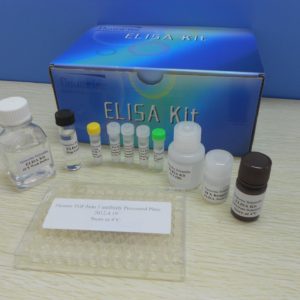
Nori Mouse METRNL ELISA Kit
Price range: $508.00 through $916.00
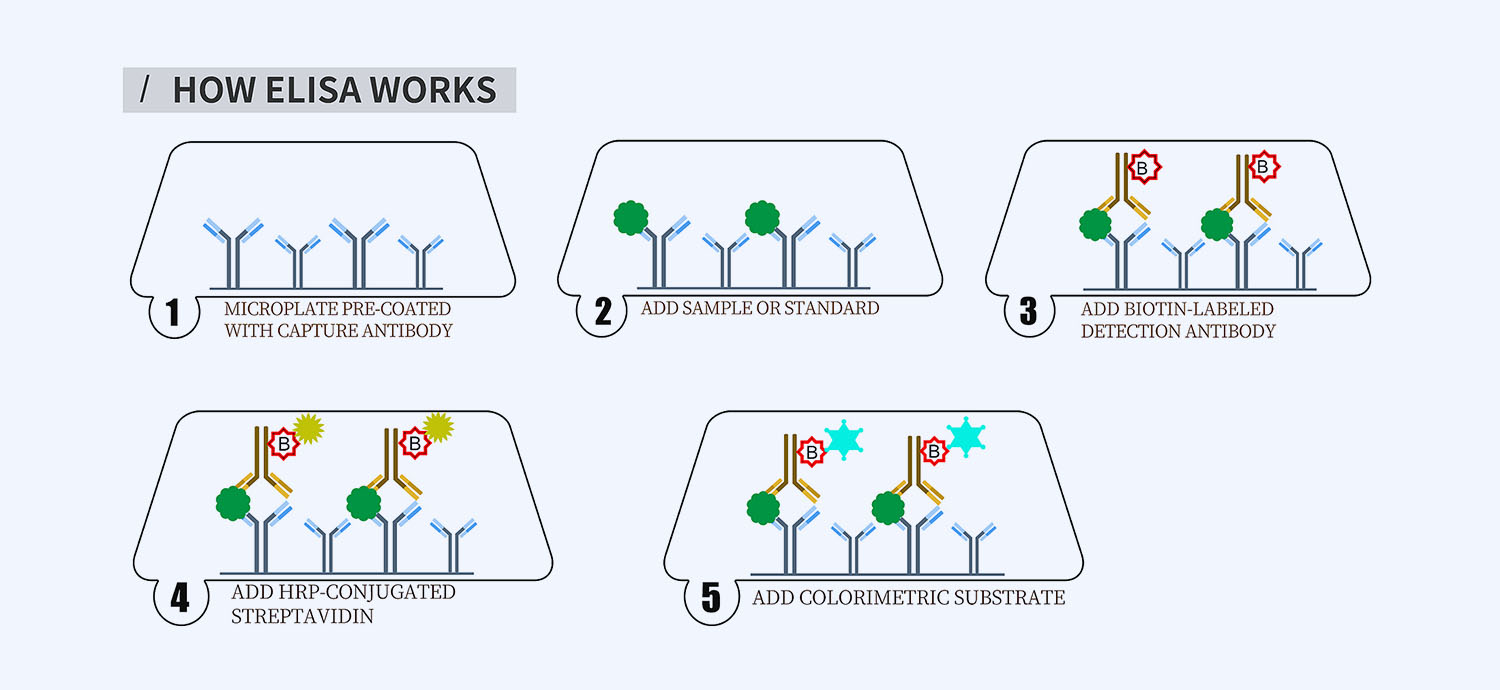
This ELISA kit is for quantification of METRNL in mouse. This is a quick ELISA assay that reduces time to 50% compared to the conventional method, and the entire assay only takes 3 hours. This assay employs the quantitative sandwich enzyme immunoassay technique and uses biotin-streptavidin chemistry to improve the performance of the assays. An antibody specific for METRNL has been pre-coated onto a microplate. Standards and samples are pipetted into the wells and any METRNL present is bound by the immobilized antibody. After washing away any unbound substances, a detection antibody specific for METRNL is added to the wells. Following wash to remove any unbound antibody reagent, a detection reagent is added. After intensive wash a substrate solution is added to the wells and color develops in proportion to the amount of METRNL bound in the initial step. The color development is stopped, and the intensity of the color is measured.
Alternative names for METRNL: Meteorin-like
This product is for laboratory research use only not for diagnostic and therapeutic purposes or any other purposes.
- Description
- How Elisa Works
- Documents
- Product Citation
- Reviews (0)
Description
Nori Mouse METRNL ELISA Kit Summary
Alternative names for METRNL: Meteorin-like
| Assay Type | Solid Phase Sandwich ELISA |
| Format | 96-well Microplate or 96-Well Strip Microplate |
| Method of Detection | Colorimetric |
| Number of Targets Detected | 1 |
| Target Antigen Accession Number | Q8VE43 |
| Assay Length | 3 hours |
| Quantitative/Semiquantitative | Quantitative |
| Sample Type | Plasma, Serum, Cell Culture, Urine, Cell/Tissue Lysates, Synovial Fluid, BAL, |
| Recommended Sample Dilution (Plasma/Serum) | No dilution for sample <ULOQ; sufficient dilution for samples >ULOQ |
| Sensitivity | 30 pg/mL |
| Detection Range | 0.156-10 ng/mL |
| Specificity | Mouse METRNL |
| Cross-Reactivity | < 0.5% cross-reactivity observed with available related molecules, < 50% cross-species reactivity observed with species tested. |
| Interference | No significant interference observed with available related molecules |
| Storage/Stability | 4 ºC for up to 6 months |
| Usage | For Laboratory Research Use Only. Not for diagnostic or therapeutic use. |
| Additional Notes | The kit allows for use in multiple experiments. |
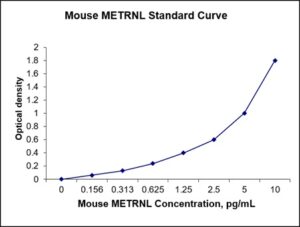
Standard Curve
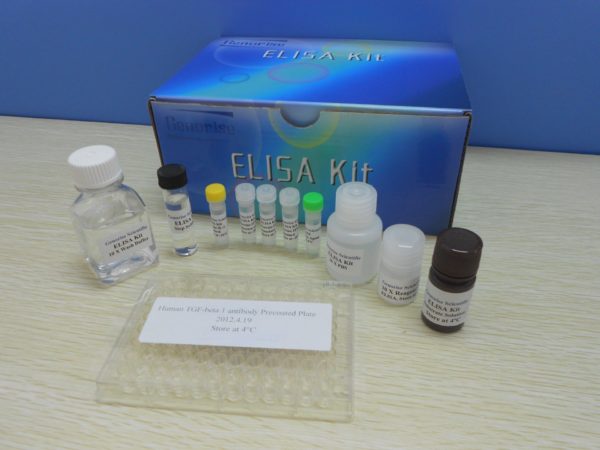
Kit Components
1. Pre-coated 96-well Microplate
2. Biotinylated Detection Antibody
3. Streptavidin-HRP Conjugate
4. Lyophilized Standards
5. TMB One-Step Substrate
6. Stop Solution
7. 20 x PBS
8. Assay Buffer
Other Materials Required but not Provided:
1. Microplate Reader capable of measuring absorption at 450 nm
2. Log-log graph paper or computer and software for ELISA data analysis
3. Precision pipettes (1-1000 µl)
4. Multi-channel pipettes (300 µl)
5. Distilled or deionized water
Protocol Outline
1. Prepare all reagents, samples and standards as instructed in the datasheet.
2. Add 100 µl of Standard or samples to each well and incubate 1 h at RT.
3. Add 100 µl of Working Detection Antibody to each well and incubate 1 h at RT.
4. Add 100 µl of Working Streptavidin-HRP to each well and incubate 20 min at RT.
5. Add 100 µl of Substrate to each well and incubate 5-30 min at RT.
6. Add 50 µl of Stop Solution to each well and read at 450 nm immediately.
Background:
Metrnl (meteorin-like) is a novel secreted protein homologous to the neurotrophin Metrn. But this protein, unlike Metrn that is mainly expressed in the brain, shows a relatively wider distribution in the body with high levels of expression in white adipose tissue and barrier tissues. This protein plays important roles in neural development, white adipose browning and insulin sensitization. Based on its expression and distinct functions, this protein is also called Cometin, Subfatin and Interleukin 39, which refer to its neurotrophic effect, adipokine function and the possible action as a cytokine, respectively. downregulation of METRNL during adipogenesis and functional induction of increased proliferation in stromal vascular fraction cells with concomitant inhibition of adipocyte differentiation may result in hypertrophic AT accumulation.[1] Overexpression of METRNL inhibited mineralized nodule formation.[2] Low Serum Metrnl is associated with worsening of glucose tolerance, impaired endothelial function and atherosclerosis.[3] Lower serum levels of Meteorin-like/Subfatin in patients with coronary artery disease and type 2 diabetes mellitus are negatively associated with insulin resistance and inflammatory cytokines.[4] there is no correlation between serum Metrnl levels and BMI (body mass index) in humans.[5] Results show that Subfatin is a novel adipokine regulated by adipogenesis and obesity, with tissue distribution different from its homologue Meteorin.[6] The spectrum of Metrnl functions remains to be determined, and the mechanisms of Metrnl action need to be elucidated.
References
- Loffler D, et al. (2017) Int J Obes (Lond) 41 (1), 112-119.
- Gong W, et al. (2016) PLoS ONE 11 (10), e0164446.
- El-Ashmawy HM, et al. (2019) Diabetes Res. Clin. Pract. 150, 57-63.
- Dadmanesh M, et al. (2018) PLoS ONE 13 (9), e0204180.
- Li ZY et al. (2015) Diabetes 64 (12), 4011-4022.
- Li ZY et al. (2014)CNS Neurosci Ther 20 (4), 344-354.
Product Citation
Be the first to review “Nori Mouse METRNL ELISA Kit”
You must be logged in to post a review.

Reviews
There are no reviews yet.