

















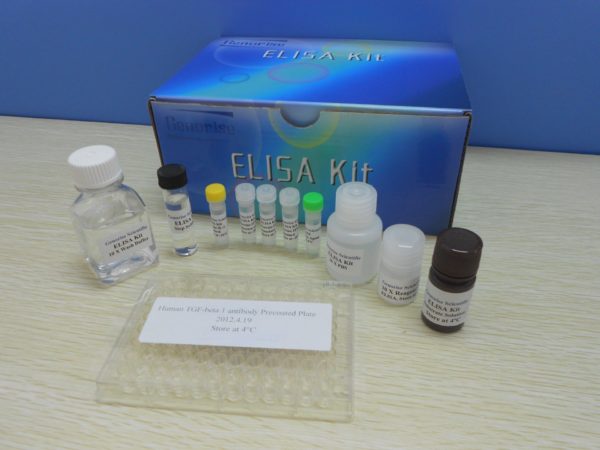
Nori Canine FSH ELISA Kit
Price range: $508.00 through $916.00
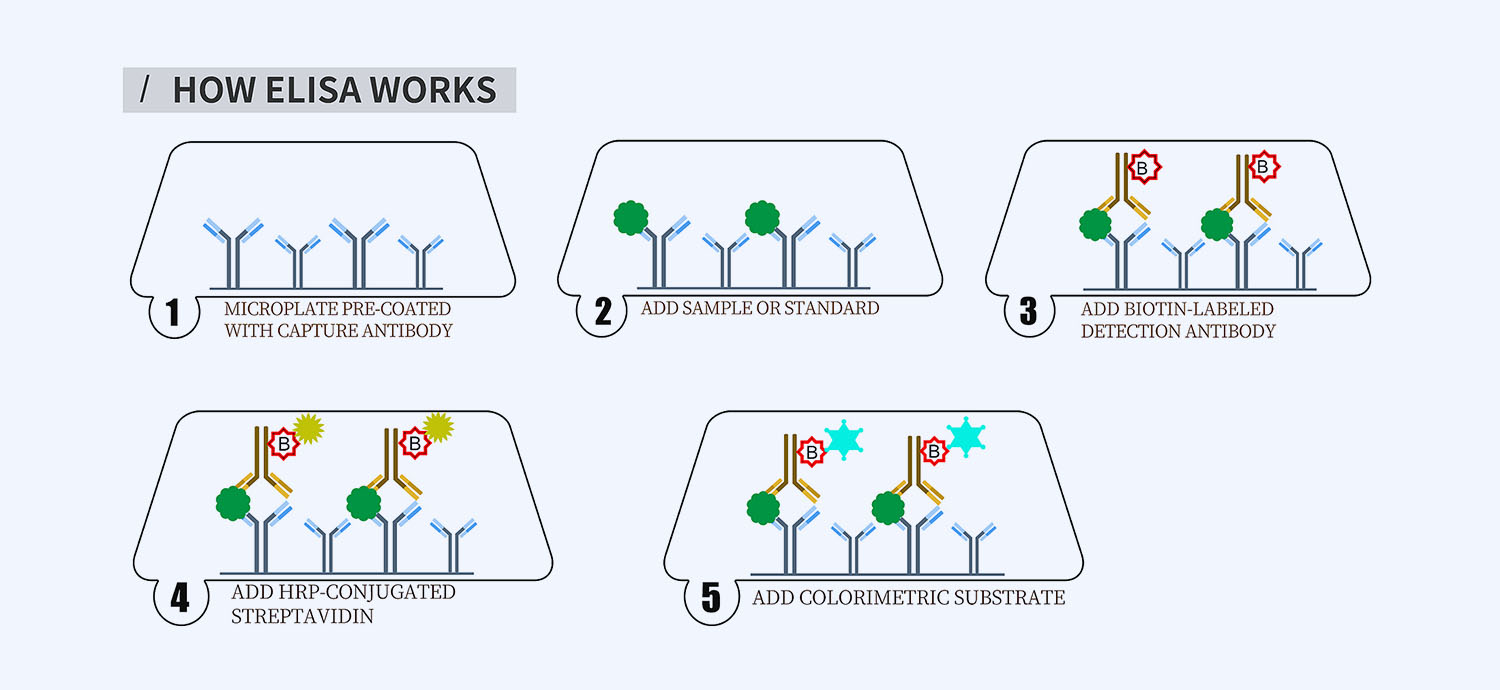
This ELISA kit is for quantification of FSH in canine. This is a quick ELISA assay that reduces time to 50% compared to the conventional method, and the entire assay only takes 3 hours. This assay employs the quantitative sandwich enzyme immunoassay technique and uses biotin-streptavidin chemistry to improve the performance of the assays. An antibody specific for FSH has been pre-coated onto a microplate. Standards and samples are pipetted into the wells and any FSH present is bound by the immobilized antibody. After washing away any unbound substances, a detection antibody specific for FSH is added to the wells. Following wash to remove any unbound antibody reagent, a detection reagent is added. After intensive wash a substrate solution is added to the wells and color develops in proportion to the amount of FSH bound in the initial step. The color development is stopped, and the intensity of the color is measured.
Alternative names for FSH: Follicle-stimulating hormone
This product is for laboratory research use only not for diagnostic and therapeutic purposes or any other purposes.
- Description
- How Elisa Works
- Documents
- Product Citations
- Reviews (0)
Description
Nori Canine FSH ELISA Kit Summary
Alternative names for FSH: Follicle-stimulating hormone
Alternative names for canine: Dog
| Assay Type | Solid Phase Sandwich ELISA |
| Format | 96-well Microplate or 96-Well Strip Microplate |
| Method of Detection | Colorimetric |
| Number of Targets Detected | 1 |
| Target Antigen Accession Number |
ADX36153 |
| Assay Length | 3 hours |
| Quantitative/Semiquantitative | Quantitative |
| Sample Type | Plasma, Serum, Cell Culture, Urine, Cell/Tissue Lysates, Synovial Fluid, BAL, |
| Recommended Sample Dilution (Plasma/Serum) | No dilution for sample <ULOQ; sufficient dilution for samples >ULOQ |
| Sensitivity | 60 pg/mL |
| Detection Range | 0.313-20 ng/mL |
| Specificity | Canine FSH |
| Cross-Reactivity | < 0.5% cross-reactivity observed with available related molecules, < 50% cross-species reactivity observed with species tested. |
| Interference | No significant interference observed with available related molecules |
| Storage/Stability | 4 ºC for up to 6 months |
| Usage | For Laboratory Research Use Only. Not for diagnostic or therapeutic use. |
| Additional Notes | The kit allows for use in multiple experiments. |
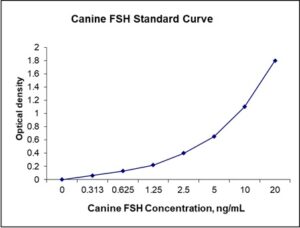
Standard Curve
Kit Components
1. Pre-coated 96-well Microplate
2. Biotinylated Detection Antibody
3. Streptavidin-HRP Conjugate
4. Lyophilized Standards
5. TMB One-Step Substrate
6. Stop Solution
7. 20 x PBS
8. Assay Buffer
Other Materials Required but not Provided:
1. Microplate Reader capable of measuring absorption at 450 nm
2. Log-log graph paper or computer and software for ELISA data analysis
3. Precision pipettes (1-1000 µl)
4. Multi-channel pipettes (300 µl)
5. Distilled or deionized water
Protocol Outline
1. Prepare all reagents, samples and standards as instructed in the datasheet.
2. Add 100 µl of Standard or samples to each well and incubate 1 h at RT.
3. Add 100 µl of Working Detection Antibody to each well and incubate 1 h at RT.
4. Add 100 µl of Working Streptavidin-HRP to each well and incubate 20 min at RT.
5. Add 100 µl of Substrate to each well and incubate 5-30 min at RT.
6. Add 50 µl of Stop Solution to each well and read at 450 nm immediately.
Background:
Follicle-stimulating hormone (FSH) is a gonadotropin, a glycoprotein polypeptide hormone. FSH is synthesized and secreted by the gonadotropic cells of the anterior pituitary gland, and regulates the development, growth, pubertal maturation, and reproductive processes of the body. FSH and luteinizing hormone (LH) work together in the reproductive system. FSH is a 35.5 kDa glycoprotein heterodimer, consisting of two polypeptide units, alpha and beta. Its structure is similar to those of luteinizing hormone (LH), thyroid-stimulating hormone (TSH), and human chorionic gonadotropin (hCG). The alpha subunits of the glycoproteins LH, FSH, TSH, and hCG are identical and consist of about 96 amino acids, while the beta subunits vary.[1] Both subunits are required for biological activity. FSH has a beta subunit of 111 amino acids (FSH β), which confers its specific biologic action, and is responsible for interaction with the follicle-stimulating hormone receptor.[2] The sugar portion of the hormone is covalently bonded to asparagine, and is composed of N-acetylgalactosamine, mannose, N-acetylglucosamine, galactose, and sialic acid. Control of FSH release from the pituitary gland is unknown. Low frequency gonadotropin-releasing hormone (GnRH) pulses increase FSH mRNA levels in the rat, but is not directly correlated with an increase in circulating FSH. GnRH has been shown to play an important role in the secretion of FSH, with hypothalamic-pituitary disconnection leading to a cessation of FSH. GnRH administration leads to a return of FSH secretion. FSH is subject to oestrogen feed-back from the gonads via the hypothalamic pituitary gonadal axis. FSH stimulates the growth and recruitment of immature ovarian follicles in the ovary. In early (small) antral follicles, FSH is the major survival factor that rescues the small antral follicles (2–5 mm in diameter for humans) from apoptosis (programmed death of the somatic cells of the follicle and oocyte). FSH stimulates primary spermatocytes to undergo the first division of meiosis, to form secondary spermatocytes. FSH enhances the production of androgen-binding protein by the Sertoli cells of the testes by binding to FSH receptors on their basolateral membranes,[11] and is critical for the initiation of spermatogenesis.
References
- Pierce, J G; Parsons, T F (1981). Annual Review of Biochemistry 50 (1): 465–495.
- Jiang X, et al. (2012). Proc Natl Acad Sci U S A 109 (31): 12491–6.
Be the first to review “Nori Canine FSH ELISA Kit”
You must be logged in to post a review.
Reviews
There are no reviews yet.