

















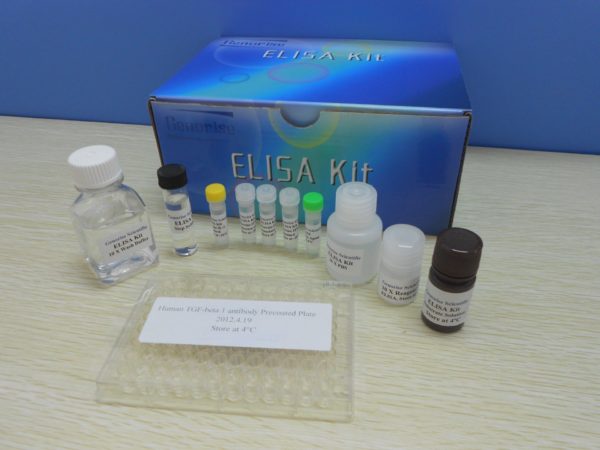
Nori Canine Fas Ligand ELISA Kit
Price range: $508.00 through $916.00
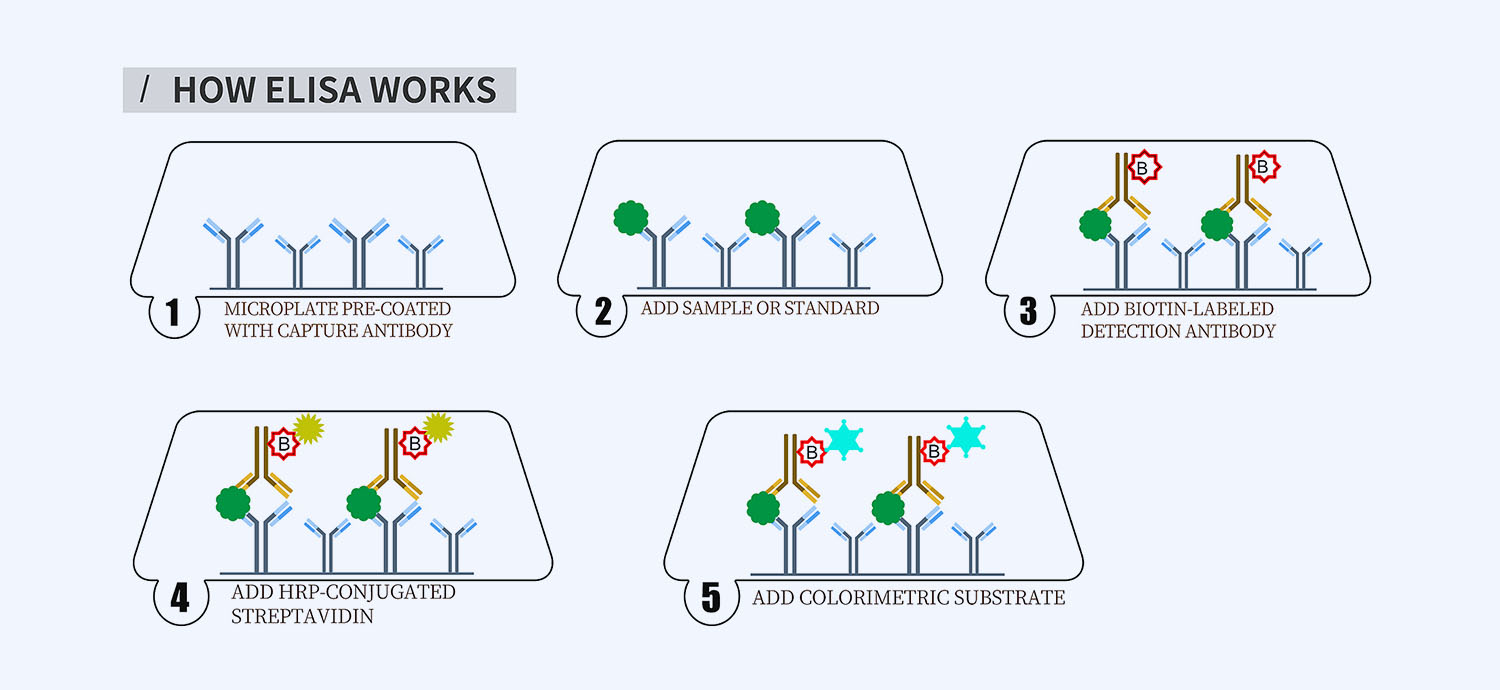
This ELISA kit is for quantification of Fas Ligand in canine. This is a quick ELISA assay that reduces time to 50% compared to the conventional method, and the entire assay only takes 3 hours. This assay employs the quantitative sandwich enzyme immunoassay technique and uses biotin-streptavidin chemistry to improve the performance of the assays. An antibody specific for FASLG has been pre-coated onto a microplate. Standards and samples are pipetted into the wells and any FASLG present is bound by the immobilized antibody. After washing away any unbound substances, a detection antibody specific for FASLG is added to the wells. Following wash to remove any unbound antibody reagent, a detection reagent is added. After intensive wash a substrate solution is added to the wells and color develops in proportion to the amount of FASLG bound in the initial step. The color development is stopped, and the intensity of the color is measured.
Alternative names for Fas ligand: FasL, FASLG, Fas antigen ligand
This product is for laboratory research use only not for diagnostic and therapeutic purposes or any other purposes.
- Description
- How Elisa Works
- Documents
- Product Citation (0)
- Reviews (0)
Description
Nori Canine Fas Ligand ELISA Kit Summary
Alternative names for Fas ligand: FasL, FASLG, Fas antigen ligand
Alternative names for canine: Dog
| Assay Type | Solid Phase Sandwich ELISA |
| Format | 96-well Microplate or 96-Well Strip Microplate |
| Method of Detection | Colorimetric |
| Number of Targets Detected | 1 |
| Target Antigen Accession Number | A0A8C0KY51 |
| Assay Length | 3 hours |
| Quantitative/Semiquantitative | Quantitative |
| Sample Type | Plasma, Serum, Cell Culture, Urine, Cell/Tissue Lysates, Synovial Fluid, BAL, |
| Recommended Sample Dilution (Plasma/Serum) | No dilution for sample <ULOQ; sufficient dilution for samples >ULOQ |
| Sensitivity | 3 pg/mL |
| Detection Range | 15.63-1000 pg/mL |
| Specificity | Canine FASLG |
| Cross-Reactivity | < 0.5% cross-reactivity observed with available related molecules, < 50% cross-species reactivity observed with species tested. |
| Interference | No significant interference observed with available related molecules |
| Storage/Stability | 4 ºC for up to 6 months |
| Usage | For Laboratory Research Use Only. Not for diagnostic or therapeutic use. |
| Additional Notes | The kit allows for use in multiple experiments. |
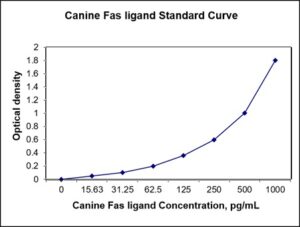
Standard Curve
Kit Components
1. Pre-coated 96-well Microplate
2. Biotinylated Detection Antibody
3. Streptavidin-HRP Conjugate
4. Lyophilized Standards
5. TMB One-Step Substrate
6. Stop Solution
7. 20 x PBS
8. Assay Buffer
Other Materials Required but not Provided:
1. Microplate Reader capable of measuring absorption at 450 nm
2. Log-log graph paper or computer and software for ELISA data analysis
3. Precision pipettes (1-1000 µl)
4. Multi-channel pipettes (300 µl)
5. Distilled or deionized water
Protocol Outline
1. Prepare all reagents, samples and standards as instructed in the datasheet.
2. Add 100 µl of Standard or samples to each well and incubate 1 h at RT.
3. Add 100 µl of Working Detection Antibody to each well and incubate 1 h at RT.
4. Add 100 µl of Working Streptavidin-HRP to each well and incubate 20 min at RT.
5. Add 100 µl of Substrate to each well and incubate 5-30 min at RT.
6. Add 50 µl of Stop Solution to each well and read at 450 nm immediately.
Background:
Fas ligand (FasL or CD95L) is a homotrimeric type-II transmembrane protein that belongs to the tumor necrosis factor (TNF) family. Its binding with its receptor induces apoptosis. Fas ligand/receptor interactions play an important role in the regulation of the immune system and the progression of cancer. It signals through trimerization of FasR, which spans the membrane of the “target” cell. This trimerization usually leads to apoptosis, or cell death. FasL is expressed on cytotoxic T lymphocytes. Soluble Fas ligand is generated by cleaving membrane-bound FasL at a conserved cleavage site by the external matrix metalloproteinase MMP-7. Soluble FasL is less active than its membrane-bound counterpart and does not induce receptor trimerization and DISC formation. DcR3 is a soluble receptor that has no signal transduction capabilities (hence a “decoy”) and functions to prevent FasR-FasL interactions by competitively binding to membrane-bound Fas ligand and rendering them inactive.[1] Fas forms the death-inducing signaling complex (DISC) upon ligand binding. Apoptosis triggered by Fas-Fas ligand binding plays a fundamental role in the regulation of the immune system and the activation of T-cells leads to their expression of the Fas ligand. Tumors may over-express Fas ligand and induce the apoptosis of infiltrating lymphocytes, allowing the tumor to escape the effects of an immune response.[2] The up-regulation of Fas ligand often occurs following chemotherapy, from which the tumor cells have attained apoptosis resistance. Fas ligand has been shown to interact with CASP8,[3] FADD, [3] EZR, [3] FNBP1,[4] FYN,[5] FAS, [3] Grb2,[4] PACSIN2,[4] and TNFRSF6B.[6]
References
- Sheikh MS, Fornace AJ (2000). Leukemia 14 (8): 1509–1513.
- Igney FH, Krammer PH (2005). Cancer Immunol. Immunother. 54 (11): 1127–1136.
- Micheau O, Tschopp J (2003) Cell 114 (2): 181–90.
- Ghadimi MP, et al. (2002). FEBS Lett. 519 (1-3): 50–8.
- Wenzel J, et al. (2001). FEBS Lett. 509 (2): 255–62.
- Yu KY, et al. (1999) J. Biol. Chem. 274 (20): 13733–6.
Be the first to review “Nori Canine Fas Ligand ELISA Kit”
You must be logged in to post a review.
Reviews
There are no reviews yet.