


















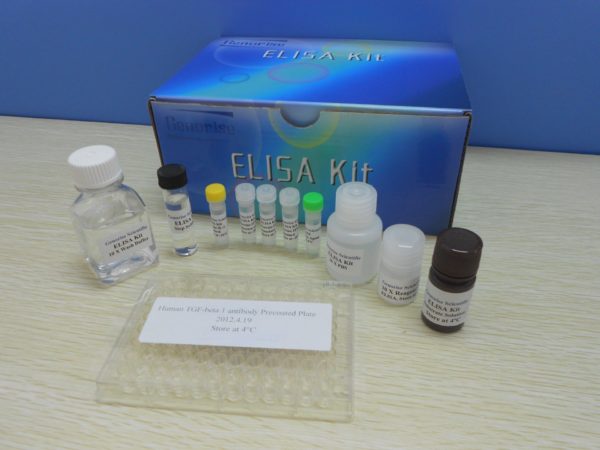
Nori Human CD63 ELISA Kit
Price range: $508.00 through $916.00
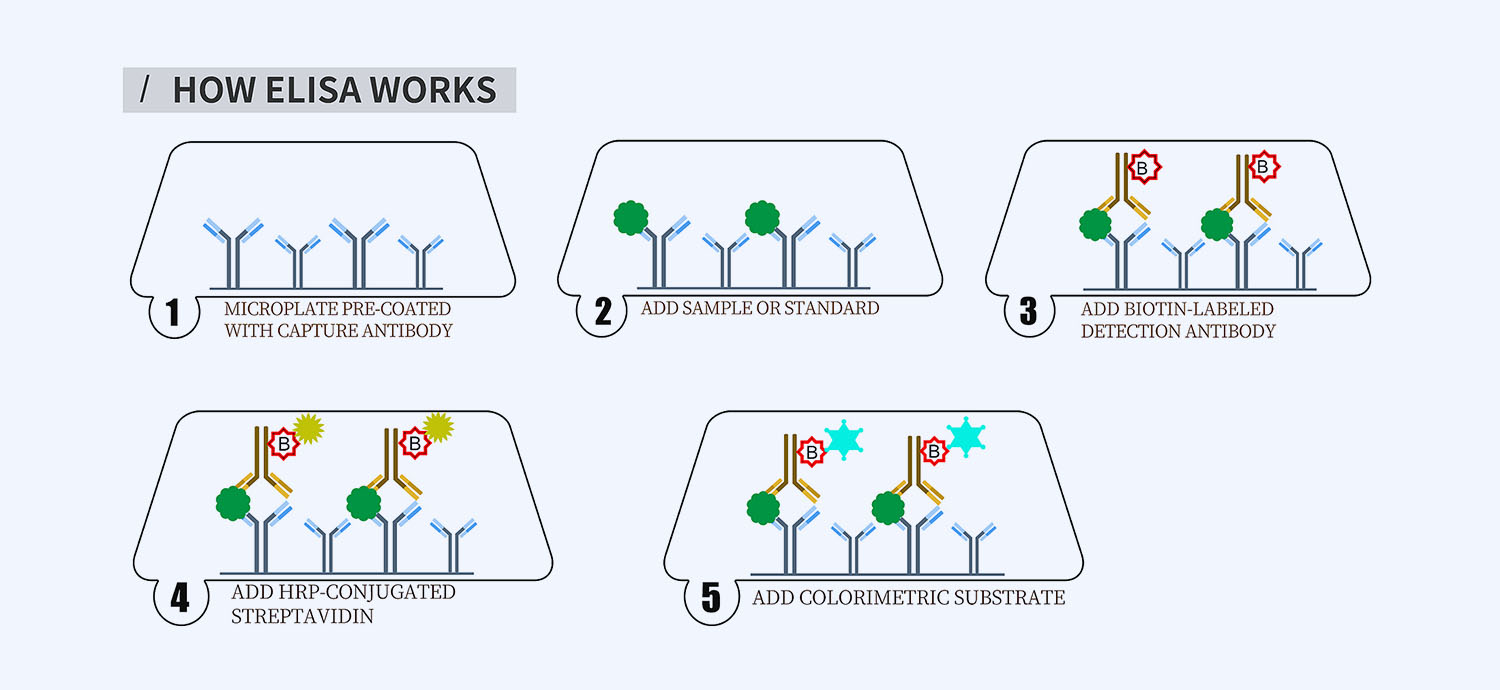
This ELISA kit is for quantification of CD63 in human. This is a quick ELISA assay that reduces time to 50% compared to the conventional method, and the entire assay only takes 3 hours. This assay employs the quantitative sandwich enzyme immunoassay technique and uses biotin-streptavidin chemistry to improve the performance of the assays. An antibody specific for CD63 has been pre-coated onto a microplate. Standards and samples are pipetted into the wells and any CD63 present is bound by the immobilized antibody. After washing away any unbound substances, a detection antibody specific for CD63 is added to the wells. Following wash to remove any unbound antibody reagent, a detection reagent is added. After intensive wash a substrate solution is added to the wells and color develops in proportion to the amount of CD63 bound in the initial step. The color development is stopped, and the intensity of the color is measured.
Alternative names for CD63: Cluster of differentiation 63, tetraspanin, ITGA7
This product is for laboratory research use only not for diagnostic and therapeutic purposes or any other purposes.
- Description
- How Elisa Works
- Documents
- Product Citations
- Reviews (0)
Description
Nori Human CD63 ELISA Kit Summary
Alternative names for CD63: Cluster of differentiation 63, tetraspanin, ITGA7
| Assay Type | Solid Phase Sandwich ELISA |
| Format | 96-well Microplate or 96-Well Strip Microplate |
| Method of Detection | Colorimetric |
| Number of Targets Detected | 1 |
| Target Antigen Accession Number | P08962 |
| Assay Length | 3 hours |
| Quantitative/Semiquantitative | Quantitative |
| Sample Type | Plasma, Serum, Cell Culture, Urine, Cell/Tissue Lysates, Synovial Fluid, BAL, |
| Recommended Sample Dilution (Plasma/Serum) | No dilution for sample <ULOQ; sufficient dilution for samples >ULOQ |
| Sensitivity | 6 pg/mL |
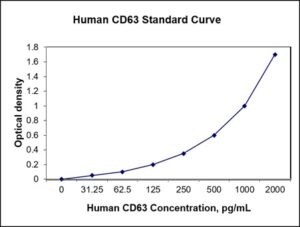
| Detection Range | 31.25-2000 pg/mL |
| Specificity | Human CD63 |
| Cross-Reactivity | < 0.5% cross-reactivity observed with available related molecules, < 50% cross-species reactivity observed with species tested. |
| Interference | No significant interference observed with available related molecules |
| Storage/Stability | 4 ºC for up to 6 months |
| Usage | For Laboratory Research Use Only. Not for diagnostic or therapeutic use. |
| Additional Notes | The kit allows for use in multiple experiments. |
Standard Curve
Kit Components
1. Pre-coated 96-well Microplate
2. Biotinylated Detection Antibody
3. Streptavidin-HRP Conjugate
4. Lyophilized Standards
5. TMB One-Step Substrate
6. Stop Solution
7. 20 x PBS
8. Assay Buffer
Other Materials Required but not Provided:
1. Microplate Reader capable of measuring absorption at 450 nm
2. Log-log graph paper or computer and software for ELISA data analysis
3. Precision pipettes (1-1000 µl)
4. Multi-channel pipettes (300 µl)
5. Distilled or deionized water
Protocol Outline
1. Prepare all reagents, samples and standards as instructed in the datasheet.
2. Add 100 µl of Standard or samples to each well and incubate 1 h at RT.
3. Add 100 µl of Working Detection Antibody to each well and incubate 1 h at RT.
4. Add 100 µl of Working Streptavidin-HRP to each well and incubate 20 min at RT.
5. Add 100 µl of Substrate to each well and incubate 5-30 min at RT.
6. Add 50 µl of Stop Solution to each well and read at 450 nm immediately.
Background:
CD63 is a cell surface glycoprotein that is encoded by the CD63 gene.[1] CD63 is mainly associated with membranes of intracellular vesicles, although cell surface expression may be induced. It is a member of the transmembrane 4 superfamily, also known as the tetraspanin family. The proteins mediate signal transduction events that play a role in the regulation of cell development, activation, growth and motility. CD63 interacts with CD117[2] and CD82.[3] and may function as a blood platelet activation marker and is associated with tumor progression. Deficiency of CD63 is associated with Hermansky Pudlak syndrome.[4] CD63 is a good marker for flow cytometric quantification of in vitro activated basophils for diagnosis of IgE-mediated allergy. A recent study showed that expression of CD63 positively correlates with the invasiveness of ovarian cancer[5] and CD63 is often used as a marker for multivessicular bodies. Interactions with CD63 may affect the trafficking and function of β2 integrins. CD63 is associated with the VLA-3 and VLA-6 integrins[6] and with CD9 and CD81.[7] like the other transmembrane-4 superfamily proteins CD81 (TAPA-1), CD82 and CD53, CD63 is specifically associated with integrin alpha 4 beta 1 (CD49d/CD29).[8] CD63 associates with tyrosine kinase activity and CD11/CD18, and transmits an activation signal in neutrophils.[9]
References
- Horejsí V, Vlcek C (1991). FEBS Lett. 288 (1–2): 1–4.
- Anzai, Naoyuki; et al. (2002). Blood. 99 (12): 4413–4421.
- Hammond, C; et al. (1998). J. Immunol. 161 (7): 3282–91.
- Nishibori M, et al. (1993). J. Clin. Invest. 91 (4): 1775–1782.
- Kobayashi M (2014). J Transl Med. 12.
- Berditchevski F, et al. (1995). J. Biol. Chem. 270 (30): 17784–17790.
- Radford KJ, et al. (1996). Biochem. Biophys. Res. Commun. 222 (1): 13–18.
- Mannion BA, et al. (1996). J. Immunol. 157 (5): 2039–47.
- Skubitz KM, et al. (1996). J. Immunol. 157 (8): 3617–26.
Product Citations
Be the first to review “Nori Human CD63 ELISA Kit”
You must be logged in to post a review.
Reviews
There are no reviews yet.