




















Recombinant Canine IL-9 Protein
Price range: $99.00 through $456.00
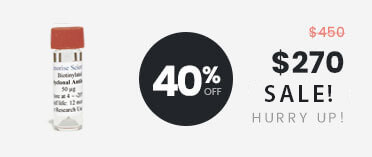
The recombinant canine IL-9 protein is derived from in vivo expression of canine IL-9 gene in E. coli and purified using his-tag affinity column and can be used in multiple applications such as cell culture, ELISA and western blot.
Alternative names for IL-9: Interleukin 9, IL9
This product is for Laboratory Research Use Only, not for diagnostic and therapeutic purposes or any other purposes.
- Description
- Product Citations
- Reviews (0)
Description
Genorise Recombinant Canine IL-9 Summary
Alternative names for IL-9: Interleukin 9, IL9
Alternative name for canine: Dog
Product Specifications
| Purity | > 95%, by SDSPAGE under reducing conditions and visualized by silver stain. |
| Endotoxin Level | < 1 EU per 1 µg of the protein by the LAL method. |
| Activity | Measured in a cell proliferation assay using MO7e human megakaryocytic leukemic cells. Avanzi G et al. (1988) Br. J. Laematol 69:359.
The ED50 for this effect is typically 0.3-0.8 ng/ml. |
| Source | E. coli derived canine IL-9. |
| Accession # | A0A8I3NQB0 |
| N-Terminal Sequence Analysis | Gln |
| Amino Acid Sequence | Gln19-Val139 |
| Predicted Molecular Mass | 13 kDa |
| SDS-PAGE | 25 kDa, reducing conditions |
Background:
Interleukin 9 (IL-9) is a pleiotropic cytokine (cell signaling molecule) belonging to the group of interleukins.[1] IL-9 is produced by variety of cells like mast cells, NKT cells, Th2, Th17, Treg, ILC2, and Th9 cells in different amounts. Among them, Th9 cells are regarded as the major CD4+ T cells that produce IL-9. Il-9 is secreted by CD4+ helper cells that acts as a regulator of a variety of hematopoietic cells.[2] Interleukin 33 (IL-33) induces IL-9 expression and secretion in T cells, which was confirmed by the results obtained in mice by using Human in vitro system.[3] Whereas the report of others confirms that TGF-β is an essential factor for IL-9 induction.[4] TGF-β may be important for production of IL-9 but it is not only the definite requirement for IL-9 induction, since cultures with IL-33 without TGF-β have noticeably increased secretion of IL-9, suggesting an important role of IL-33, even though that the effect was not found significant on the gene level.[5] This cytokine stimulates cell proliferation and prevents apoptosis. It functions through the interleukin-9 receptor (IL9R), which activates different signal transducer and activator (STAT) proteins namely STAT1, STAT3 and STAT5 and thus connects this cytokine to various biological processes. [6] The gene encoding this cytokine has been identified as a candidate gene for asthma. Genetic studies on a mouse model of asthma demonstrated that this cytokine is a determining factor in the pathogenesis of bronchial hyperresponsiveness. Interleukin-9 has also shown to inhibit melanoma growth in mice.[7] Additionally, it gives rise to the multiplication of hematologic neoplasia and also Hodgkin’s lymphoma in humans but IL-9 also has antitumor properties in solid tumors, for example melanoma.
References
- Kelleher K, et al. (1991). Blood. 77 (7): 1436–41.
- Perumal NB, Kaplan MH (2011). Trends in Immunology. 32 (4): 146–50.
- Humphreys NE, et al. (2008). Journal of Immunology. 180 (4): 2443–9.
- Beriou G, et al. (2010). Journal of Immunology. 185 (1): 46–54.
- Blom L, et al. (2011). PLoS One. 6 (7): e21695. doi:1371/journal.pone.0021695.
- Purwar R, et al. (2012). Nature Medicine. 18 (8): 1248–53.
- Knoops L, Renauld JC (2004). Growth Factors. 22 (4): 207–15.
Product Citations
Be the first to review “Recombinant Canine IL-9 Protein”
You must be logged in to post a review.
Reviews
There are no reviews yet.